

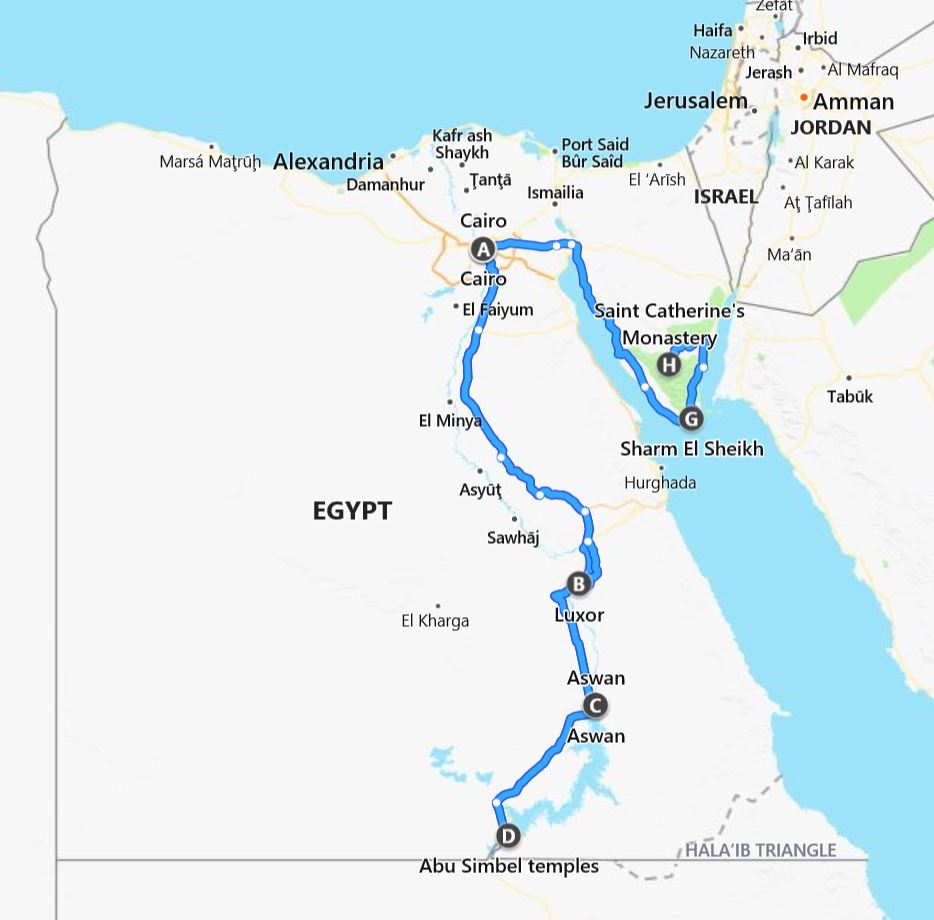
Day 1 – Cairo – November 18
After a slightly bumpy flight we touched down in Cairo at 3 pm. We breezed right through passport control and immigration then managed to skirt around all the aggressive taxi drivers offering their services to find our Uber. He spoke no discernible English and we found him wandering the parking lot on foot. If there’s no traffic, it takes about 30 minutes to get to the airport, but we were looking at more like an hour of travel. No one drives in the lanes: on a two-lane road there will be three lanes of traffic and people honking and weaving in and out. That’s not even mentioning the thousands of people in the streets grabbing rides or just walking along the highways. It was an interesting drive to hear all the different kinds of horns (yes, many people seemed to have aftermarket horns), see all the buildings (are they all brown on purpose?), and to smell and see the hazy smog (interesting, but not enjoyable). Twenty-three million people live in Cairo, that’s a lot of cars.
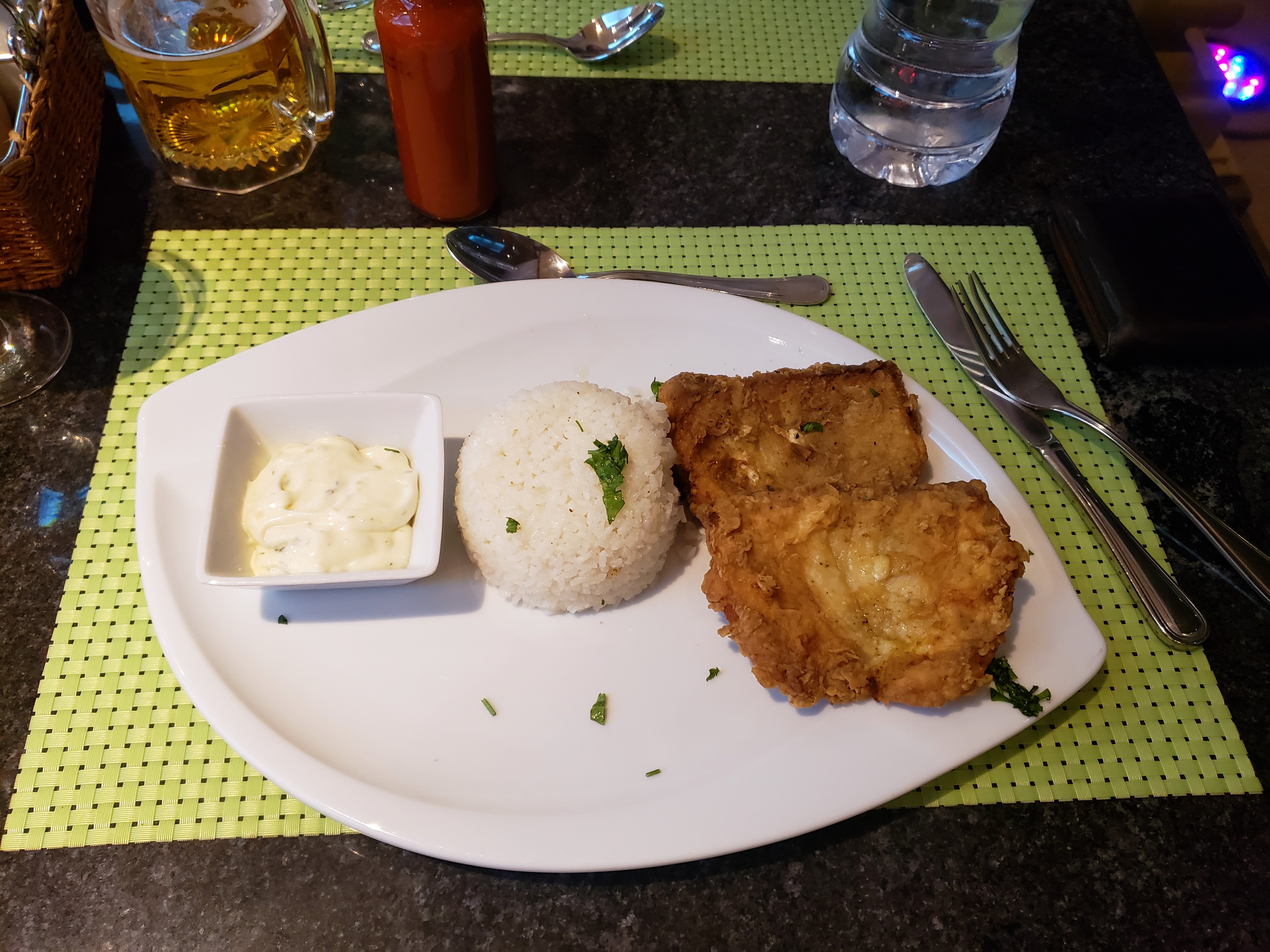
We pulled up to our hotel, which is right on the Nile and on a street with a large number of the foreign embassies. Our car got checked for bombs with a dog and a mirror before we were let in. Then we had to go through metal detectors to get into the lobby and check in. This would end up being a theme on our journey through Egypt. Our room was pretty nice, facing the city, and we walked around the outside pool area to see the sun set. Joan, Elizabeth’s aunt, would be joining us for a couple weeks and her birthday. Poor thing was flying alone and not set to land until 11:45 pm. We went to the hotel gym, something we hadn’t done in forever, and discovered we’d gotten a little fat. We ate dinner in a hotel restaurant, which left a lot to be desired. Ryan ordered the fish and chips and was served a pathetic plate of fish and rice. Joan finally made it to the hotel around 1 am and we all got as much sleep as we could before our early morning pick-up.
Day 2 – Cairo – November 19
We were in the lobby at 7 the next morning to meet our tour guide Josef. Josef was taking us to see three main sights today, the Pyramids of Giza, the Steps Pyramid, and the Egyptian Museum. Since traffic in Cairo is so bad, and these sights are about 30 km apart, we had to leave bright and early to see it all. On the drive to the Pyramids of Giza he told us all about Cairo regarding the population, the number of cars, what the people did for a living, etc. Traffic is pretty bad from 6 am to 9 am for the morning commute, but luckily, we were to the pyramids in less than an hour.
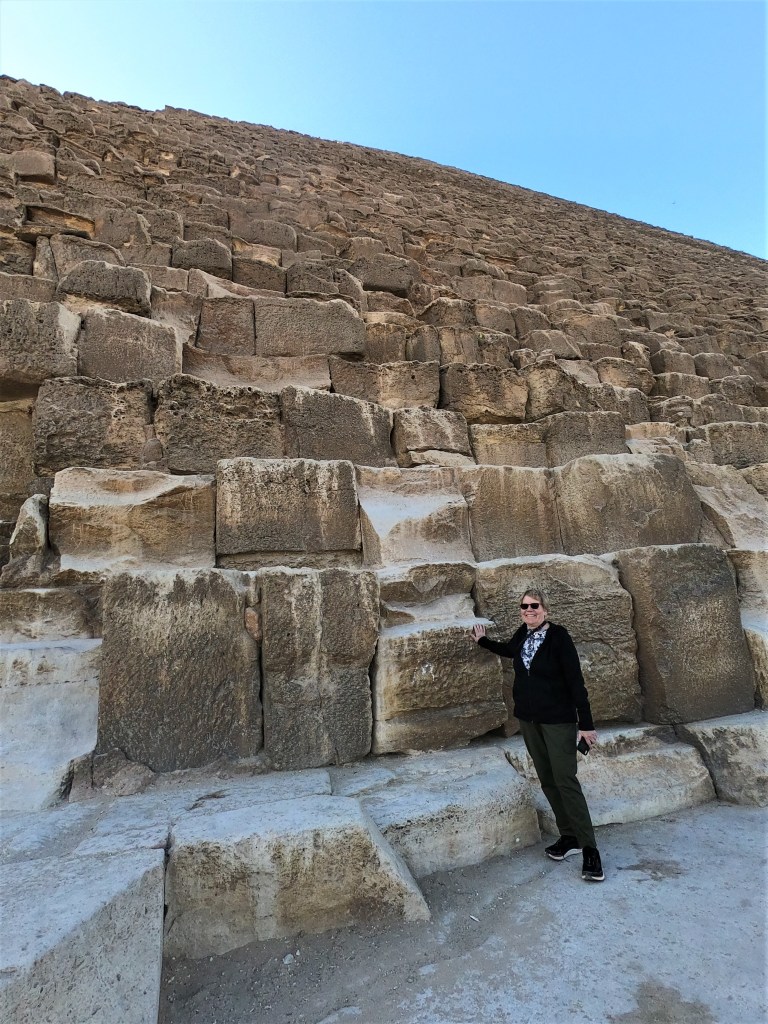
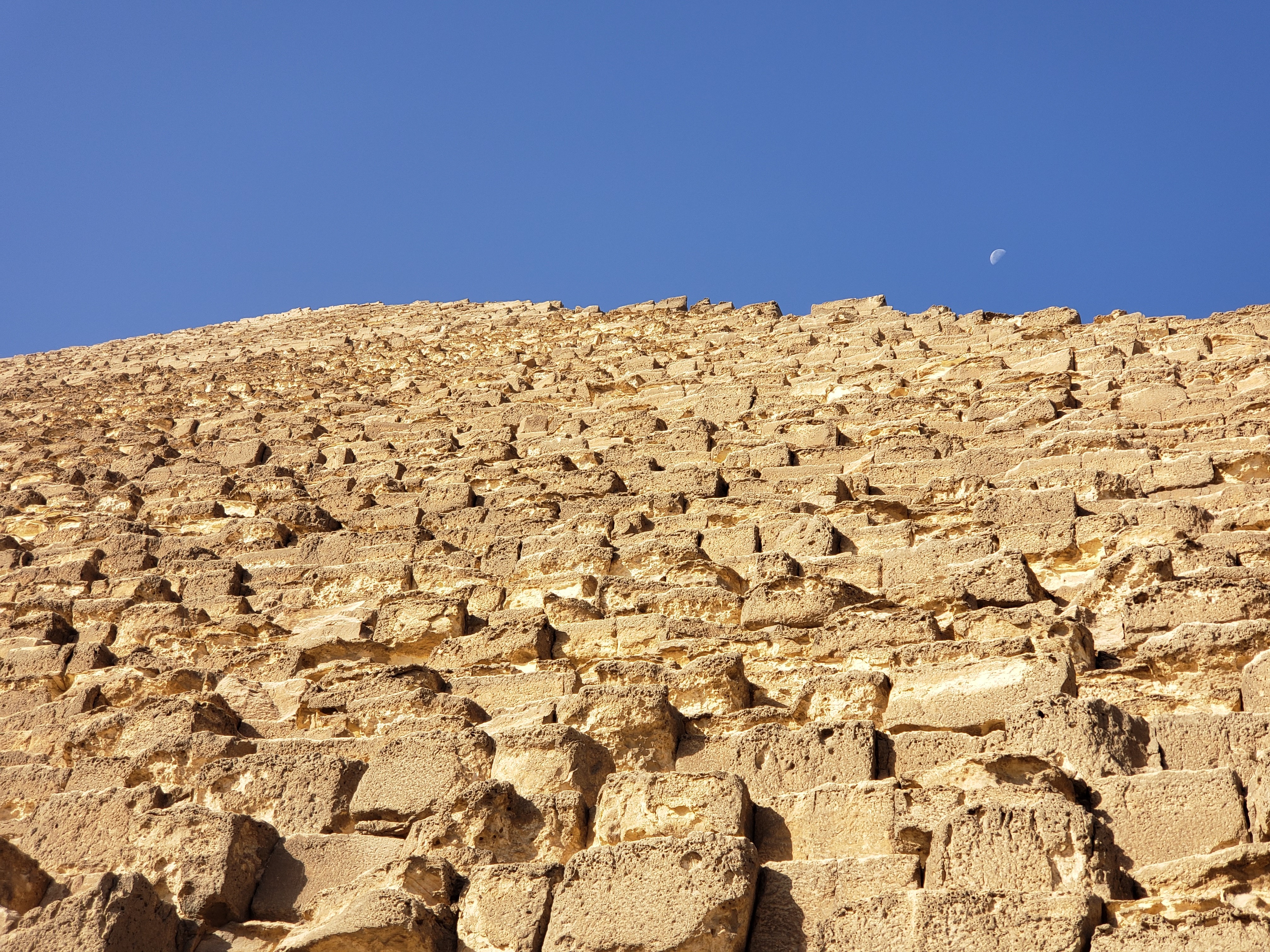
He was so smart to make us get up early because the pyramids were empty. We walked all along one of the giant monoliths, while learning about the stone and processes they think the Egyptians used to build them. Sadly, Romans and other empires stripped the pyramids of their outer layer to use the stones to build other historic buildings, but you could still see a completed top of one pyramid. The pyramids of Giza constitute 9 pyramids all belonging to the Khufu family. Three large ones are standing tall and six smaller ones that are more broken stand on the outer edges.
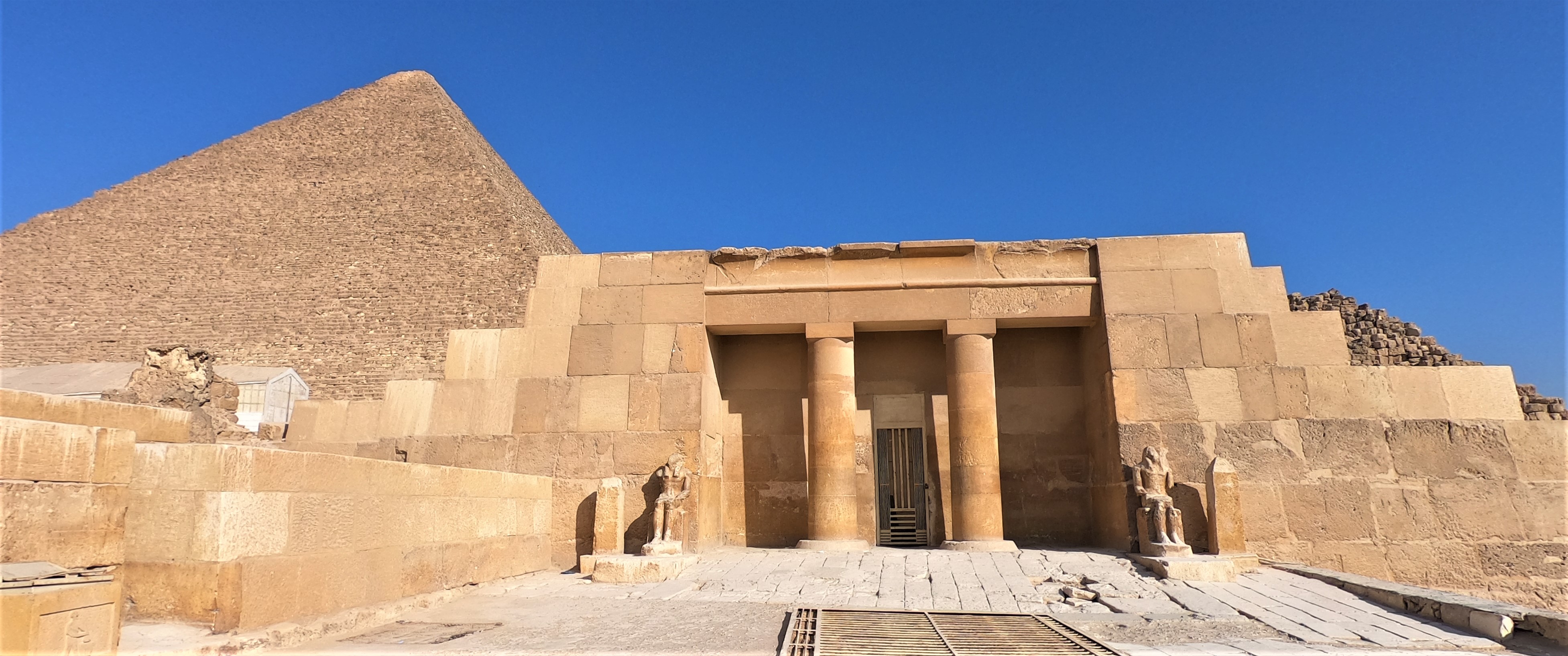
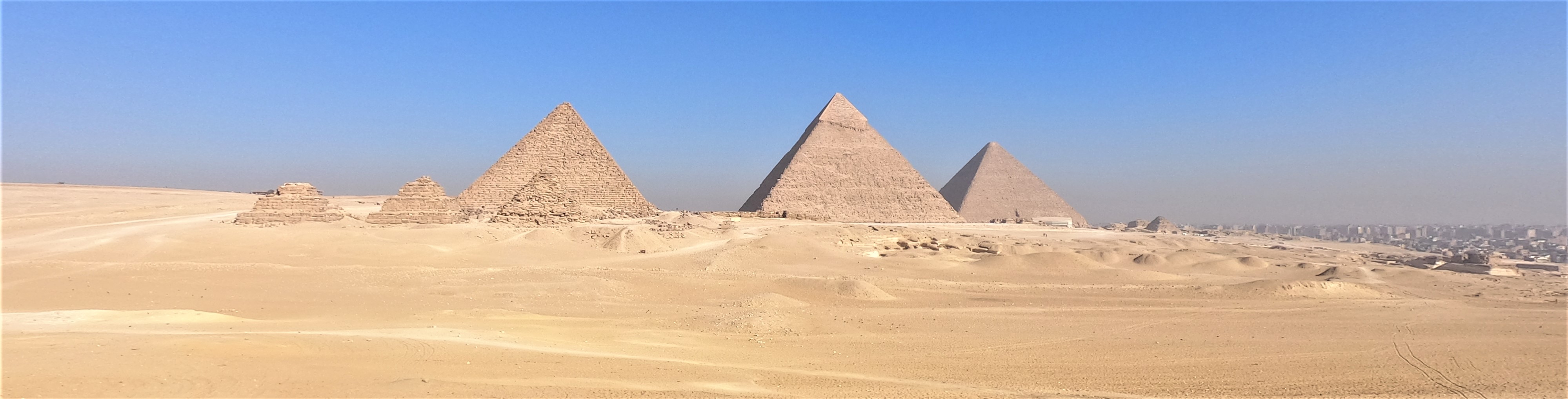
We learned all about mummification and the ancient Egyptian views of the afterlife. These pyramids date back to 2580 B.C. and were the oldest things we’d ever seen. Indeed, they are among the oldest stone structures in existence. The moon was full and present in the sky where we could see it behind the great pyramids. We learned that archeologists found the remains of a village belonging to the workers and no longer think the pyramid workers were slaves, but hired labor who enjoyed a great honor by working on the pharaoh’s tomb. They only worked 4 months out of the year during the flood season! They also found a network of tombs a few kilometers away and are studying the bones to try to figure out the strength of an average worker and see how they could lift such massive stone.
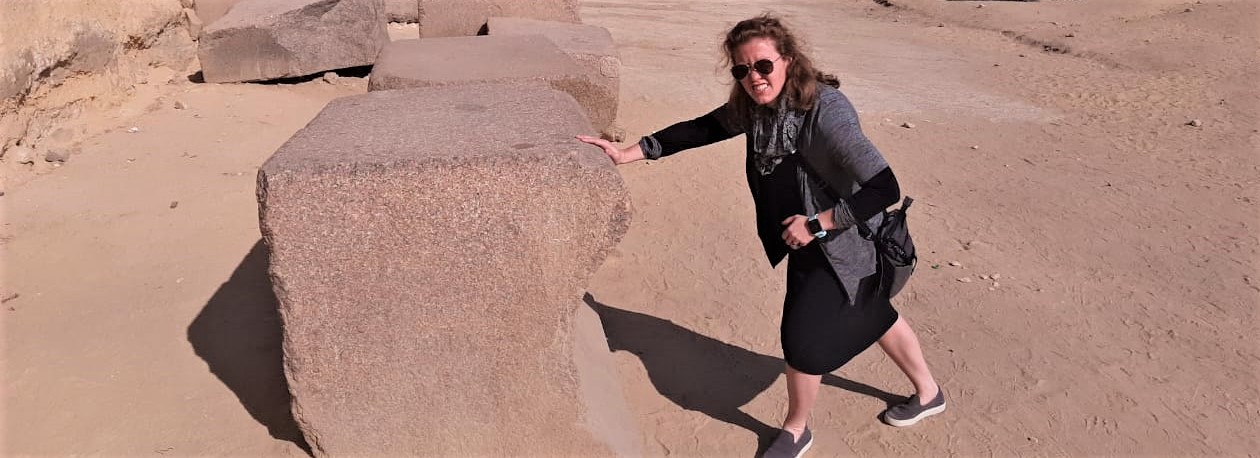
We also saw sections that were made of basalt and granite, pieces of rock that can only be mined near cities much further down the Nile. That means they transported these blocks weighing tens of tons miles up the Nile. We asked Josef about the theory of aliens building the pyramids, and he very matter-of-factly argued, since much of the technology and innovation took place over thousands of years the aliens would have had to come multiple times and given their knowledge one piece at a time. He did claim, however, that around 10% of Egyptologists think the technology came from the lost city of Atlantis.
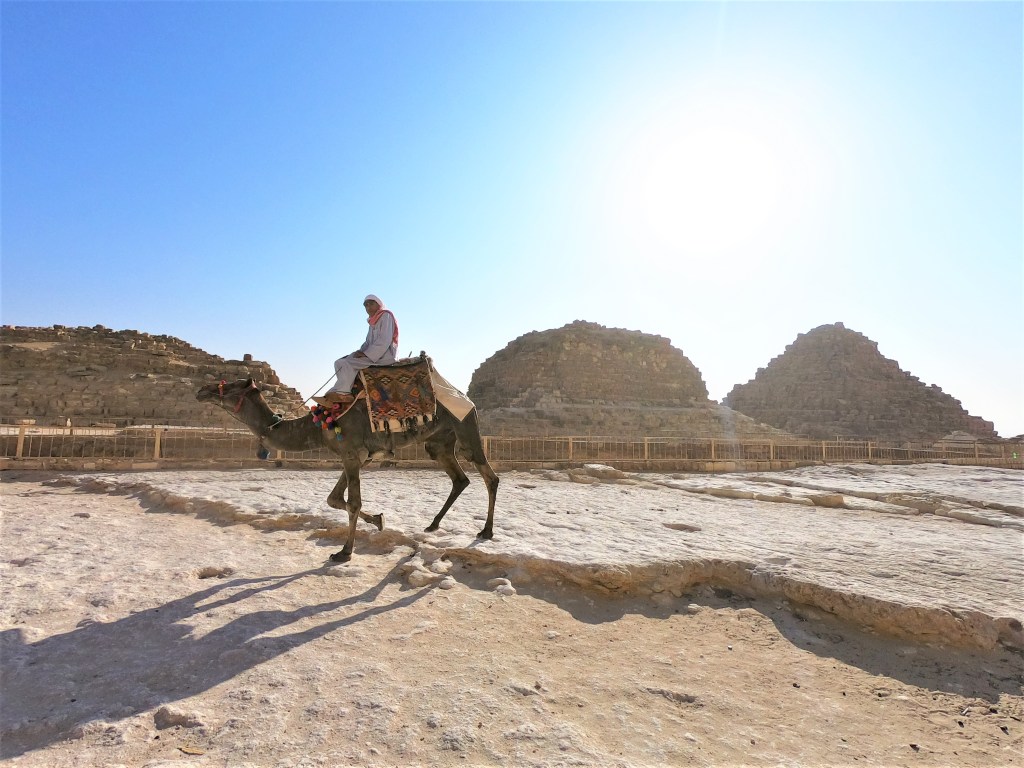
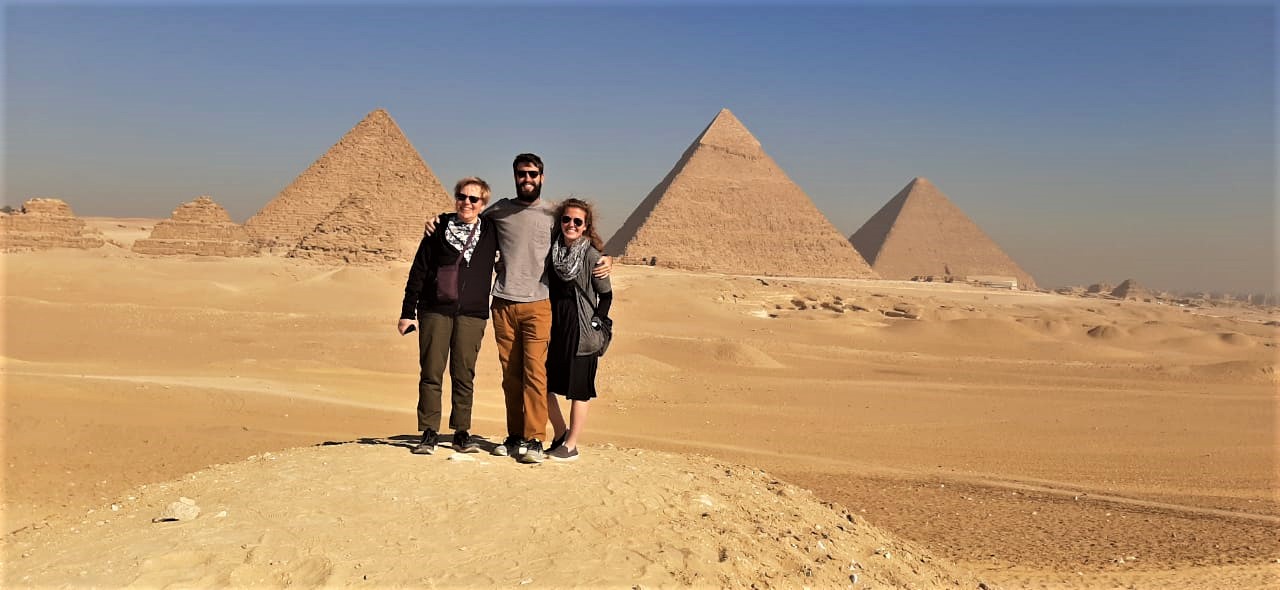
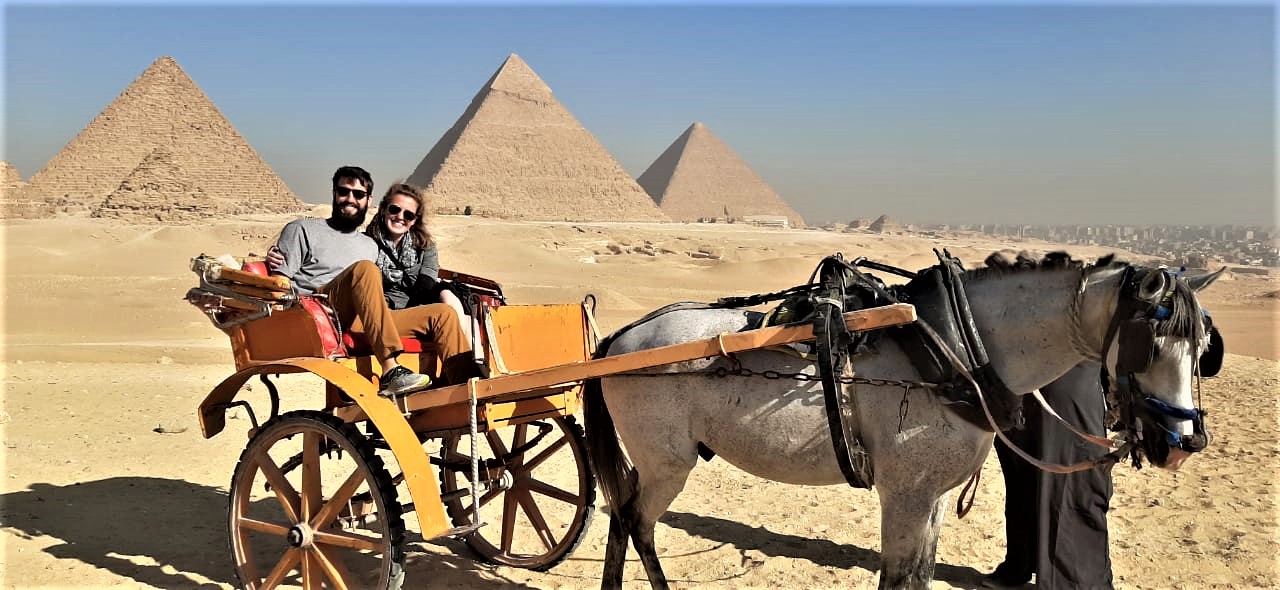
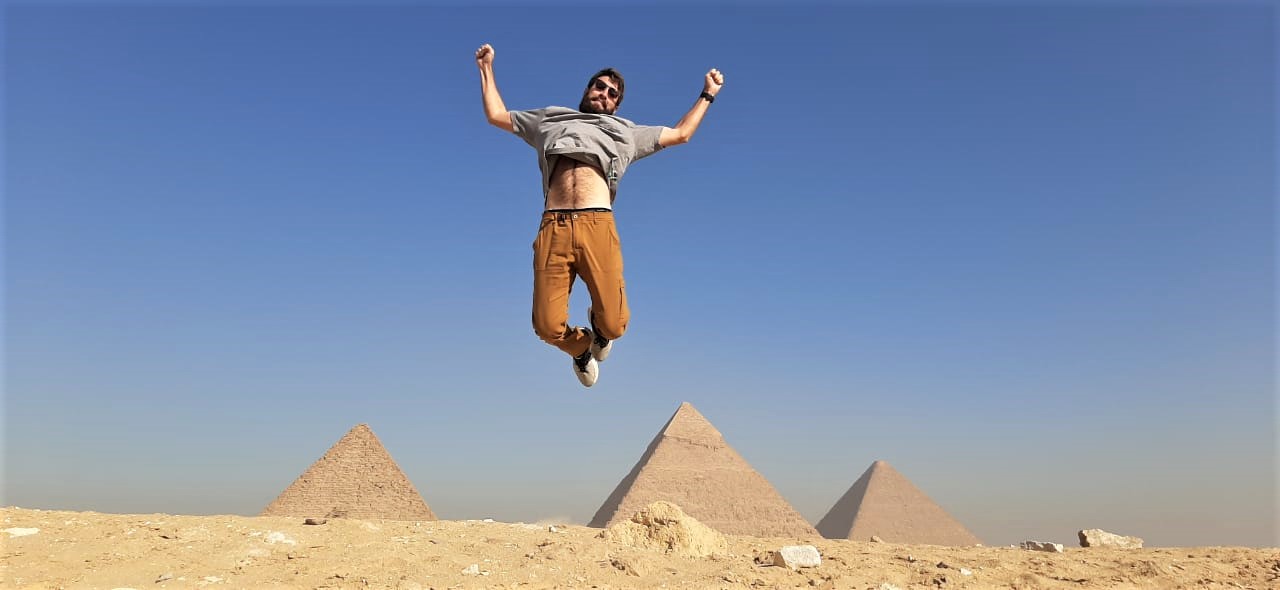
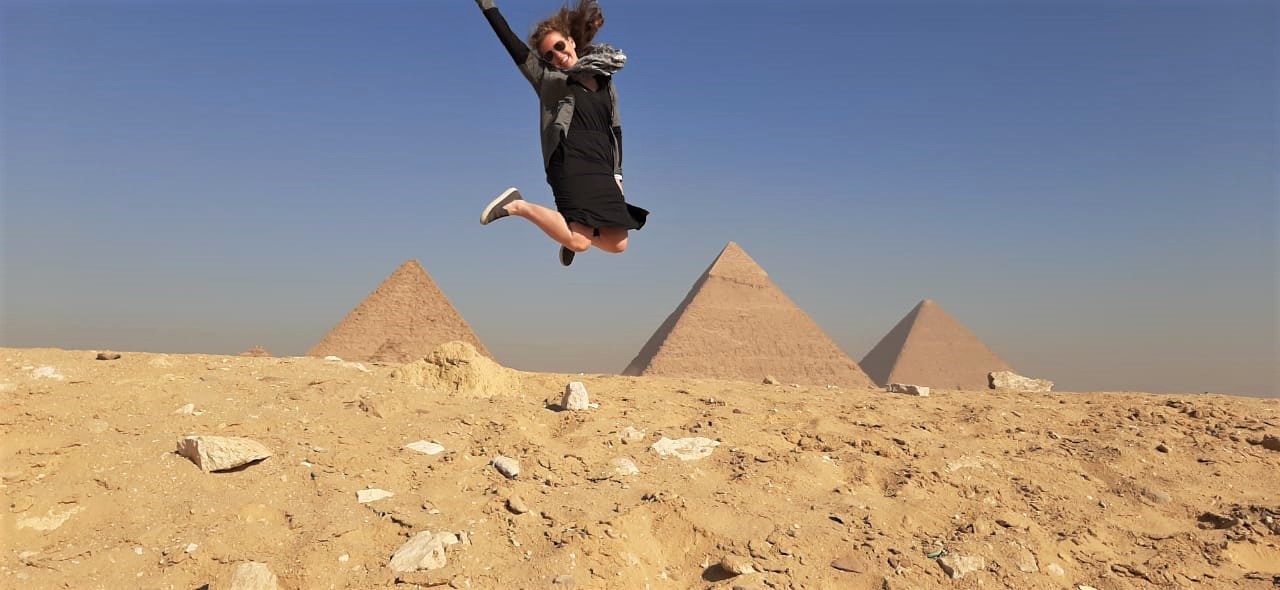
After walking around and getting a history of the great pyramids, our guide suggested taking a horse and chariot ride out into the desert to see all the pyramids together in one frame. He claims he only uses a company that treats their horses well and doesn’t over work them so we agreed. Joan and Josef were in the first cart and Ryan and Elizabeth were in the second. We had beautiful weather and Josef said if it was dusty, he wouldn’t have recommended it, because the dust in unbearable in the desert. We rode out about 30 minutes and Josef led us through a series of tourist photographs like jumping, kissing the pyramid, and touching the top of the pyramid. Some people were doing a similar experience on camels but we were wise enough, thanks to Morocco, to know that’s not a comfortable activity.
Next, we rode the horses back and walked down the causeway to the sphynx and the mummification room. For mummification, which is a long process, they remove 4 essential organs: the liver, lungs, intestines and stomach. They throw away the brain and keep the heart in the body. These organs are then put in sacred jars and buried near the bodies for the afterlife. The sphinx was really impressive to see, especially when we walked out in front of it and could see all the pyramids in the background.
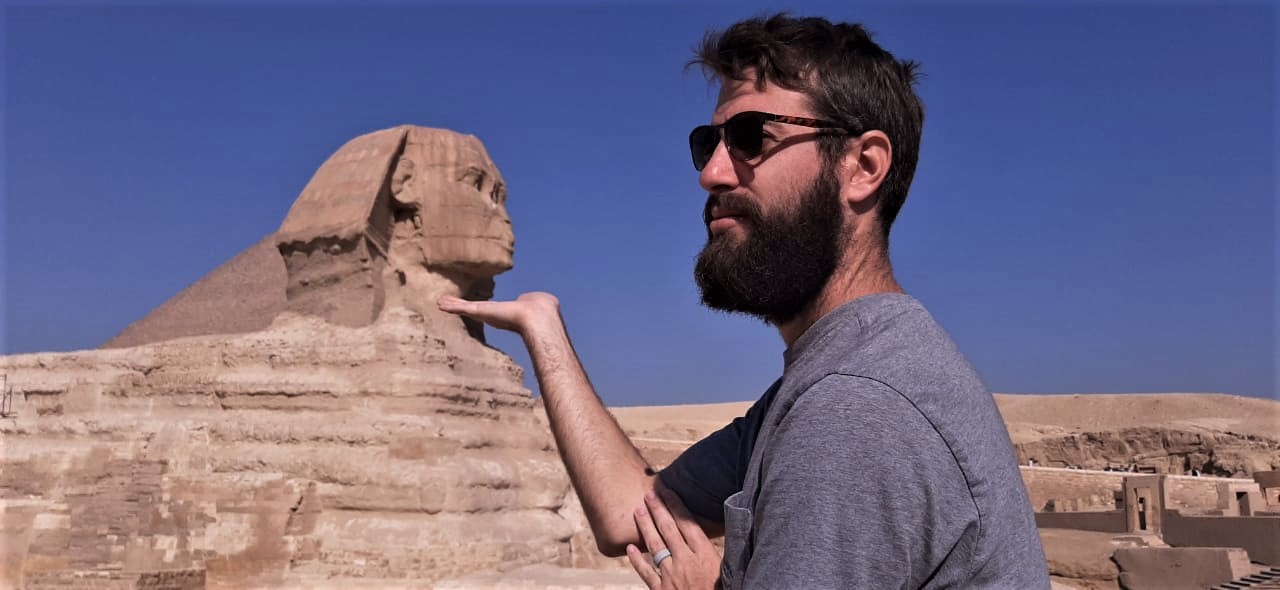
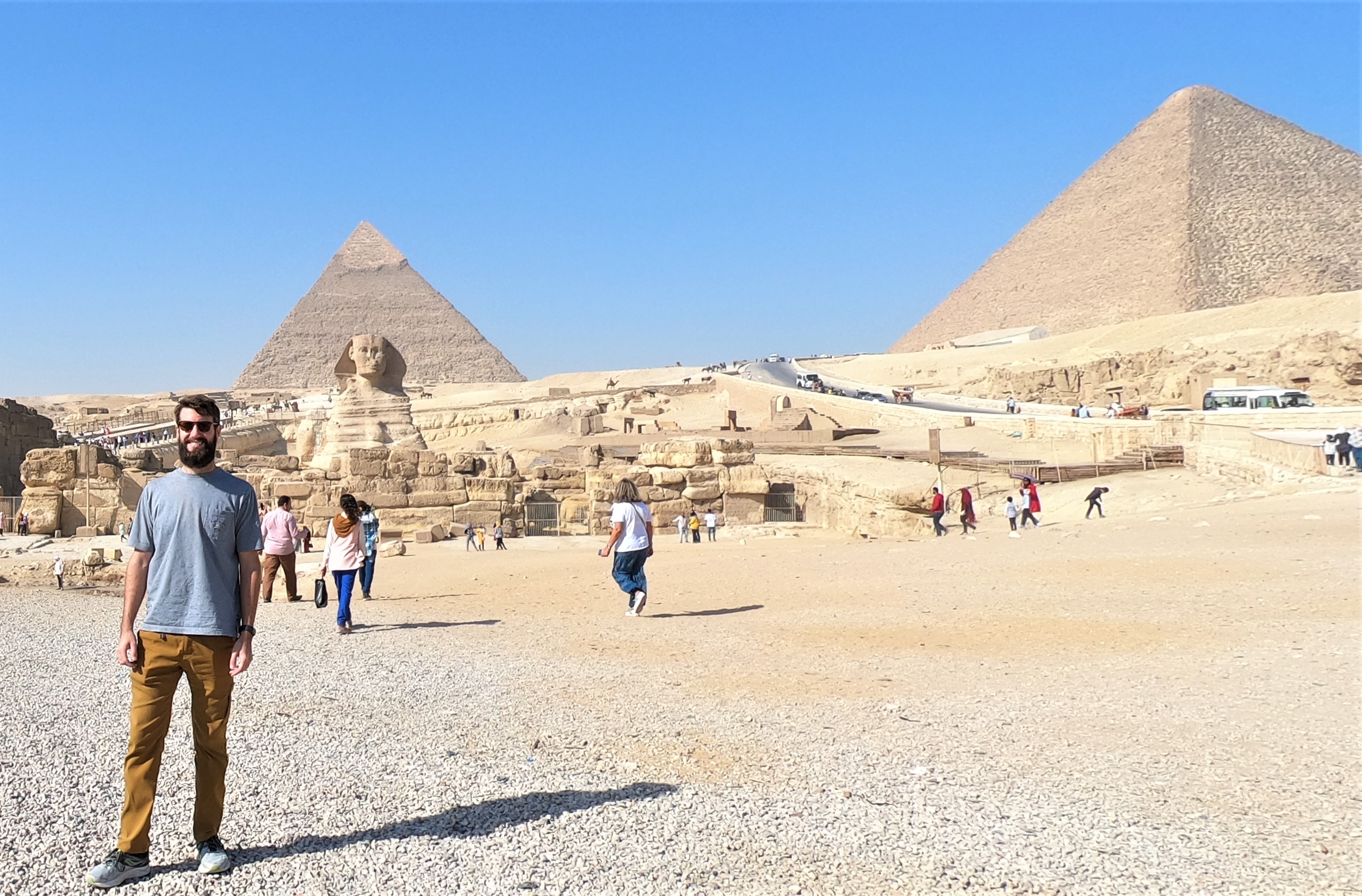
We were next dropped off at a papyrus art store while our guide picked up our lunch. We were ready for the standard African “let me show you my friend’s store, but you don’t have to buy anything” routine. They taught us how the Egyptians made paper in the past by cutting papyrus leaves and soaking them in water, then weaving them together and squeezing out the water. This group of artisans makes the paper the same way and then adds Egyptian art. We bought a small boat picture, but it was the one place Elizabeth wishes she could have spent more money, because the paintings were beautiful.
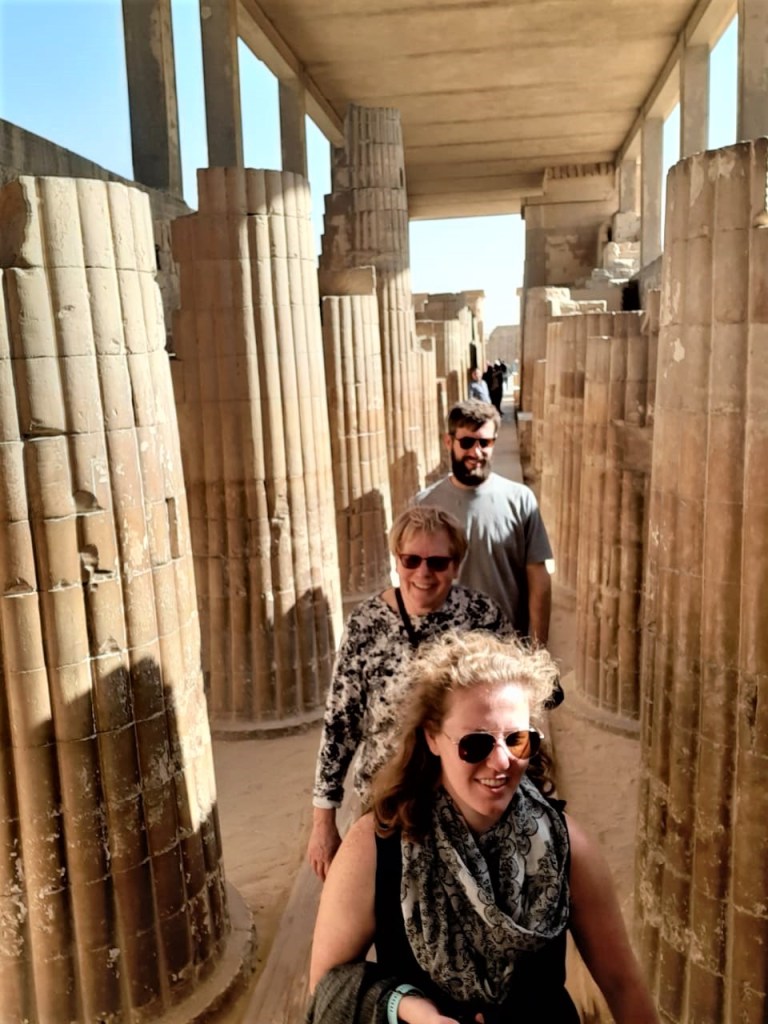
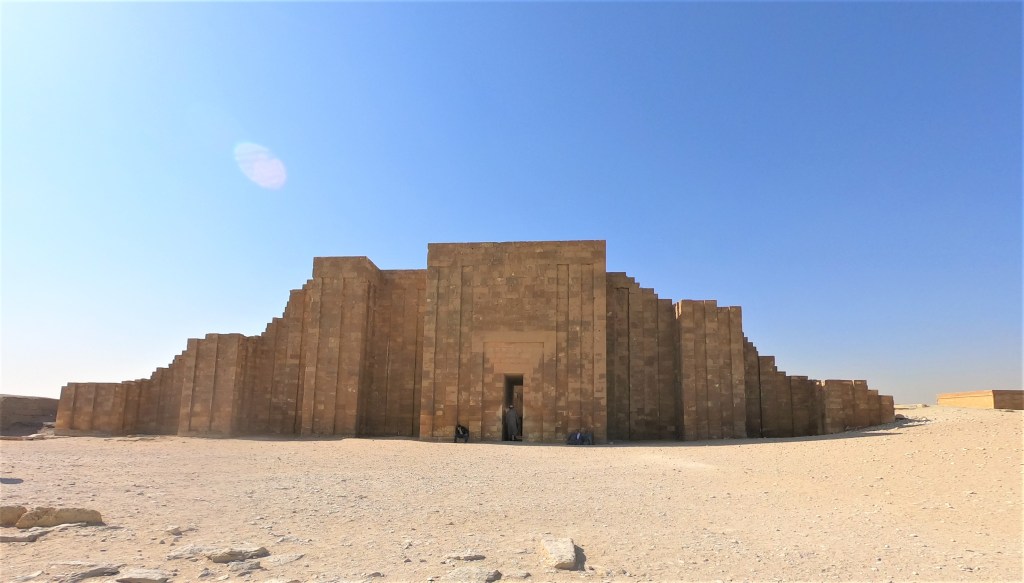
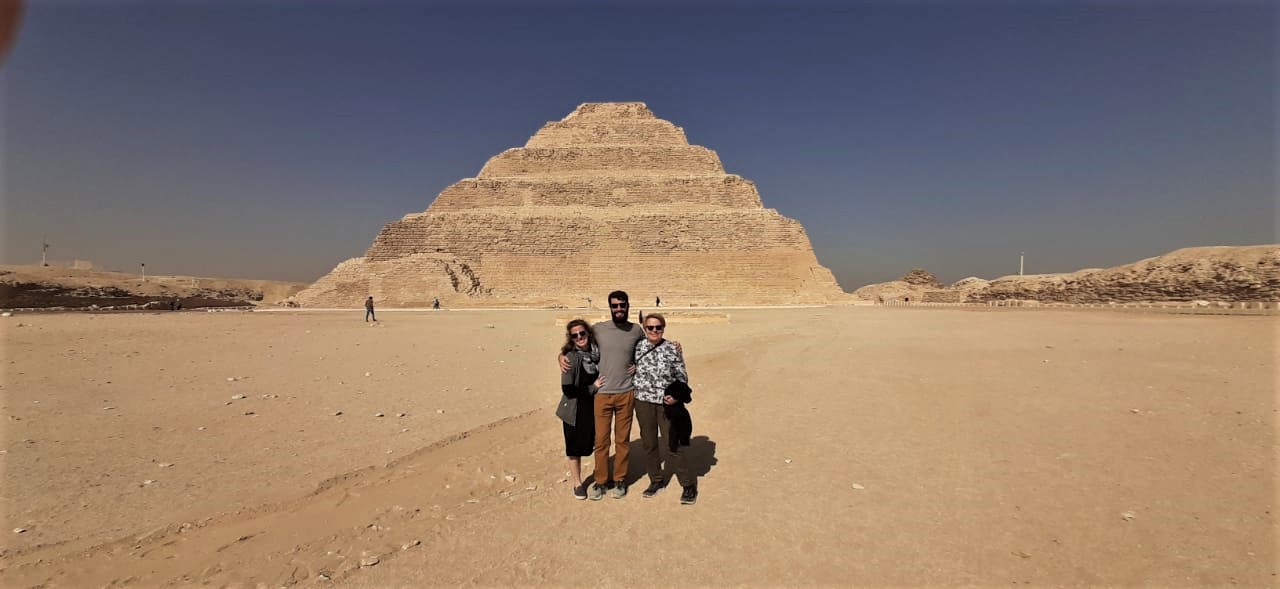
We piled back in the car and enjoyed our first official Egyptian meal. We had three sandwiches, two types of falafel and the third was babaganoush. Joan was brave and ate a single falafel sandwich, but we absolutely loved them. We ate while driving to our second stop, the step pyramid or the Pyramid of Djoser. We pulled up and it was again, pretty empty. We walked through the oldest stone building in the world. You can see the bottom half is original and the upper portion was restored in the same style in the 1800s. It was a tomb where lots of pharaohs could be held in little rooms between gorgeous pillars. There were massive stone doors on hinges that would be closed to keep the bad spirits out. The tombs opened up to a large square; the pyramid shaped like steps. This was a monument built for Pharaoh Djoser by his vizier Imhotep, who wanted steps to reach heaven and a large bull fighting square like the one they had in Memphis. They replicated the things they had in this life that they wanted to take in the next life.
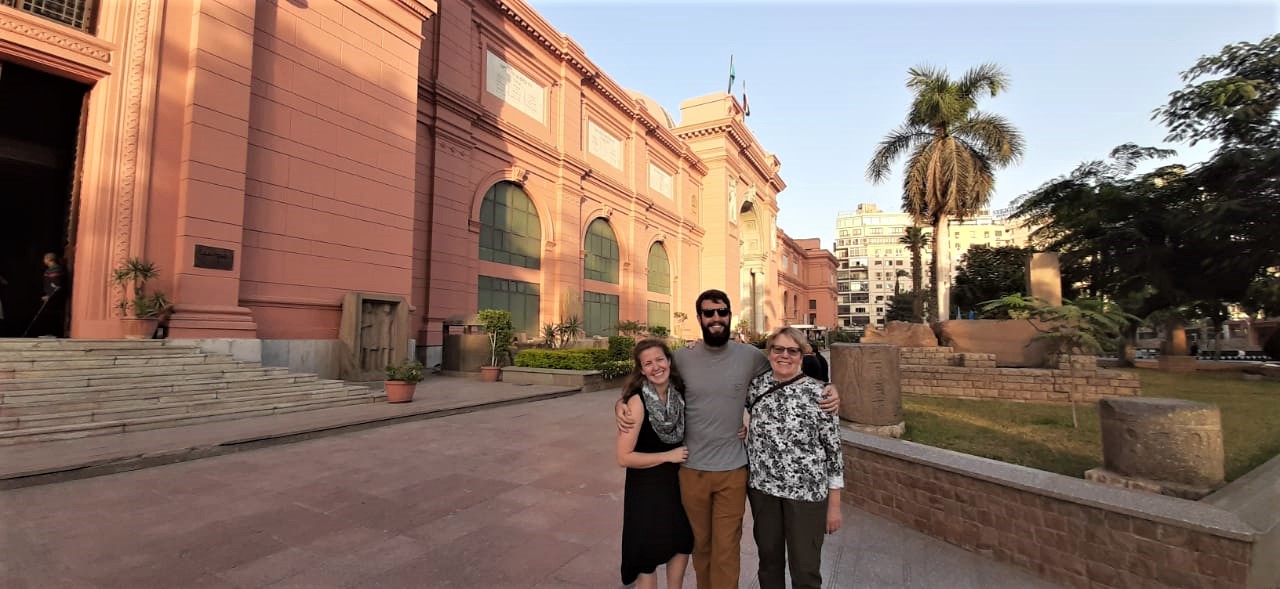
Finally, we made the long drive back into Cairo to go to the Egyptian Museum, which is located deep downtown. We weaved in with traffic for about an hour before arriving. We got lucky with our timing, as they are moving the museum into a new building out near the pyramids, but they haven’t taken away all the exhibits yet. We weren’t too excited about the museum, since we aren’t exactly museum people, but Josef made it a wonderful experience. The museum is two floors. We started in the upper and saw lots of pottery and jewelry and an animal mummification room with a giant Nile crocodile. We saw two mummies and lots of sarcophagi. The highlight was learning about King Tut and seeing all his treasures.
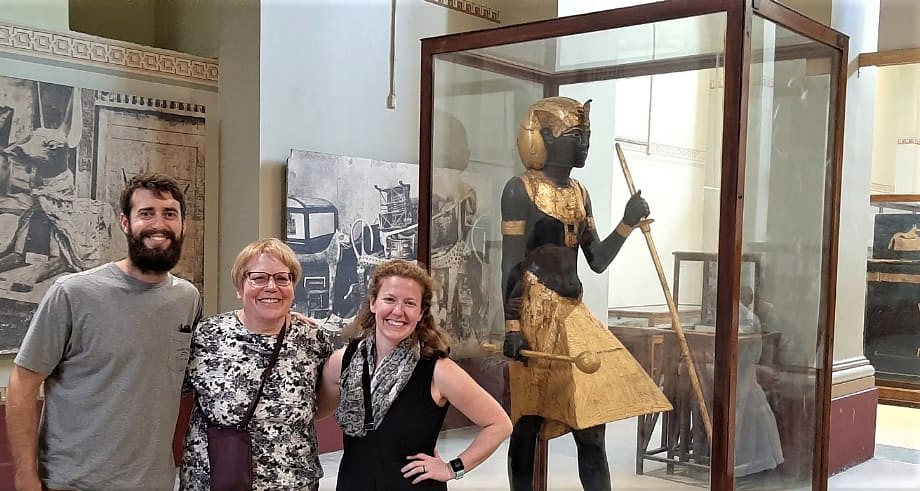
Tut’s tomb was discovered by accident. A British explorer, Howard Carter, spent many years hunting in Egypt. Every night one of the servant boys would toss the camp’s wastewater off the edge. Unbeknownst to anyone, this water was slowly eroding the sand covering the entrance to the tomb. After years* of searching without success Carter was giving up on his expedition, but that night when he was packing everything up, the boy revealed the first step of the tomb leading underground. This led to the excavation of the hut and the unearthing of a trove of gold, furniture, his body and organs. We saw the first known flip flops, folding chairs, and cots. One of our favorites was seeing the pieces for an old Egyptian game like chess, but no one knows how to play. We went into the treasure room and saw all his gold jewels, gold tomb, and gold head piece he was buried in. All of this was found in Luxor, but transported to Cairo, except for his body. We felt kind of bad for the guy, they dug him up, ripped him out of his tomb and jewels and headdress then shipped away all his stuff.
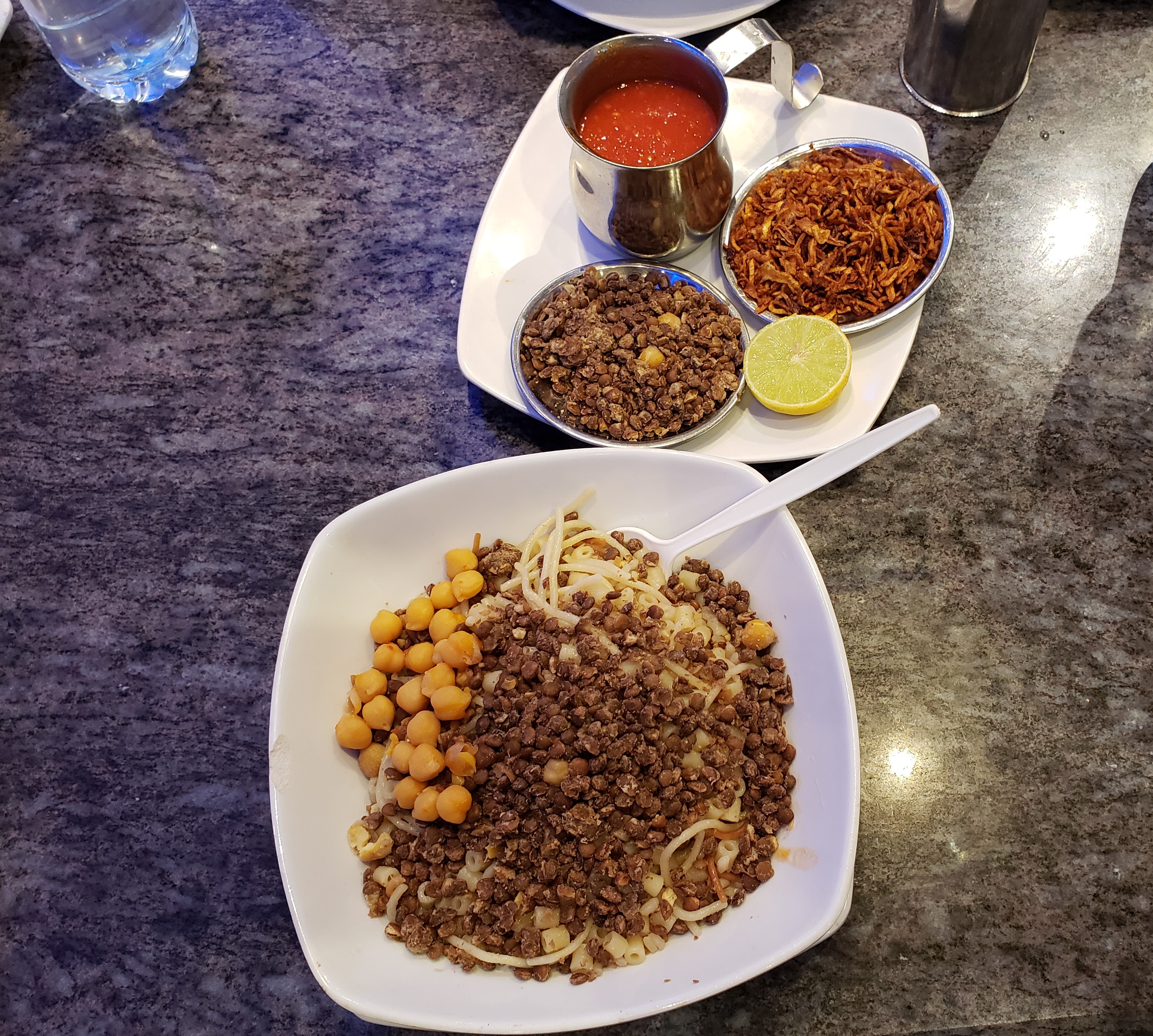
We finished walking around the museum and saw a female pharaoh, Hatshepsut, and the pharaoh Akhenaten who was thought to be disfigured and wanted his statues to show his odd shaped body and face. We learned so much about ancient Egypt, but it’s so hard to retain all the details. We piled back in the car and headed to dinner at a restaurant called Abou Tarek. We had to try a dish called kushari which our guide raved about. It. Was. Phenomenal. It’s a bowl of noodles, beans and lentils that you cover in fried onion crisps and tomato sauce so it’s like a flavorful spaghetti. We topped it off with rice pudding and we had very full bellies.
They dropped us back off at the hotel and we lounged around the pool sipping wine and beer before calling it a night. It’s a shame we only had one day in Cairo, but we packed it as full as we could and it was worth all the traffic and driving.
Day 3 – Cairo to Luxor – November 20
We had an alarm malfunction, but luckily Joan woke us up in time to catch our 5:30 am cab to the airport. Our driver seemed slightly lost at times, but a lot of roads seemed blocked that maybe shouldn’t have been. We made it though and had to go through lots of pre-security before we could check in. The security lines were all gender segregated. Finally, we checked our bags with all the other tourists and boarded our one-hour Nile Air flight to Luxor.
We collected our bags upon landing and Ryan realized they broke the chest strap of his backpack. We reported it to the office, but aren’t sure if anything will be done. We found our tour guide for the day outside and our air-conditioned van. We loaded up and were off to our first sight Medinet Habu, memorial of Ramses III. It was only 9 am so there were hardly any tourists out. This was our first temple and first opportunity to see walls, pillars, and ceilings covered in hieroglyphics.
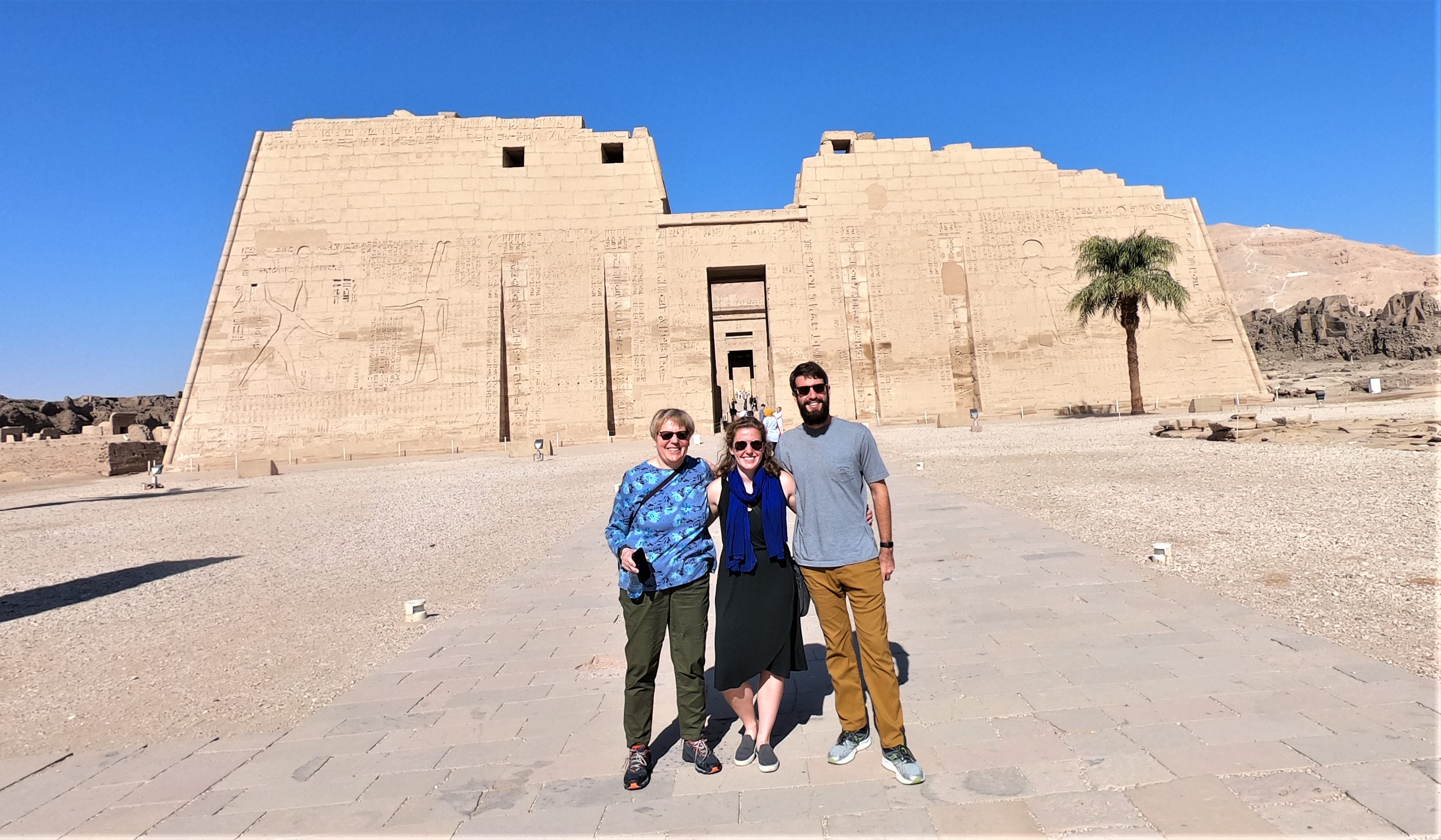
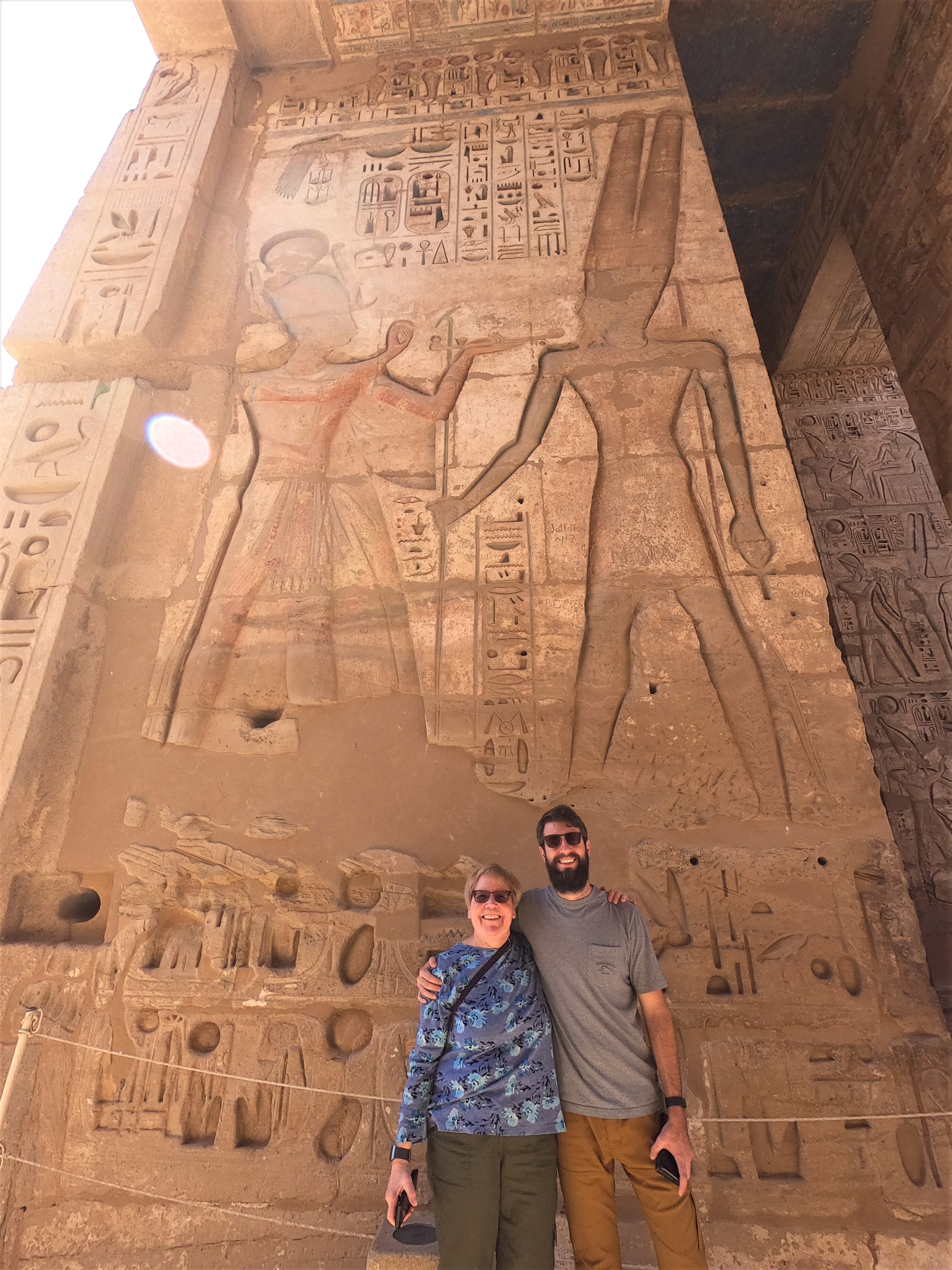
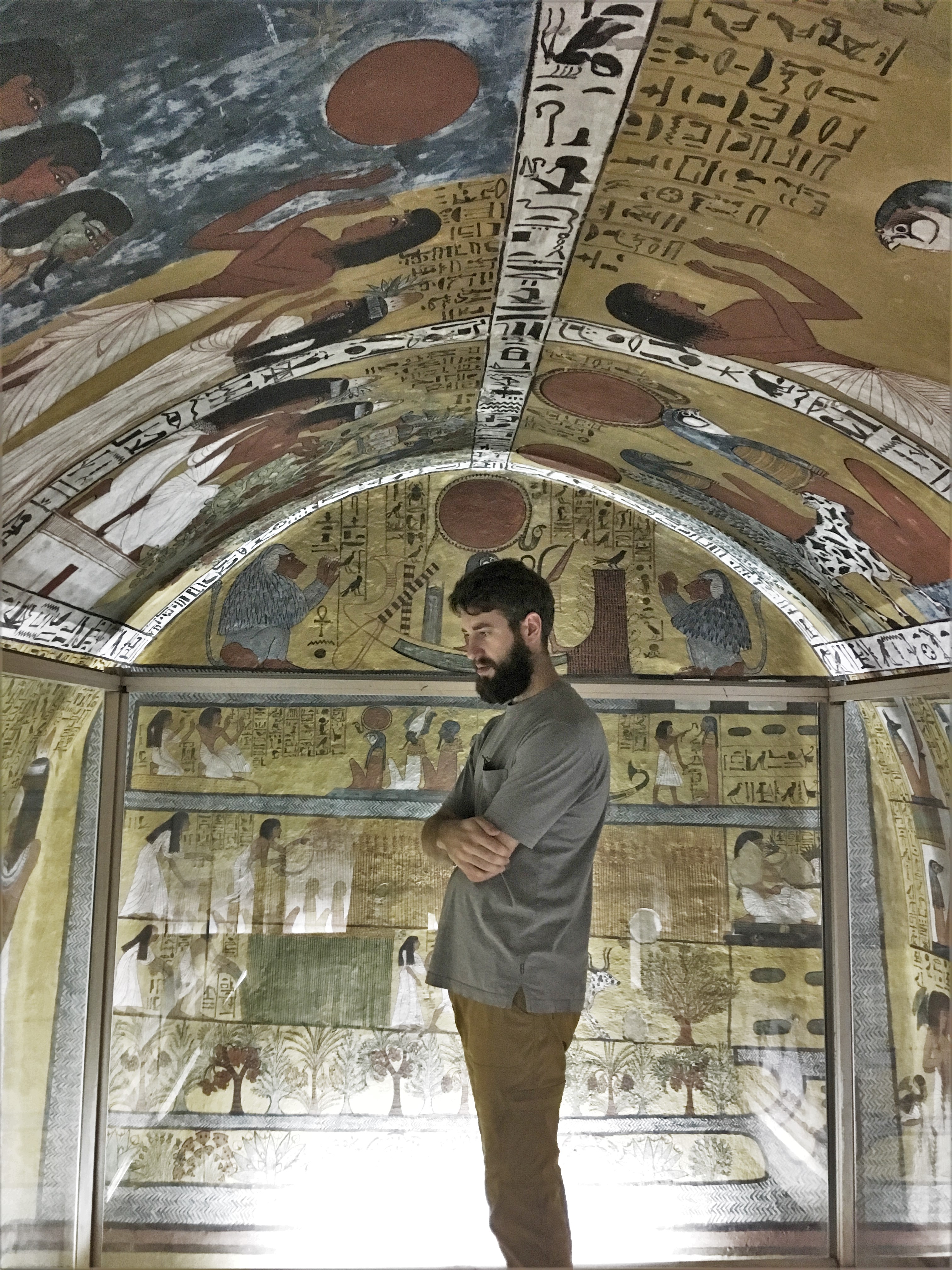
We again were taught about a lot about the scenes depicted and the history of Ramses III, but we didn’t really learn much, really, we just got mixed up and confused by a barrage of new information. Then we jumped back in the car and headed to the Tombs of the Artisans. The artists who actually painted and carved the pyramids have a valley where they constructed their own tombs. We were able to go inside three. They weren’t very large and we had to squat down like ducks to walk through the low passages, but inside were beautiful paintings all preserved for the last 3000 years.
It wouldn’t be Africa if we weren’t forced into a store to watch a presentation and be pressured into purchasing souvenirs. Today’s adventure was an alabaster store. We watched a funny presentation by the workers about how they carve their stone and etch in the designs then show you the evils of buying souvenirs from street vendors, since they aren’t real stone. They had very impressive work in their store and Joan was convinced to buy some gifts for her office. We were each given a small Scarab made of onyx as a keepsake and to know we always had a friend at the alabaster store. The negotiations took about 20 minutes and we tried to drive him lower, almost walking away, but in the end, he made the sale.
Today was the day of tombs so we next headed towards the Tombs of Nobles. In ancient Egypt, there were local governments and they would report to the pharaohs regarding crops, people, etc. These tombs were larger than the artisans and a lot of the decoration showed number of cattle and crops that came from that noble’s region. We were able to go into three tombs and in one we saw how sunlight could reflect off a mirror to light up the whole tomb. They used these tricks during the excavation and allegedly during the construction of the tombs.
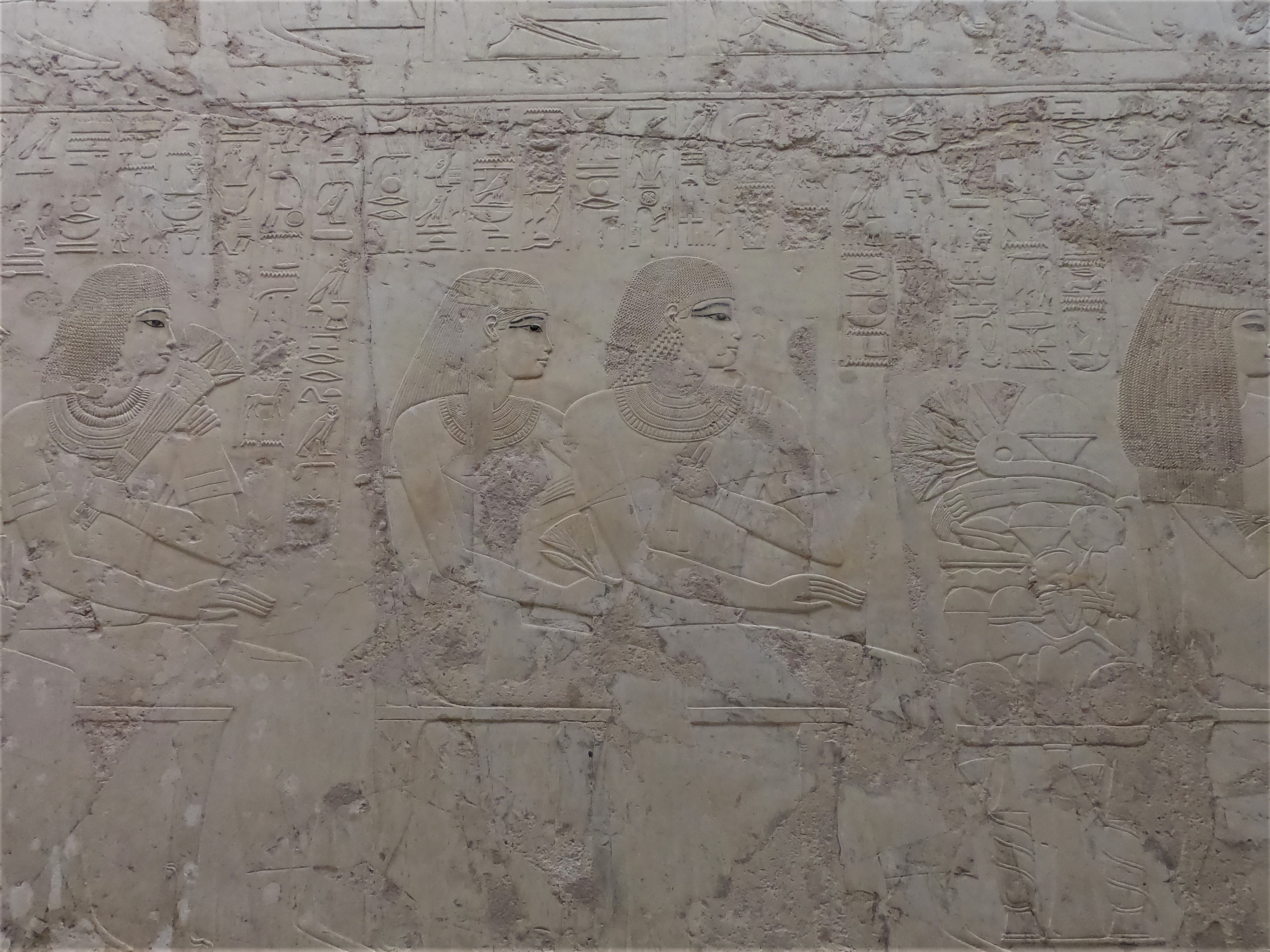
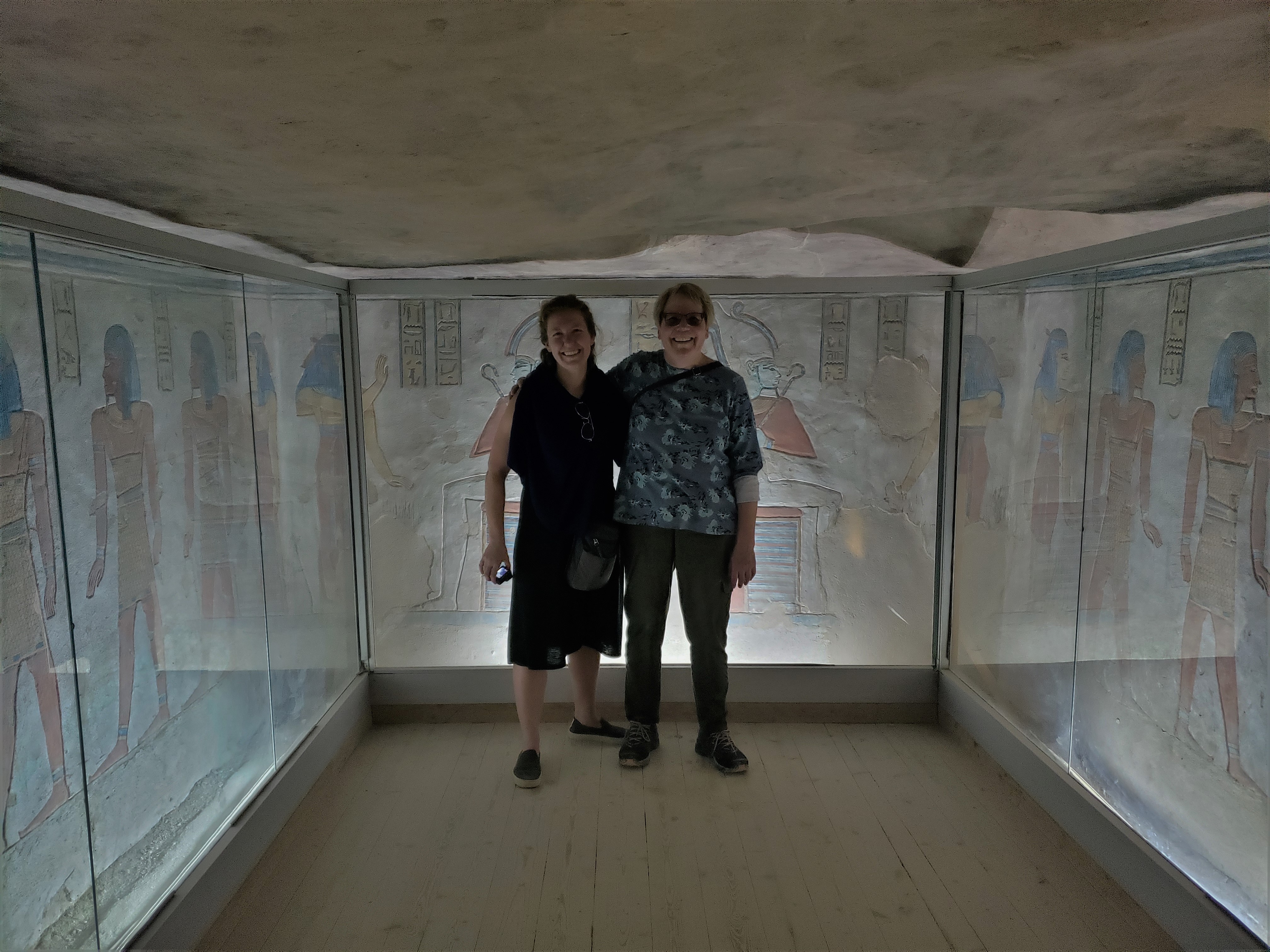
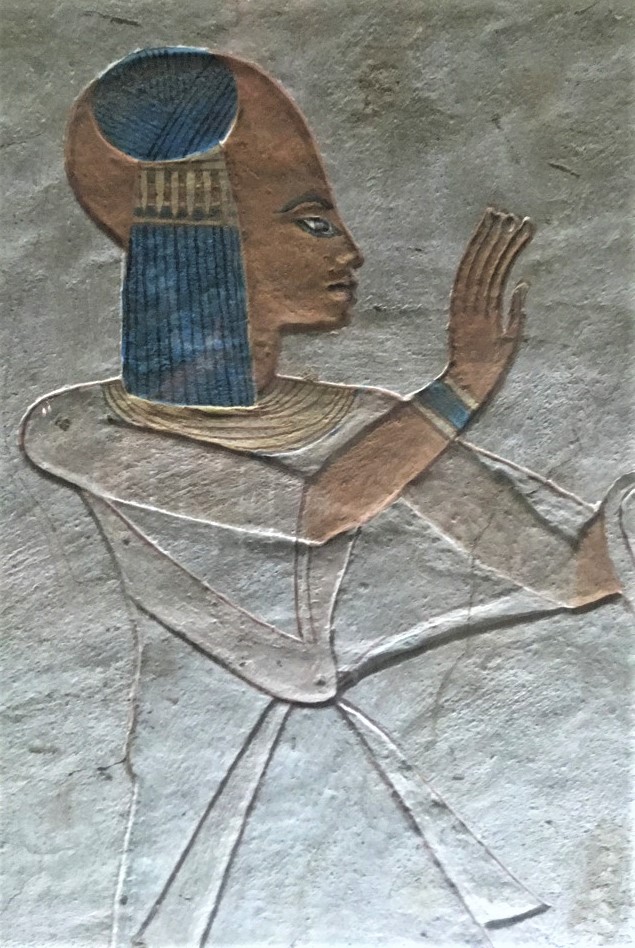
Our final stop on our tombs tour was the Valley of the Queens. We were able to go into three tombs, though one was actually a prince. The guide wasn’t able to go with us into a lot of the tombs. Because of crowds and the guides taking too much time to explain they have a man inside to make sure people move along and he points out animals in the hieroglyphics and expects a tip. The biggest tomb we saw was Queen Titi. There were depictions of lions, apparently there used to be lions in Egypt, and boys with a side ponytail like we see in the Prince of Egypt. Elizabeth asked all of our guides if they’ve seen the Mummy and the Prince of Egypt so they know what she’s looking for in a tour.
We were pretty hungry at this point and our guide took us to lunch at a restaurant called African Cuisine, a very local restaurant right along the bank of the Nile. We sat on the shaded roof overlooking the river. The food was again, delicious and we ate pita and tahini, veggie salad, and lentil soup before really digging into the rice, chicken, and beef kofta. For dessert they brought small pastries with honey and bananas. We were stuffed.
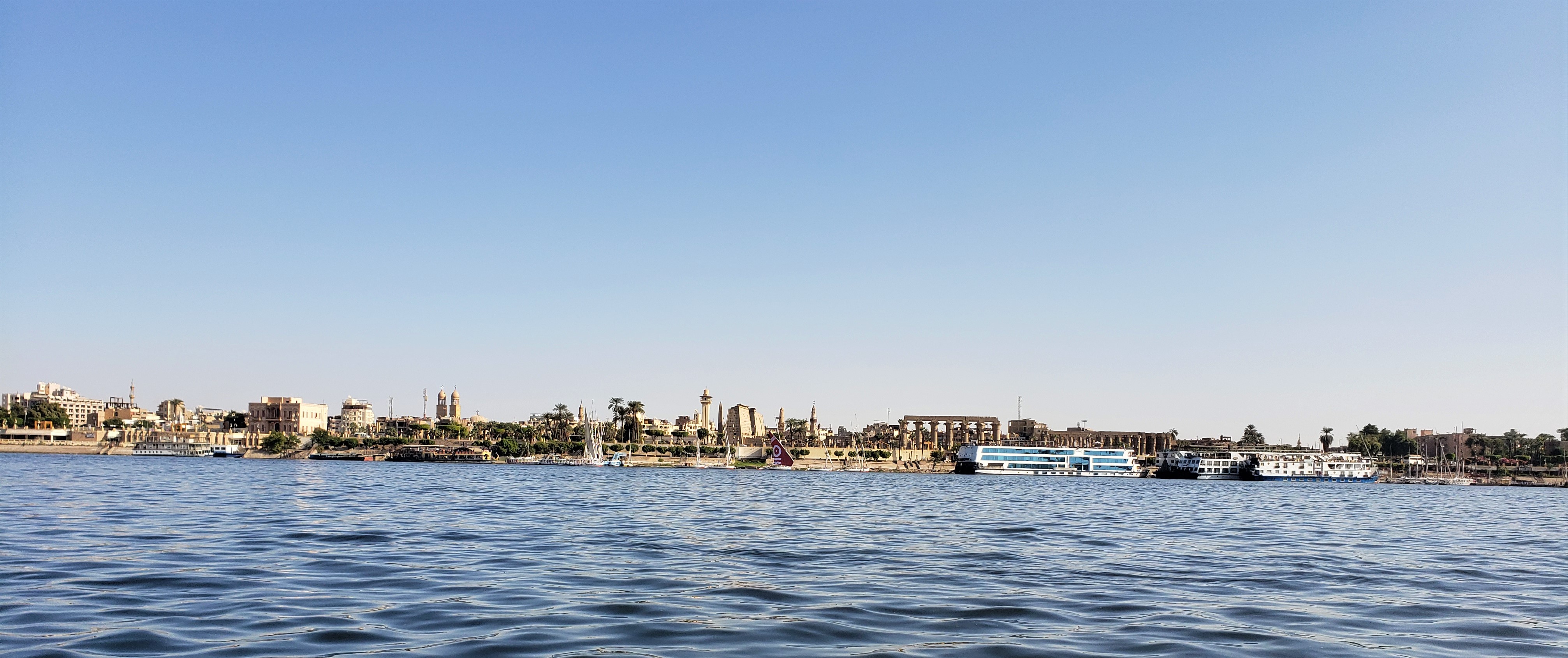
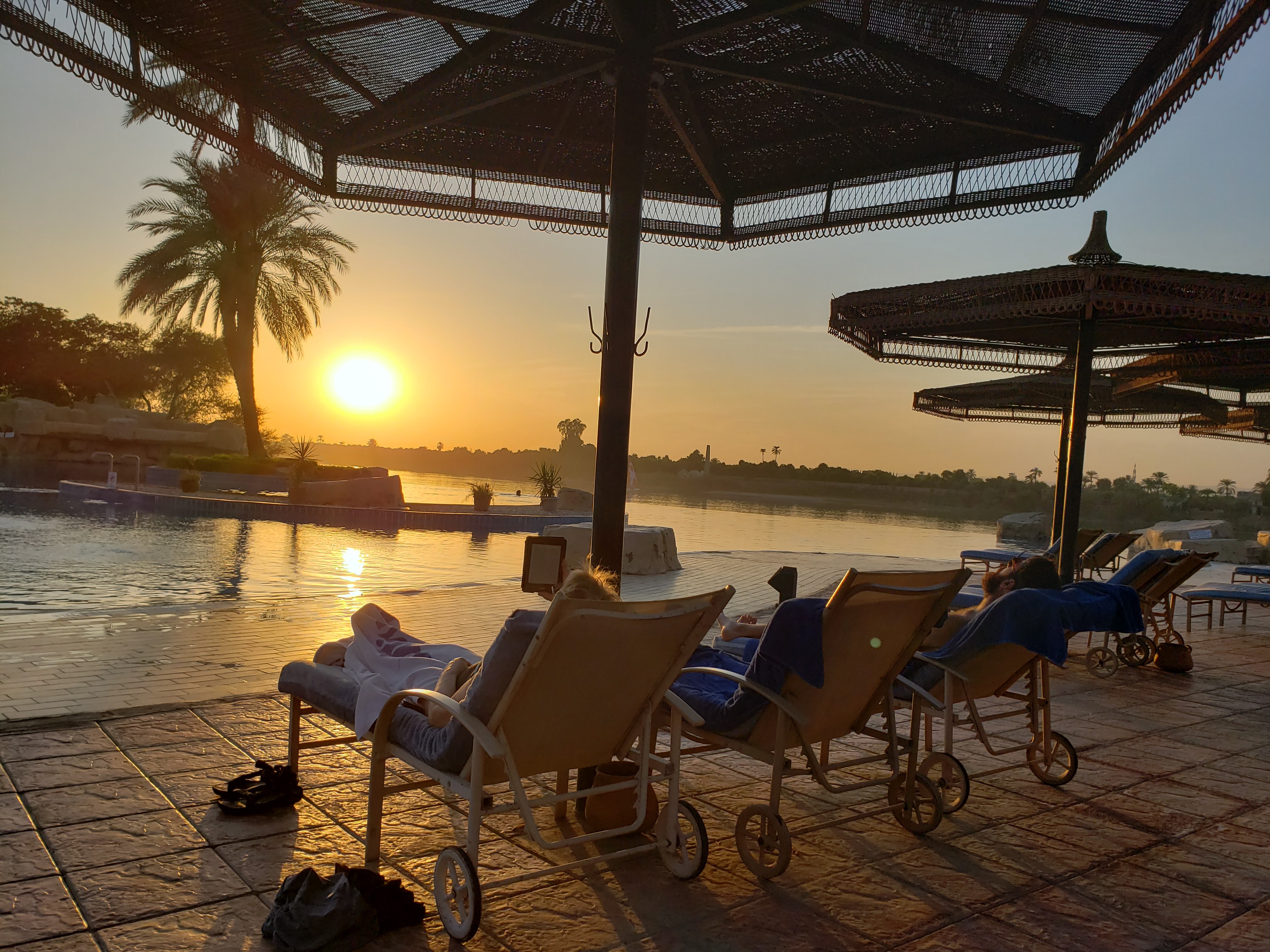
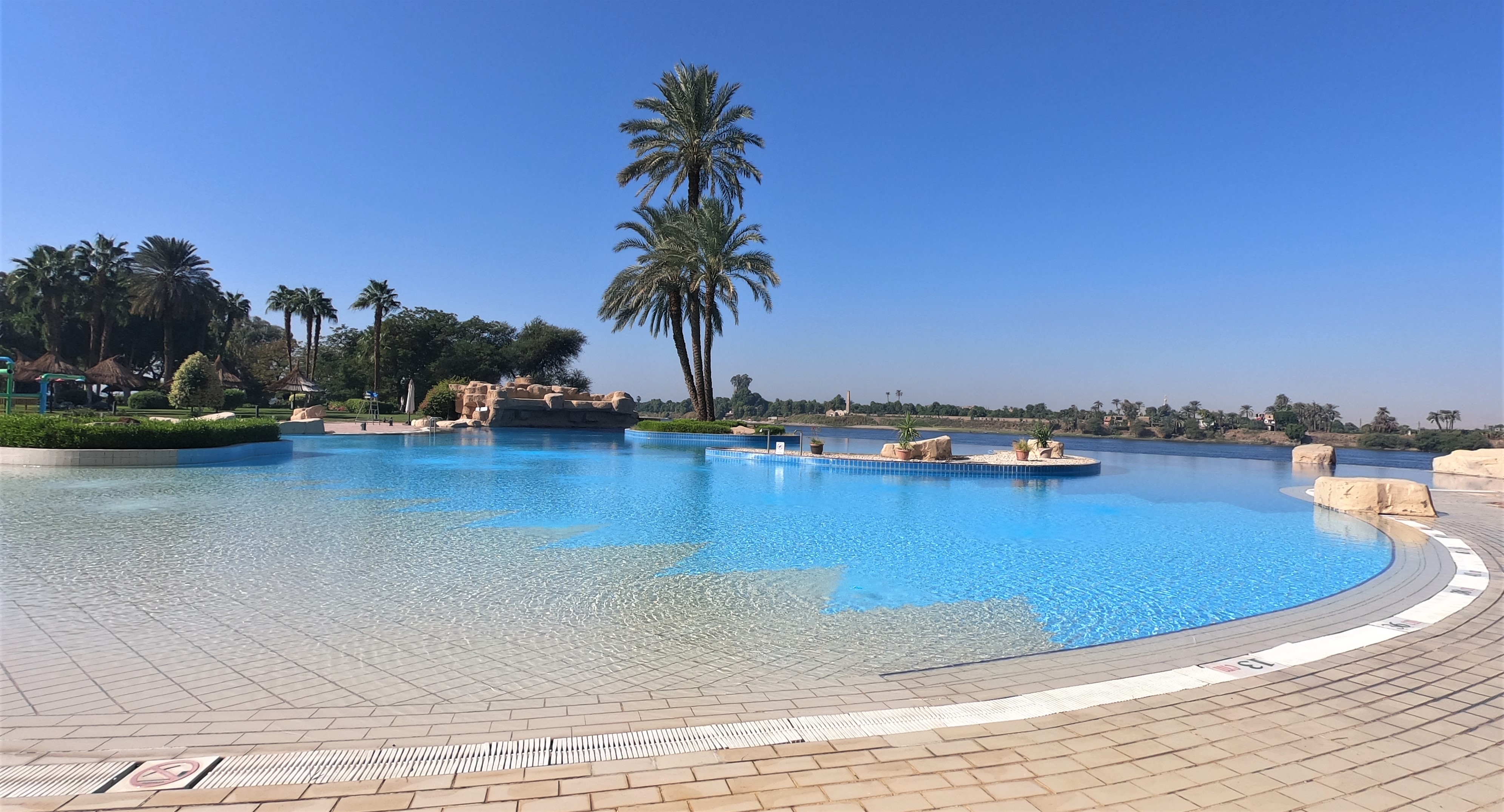
Our guide and driver dropped us off at our hotel for the night, Jolie Ville located on Kings Island in the middle of the Nile. We got there around 3 and headed straight for the infinity pool to swim and watch the sun set. We’d been so hot during the day and excited to finally cool off in the pool, but it was freezing cold! Ryan made us all get in and swim around. The hotel grounds are sprawling and gorgeous and our rooms are massive, we are sad to only spend one night. We know understood why our Austrian cat-sitting hosts were so eager to recommend this place. We watched the sun dip behind the horizon then headed back to our rooms for a pre-dinner rest.
After a brief recuperation, we wandered back to the main lobby area to get a drink on the patio. We’d been harassed by a staff member all day trying to set us up in his dinner area, ostensibly as they were nowhere near capacity for the night. We successfully rebuffed his advances until he cornered us when we ordered drinks. He managed to coerce us down onto the grass where he had a nice table set up complete with white tablecloths and flowers. We shared a bottle of white wine called Obelisk and Ryan had another Sakhara beer. Eventually we got hungry and ate a couple of crappy, but just what we needed pizzas. We called it a night and slept like the dead in our wonderful rooms.
Day 4 – Luxor – November 21
The next morning Elizabeth got up to go to the gym at 7:30 but they didn’t open until 8. She explored the island and found a “zoo” of water buffalo, horses, and cows. Our waiter last night proudly told us how they grow their own beef on the island. The whole island only took about 30 minutes to walk around and it was nice to get out before the heat came. We met Joan for breakfast at 9 and enjoyed a nice buffet with an omelet bar and pancake station. Ryan hadn’t had cereal in a few weeks so he went hog wild. Joan and Elizabeth lounged by the pool for a few hours watching a group of Asian women sing and do strange rituals in the lounge chairs next-door while Ryan got his beard trimmed and hair cut.
At noon we were picked up by our cruise ship transportation and taken to the M/S Alyssa to begin our 4-night cruise on the Nile from Luxor to Aswan. They stack the boats out from the banks so we had to walk through one broken down boat to get to our much nicer boat. There was some confusion dropping us off as the driver told us our tour guide would meet us after dinner but Elizabeth’s schedule said, and the boat staff confirmed, that there were no activities that day. We settled into our rooms which were very nice with huge windows facing overlooking the river.
Lunch is served from 1:00 to 2:30 every day and you know we were the first group down there at 1 o’clock sharp. We got to pick our assigned table and chose number 21 right by the window. Lunch was a fixed menu that day since people were arriving at all different times. We started with soup and salad then a huge pile of rice with beef, chicken and pork chops. Dessert was a fruit salad topped with ice cream. It was so much food we couldn’t finish it all. We changed into our swimsuits to go enjoy the afternoon heat on the sundeck. Ryan wasn’t feeling well, a grumble in the tummy, so he rested in the room. He found us an hour later after receiving a call that our tour guide was waiting for us in the lobby.
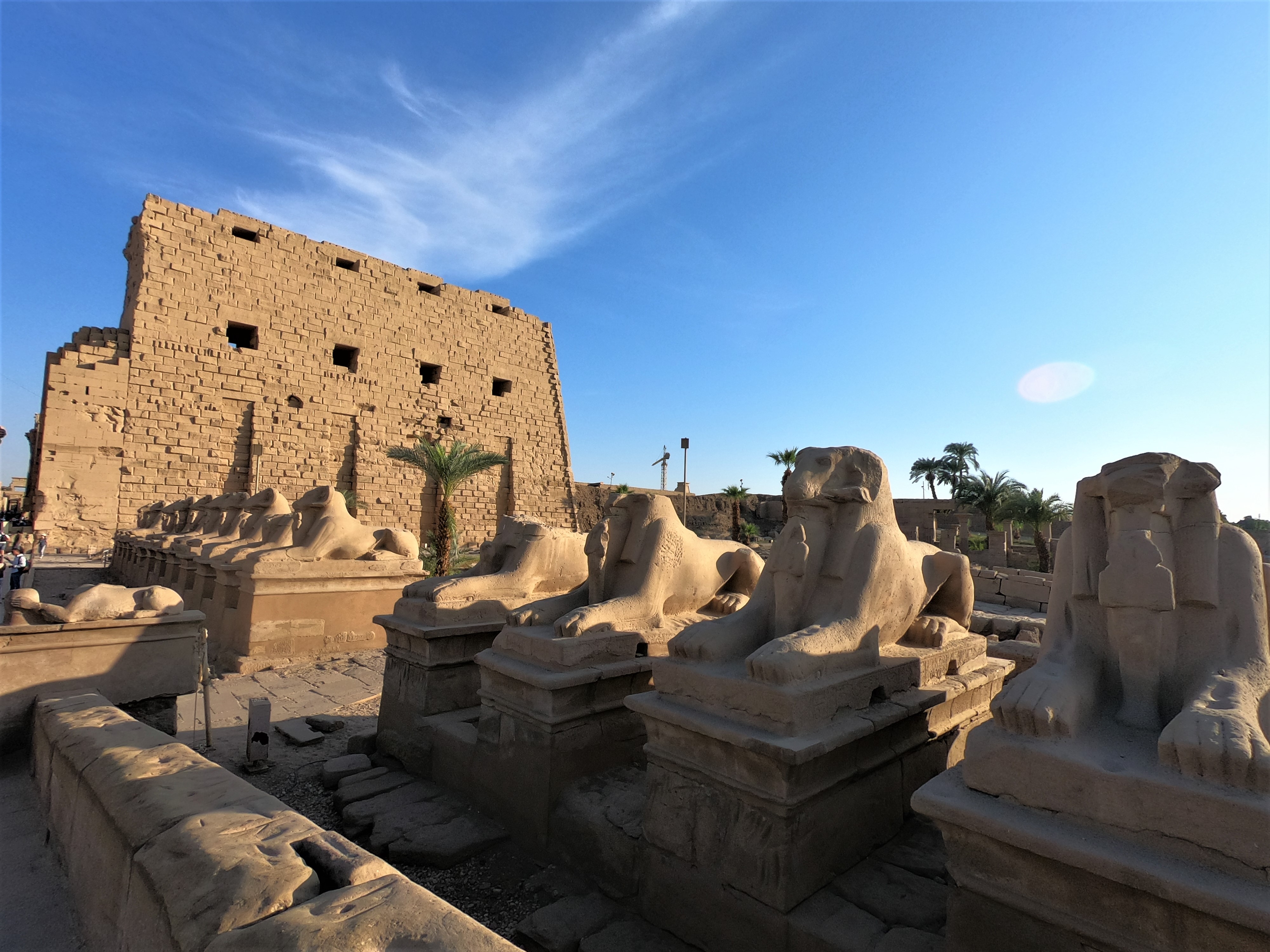
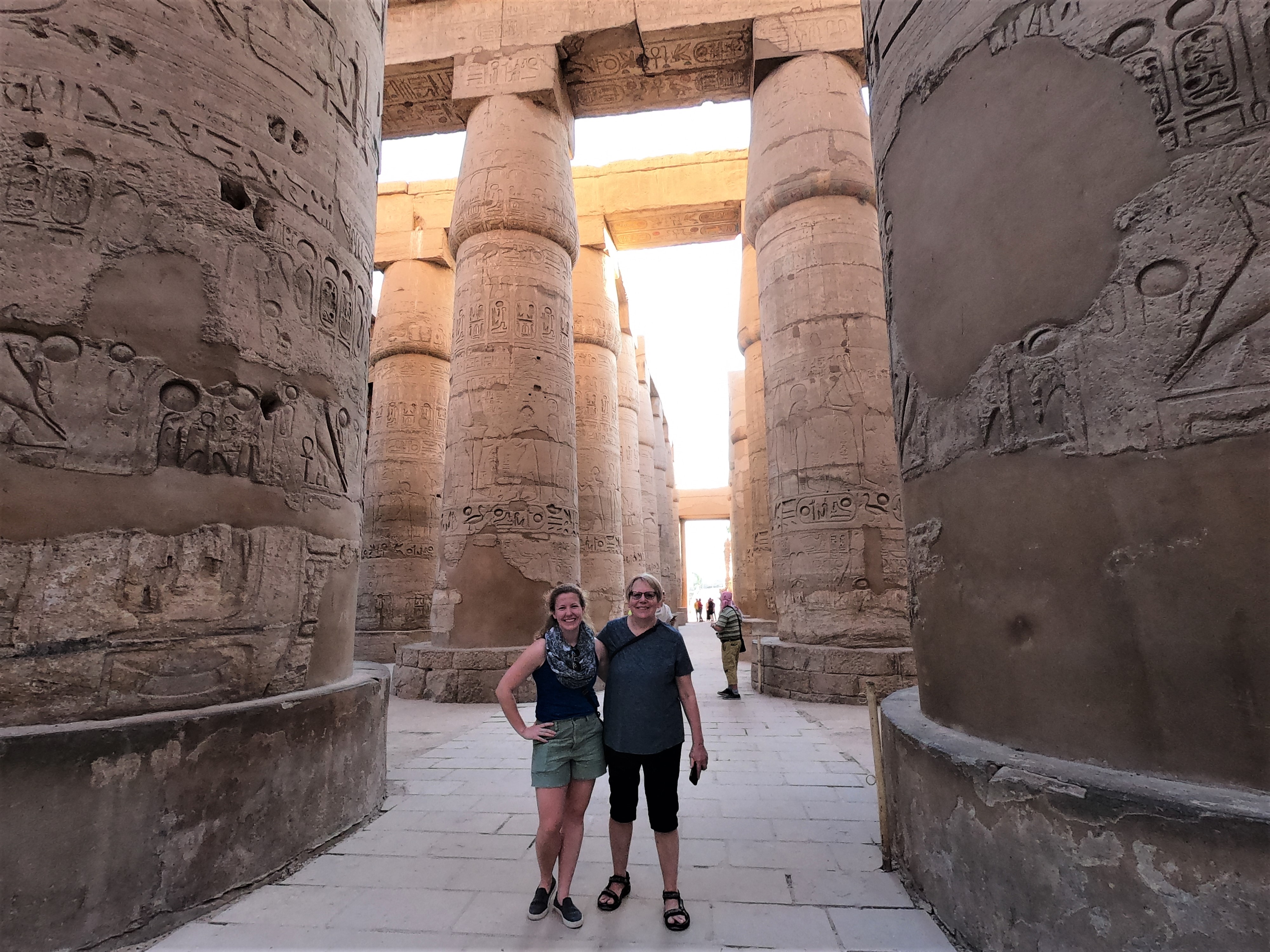
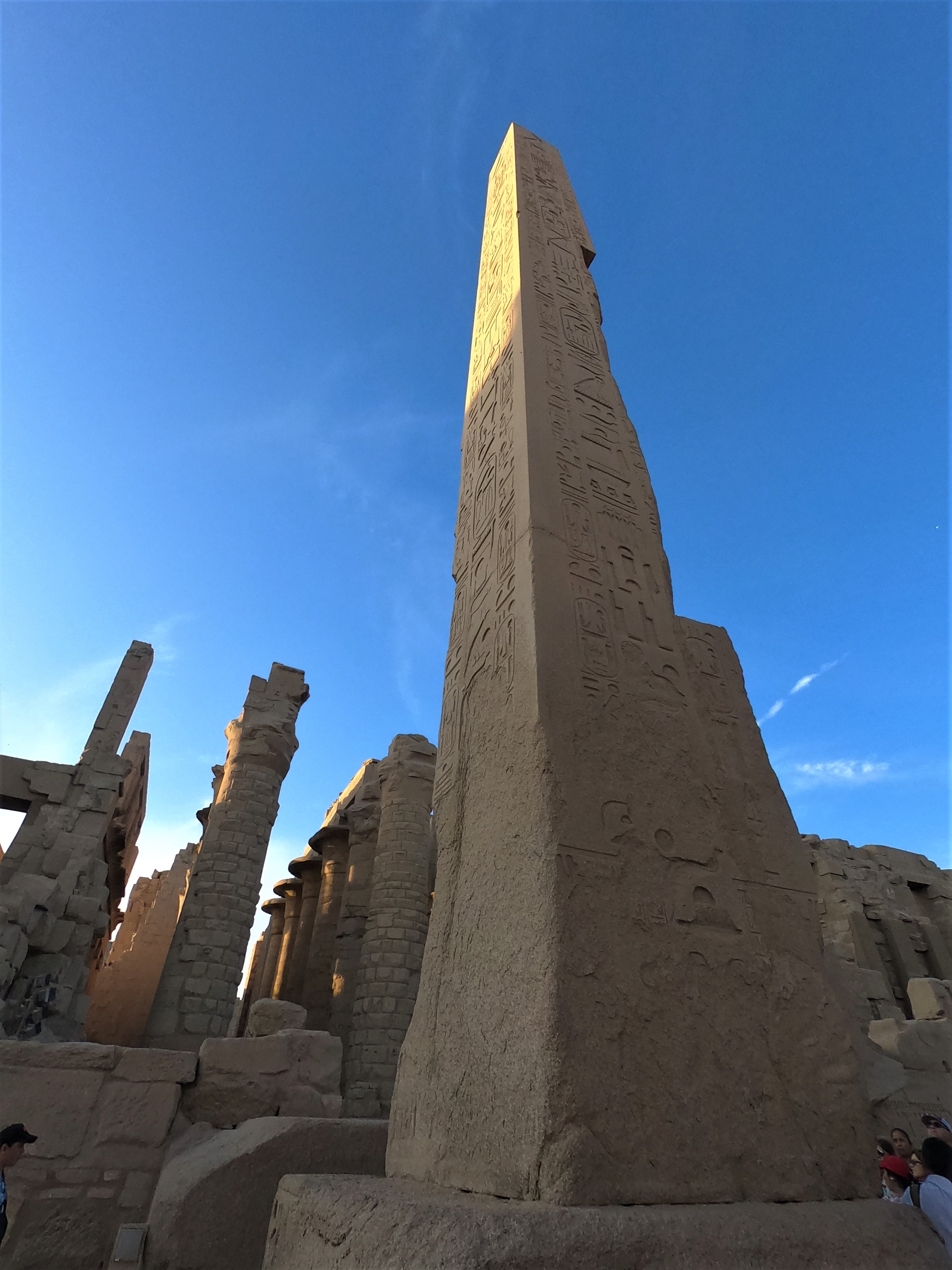
Our guide is Zidan and apparently the company didn’t send Elizabeth the updated itinerary. He patiently waited for us to change and Ryan hung back, too afraid to be away from a toilet. Our first of two stops was Karnack Temple in Luxor. This temple is built on 14 acres and was built by a bunch of different pharaohs adding onto it. It was restored and unburied in the 1800s after Nile floods had covered it up for years. We saw two large obelisks and lots of sphinxes with the body of a lion and the head of a ram. This temple has over 150 columns all the shape of a bunched papyrus plant and covered in hieroglyphics. We got to watch the sun set over the ruins before piling back into the van.
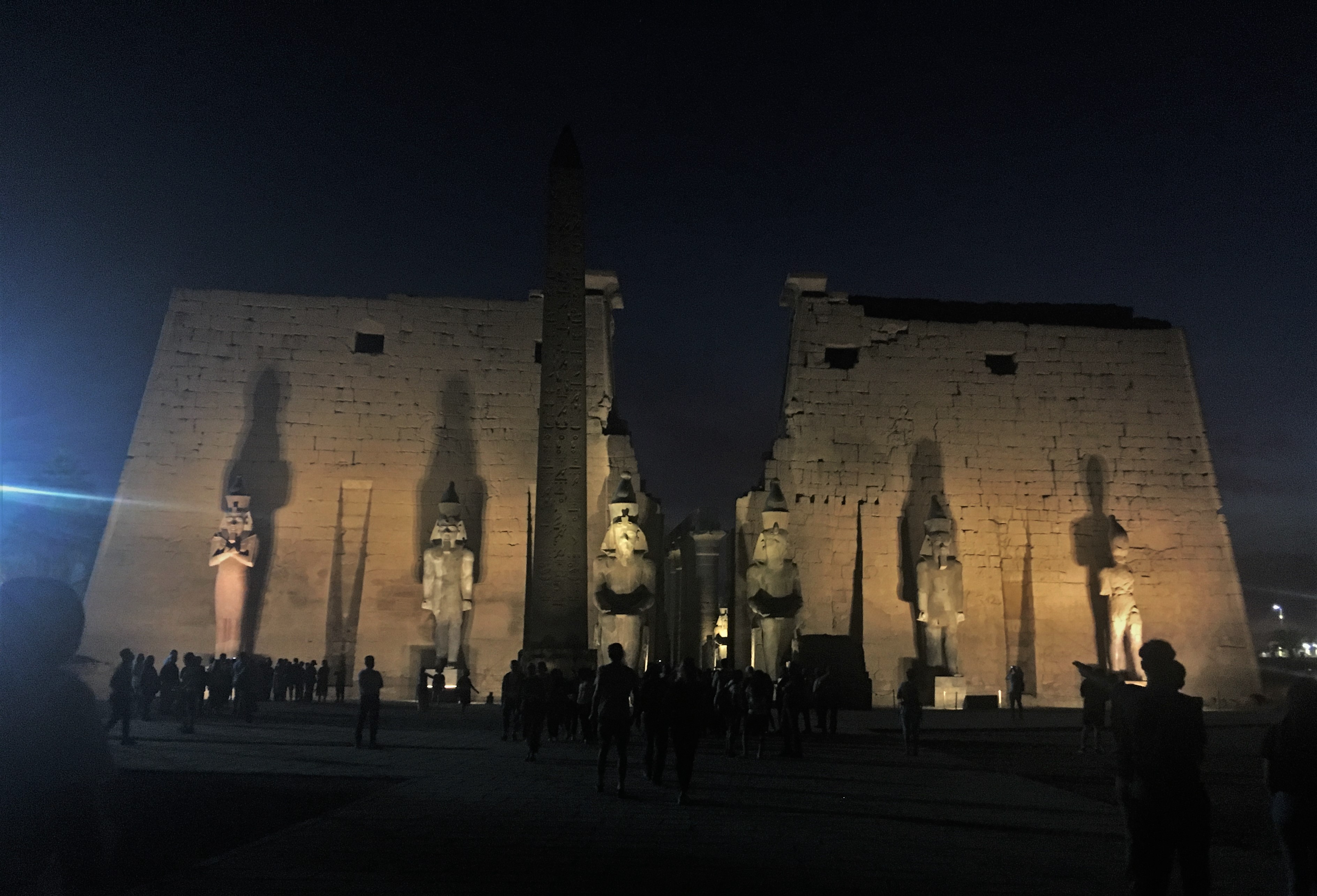
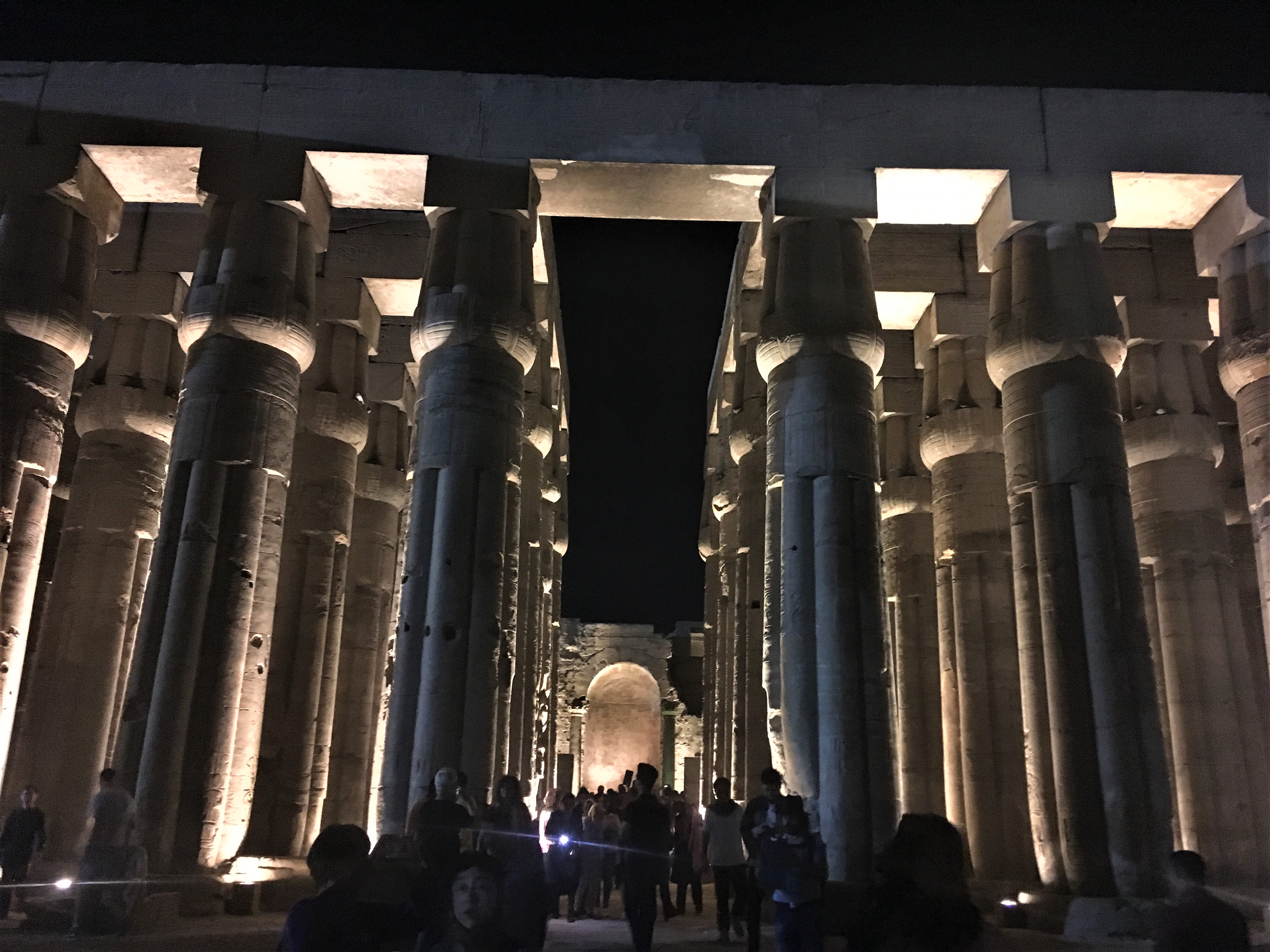
Our last stop was Luxor Temple. It was dark when we arrived so we got to see all the columns and statues lit up with large spot lights. It was amazing to get to see the temple and go inside with just spot lights, it made it feel more like old times as we walked through the different chambers just for the high priest and pharaoh. The hieroglyphics were harder to see and we always seemed to be casting our shadow over whatever he was trying to point out. Inside is a temple that was constructed and restored by Alexander the Great.
We were dropped back off at the boat and checked on Ryan. He still wasn’t feeling well so Joan and I went down and enjoyed the buffet dinner on our own. The dessert table was amazing with fancy and artistic selections including a large spoon with crème brûlée. Since the boat is so underfilled we get a lot of attention and Ryan’s absence was immediately noticed. The staff was so kind and brought plain rice, bananas, and lemon tea to his room to help him recover.
Day 5 – Luxor to Edfu – November 22
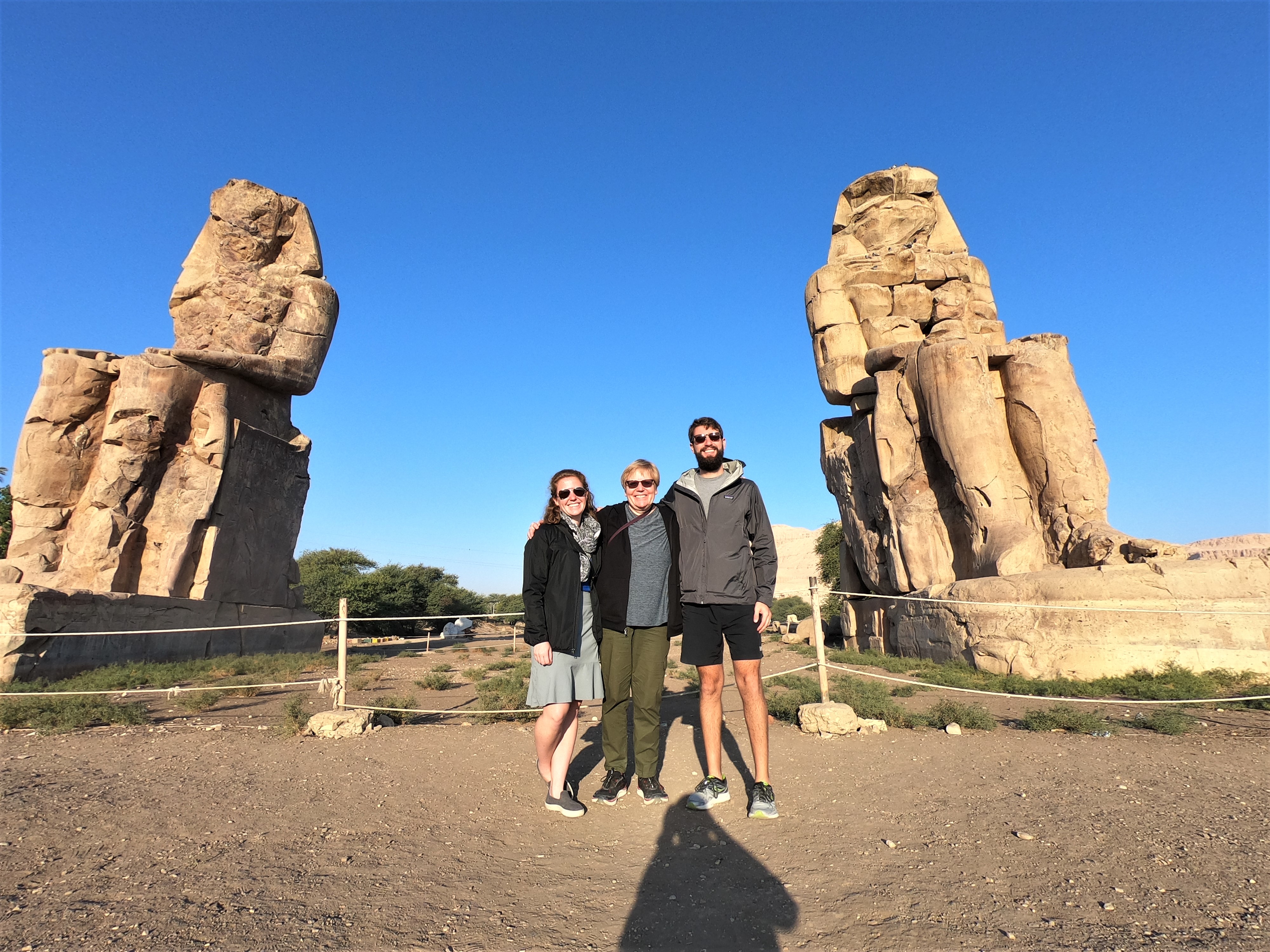
Much to Ryan’s dismay, we began our touring bright and early the next morning. We ate breakfast at 6, another buffet, and he was thankfully feeling much better. Zidan picked us up around 6:45 and we were off to the West Bank of the Nile. Our first stop was the Colossei Memnon. Here two tall statues of Pharaoh Amenhotep III mark the entrance to the Temple of Hatshepsut where we were headed next. These statues have stood by themselves for some time, but now the University of Chicago has sent researchers over to uncover additional artifacts behind the two large statues. Millenia of Nile floods have covered this area in layers of sediment, so the archeologists were hard at work digging up piles and piles of artifacts for restoration. The statutes themselves are so old you can see graffiti from ancient Greece. All the while, we were surrounded by hot air balloons, as people soared over the breadth of Luxor Valley.
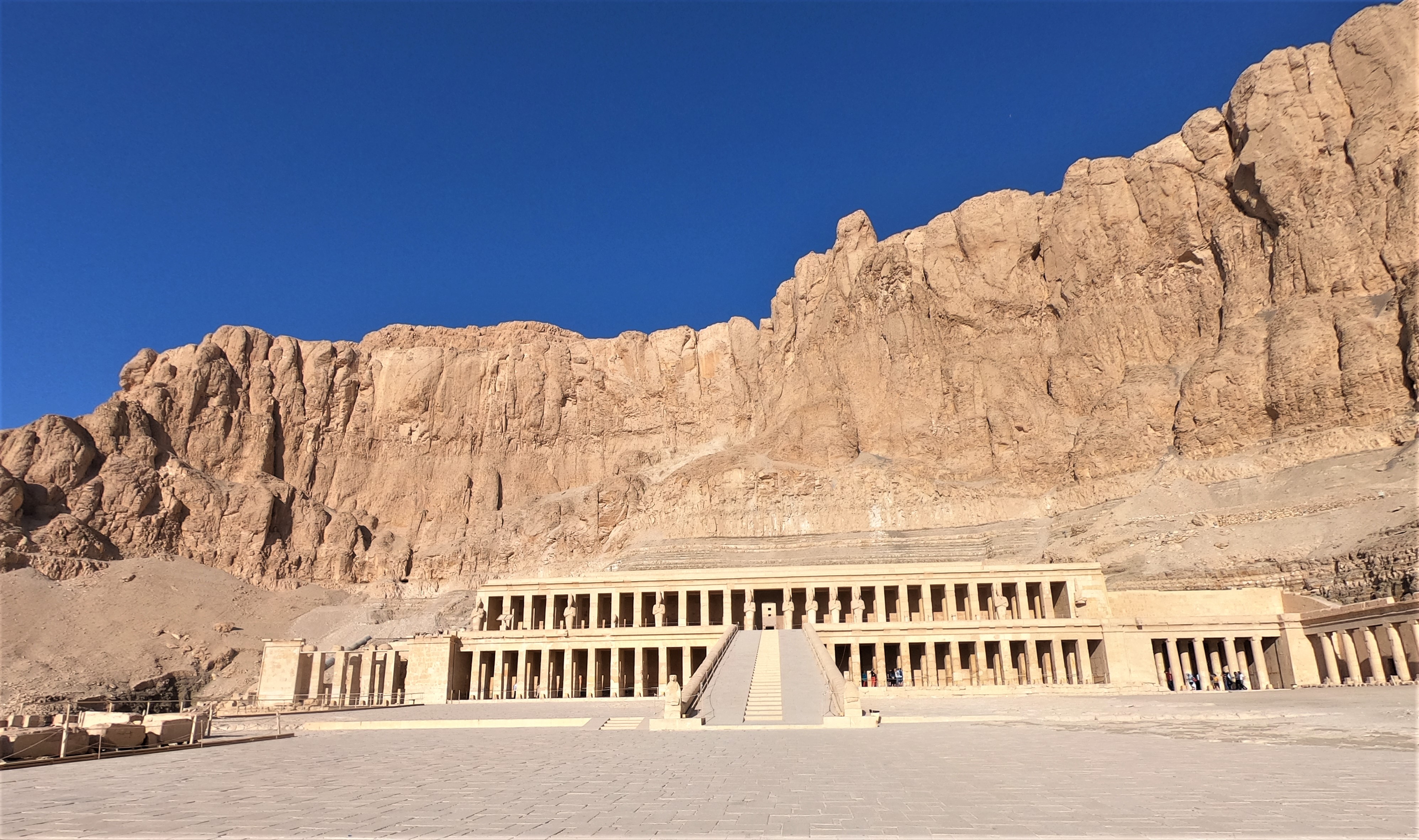
We piled back in the car for the short drive to the Temple of Hatshepsut. Just like in Cairo, our wise guide was smart enough to get us there early before the crowds arrived. It wasn’t even 8:30 yet, but the sun was already baking the bluff sands of the desert, and us with them. We walked through the security metal detectors and got our bags screened, they apparently do this in all hotels and sightseeing spots, then boarded a tram towards the temple. Ryan noticed from the labels and warnings on its cab that the tram was from an old chemical facility back in the US, how it got to Egypt we aren’t sure.
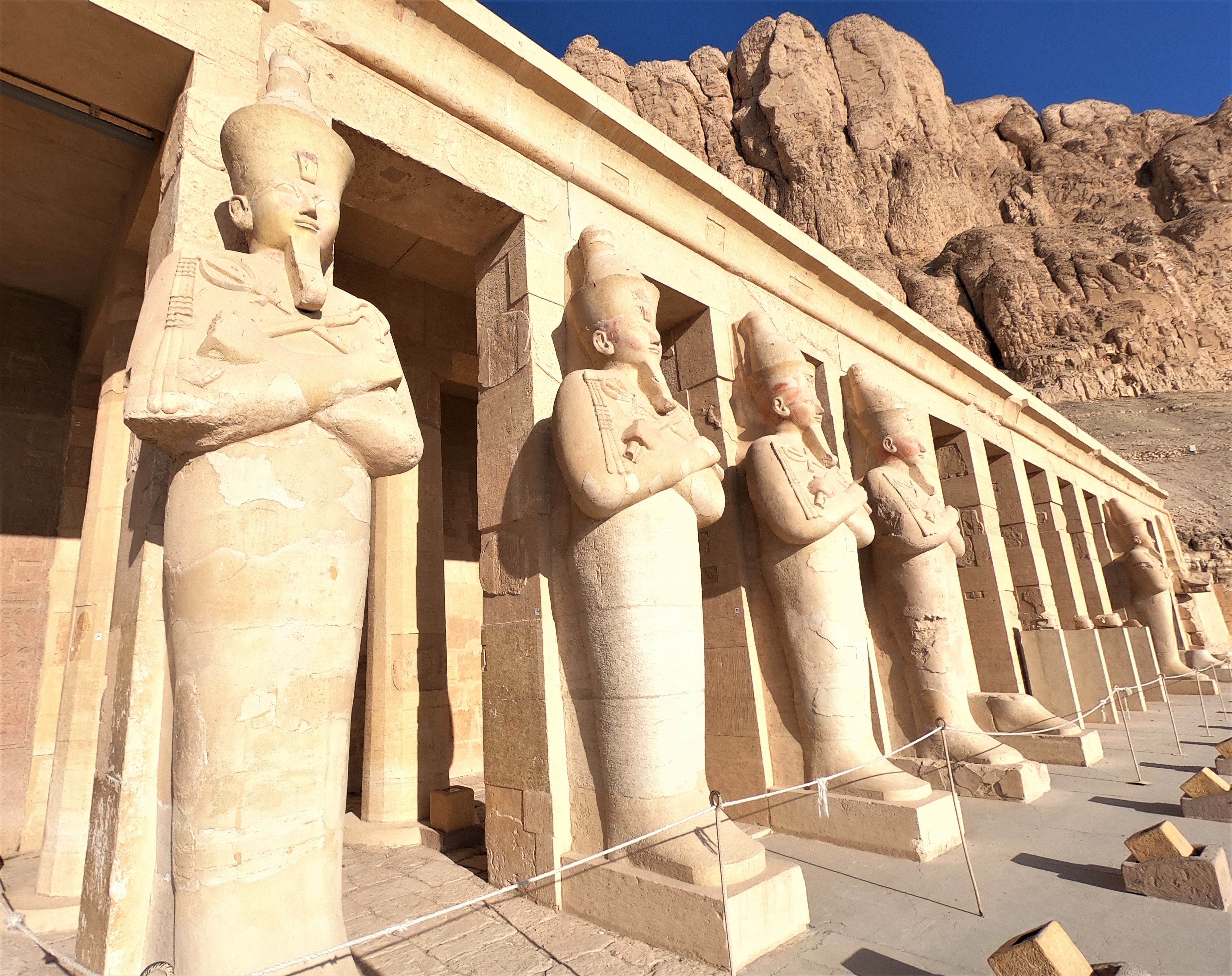
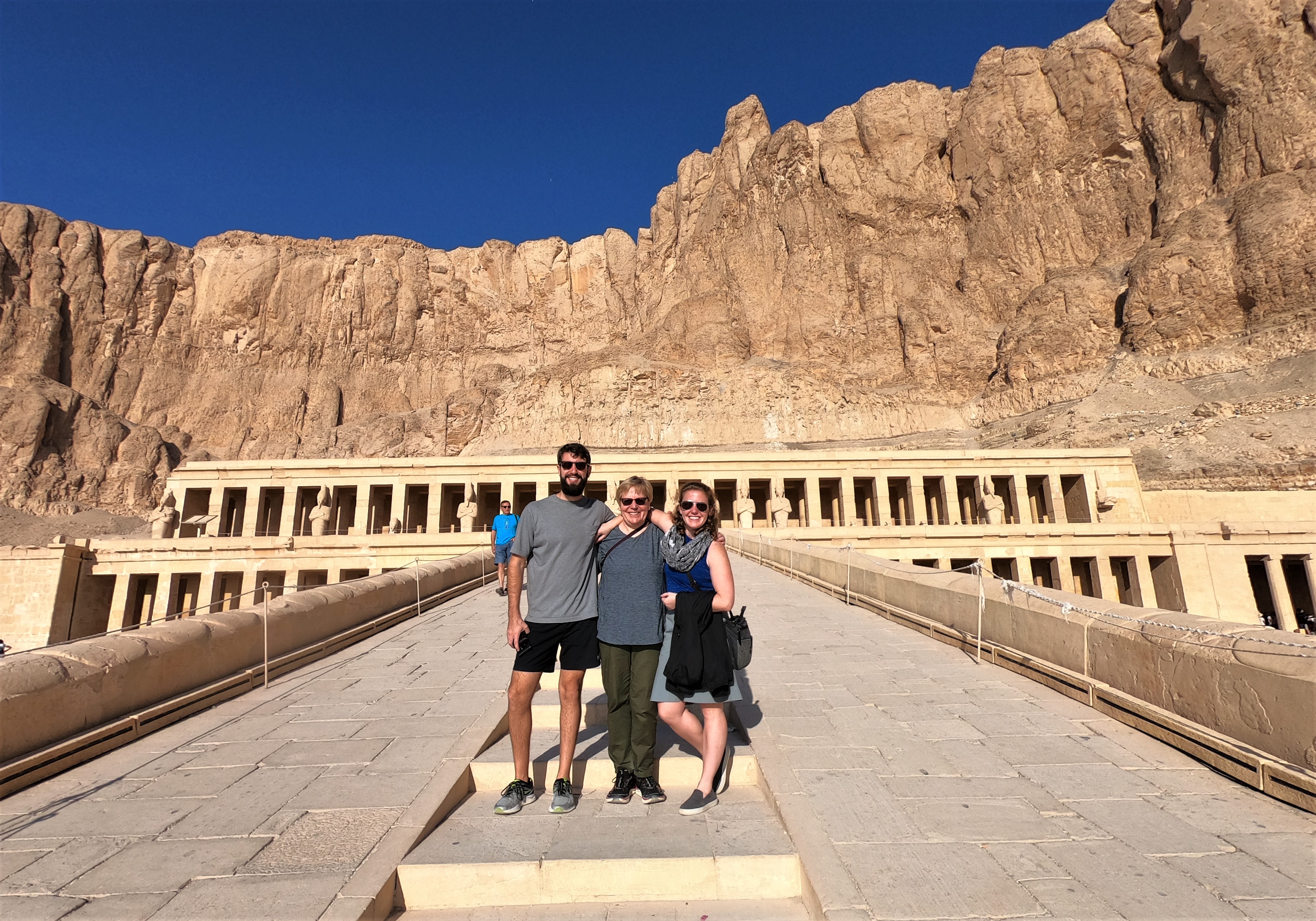
We rode the trams to the front of the temple and walked up the giant staircase. This temple is dedicated to the second known female pharaoh, regarded as the most successful female pharaoh, Hatshepsut. She was married to Tutmoses II and ruled beginning in 1478 BC. She and her son Tutmoses III officially ruled together, though he was a young child when named pharaoh. We got to see a lot of restoration work and saw the progress of uncovering the palace from the surrounding collapsed mountains.
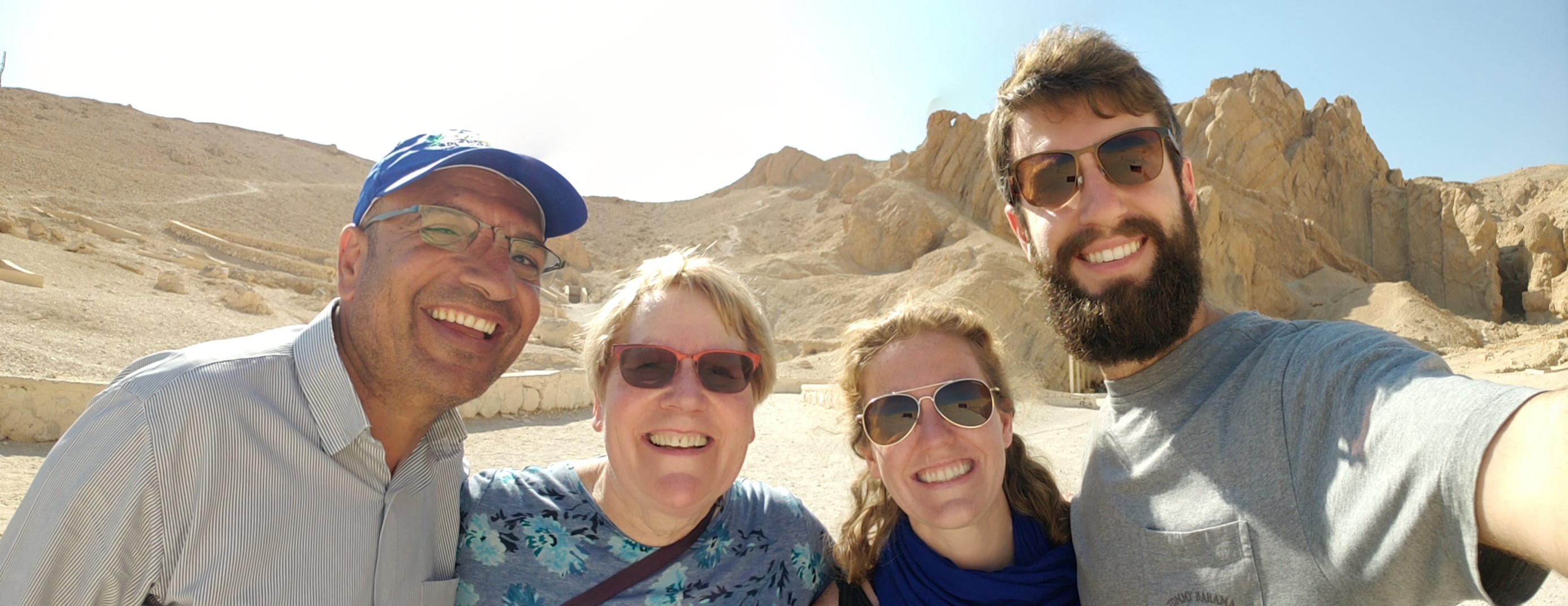
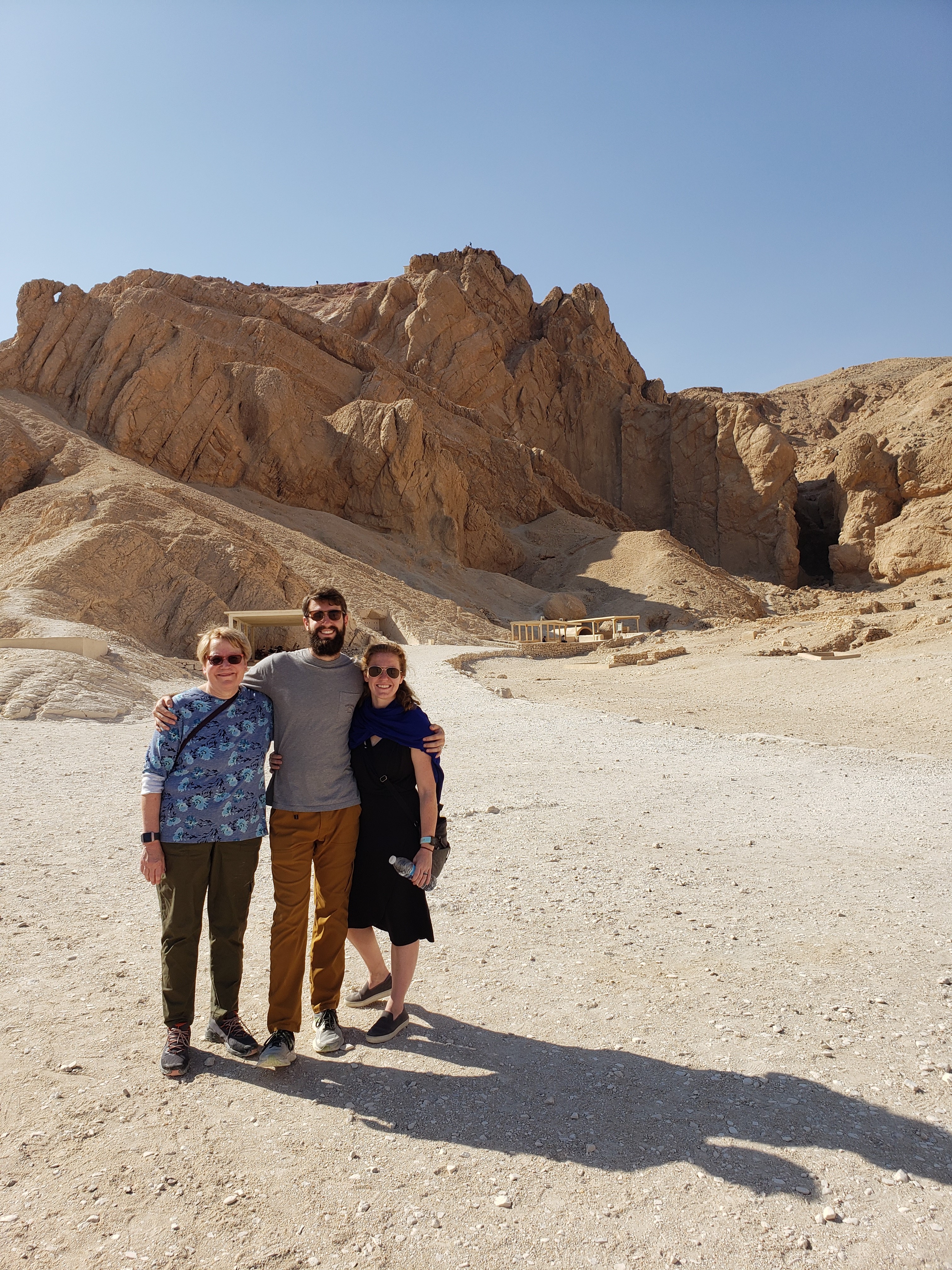
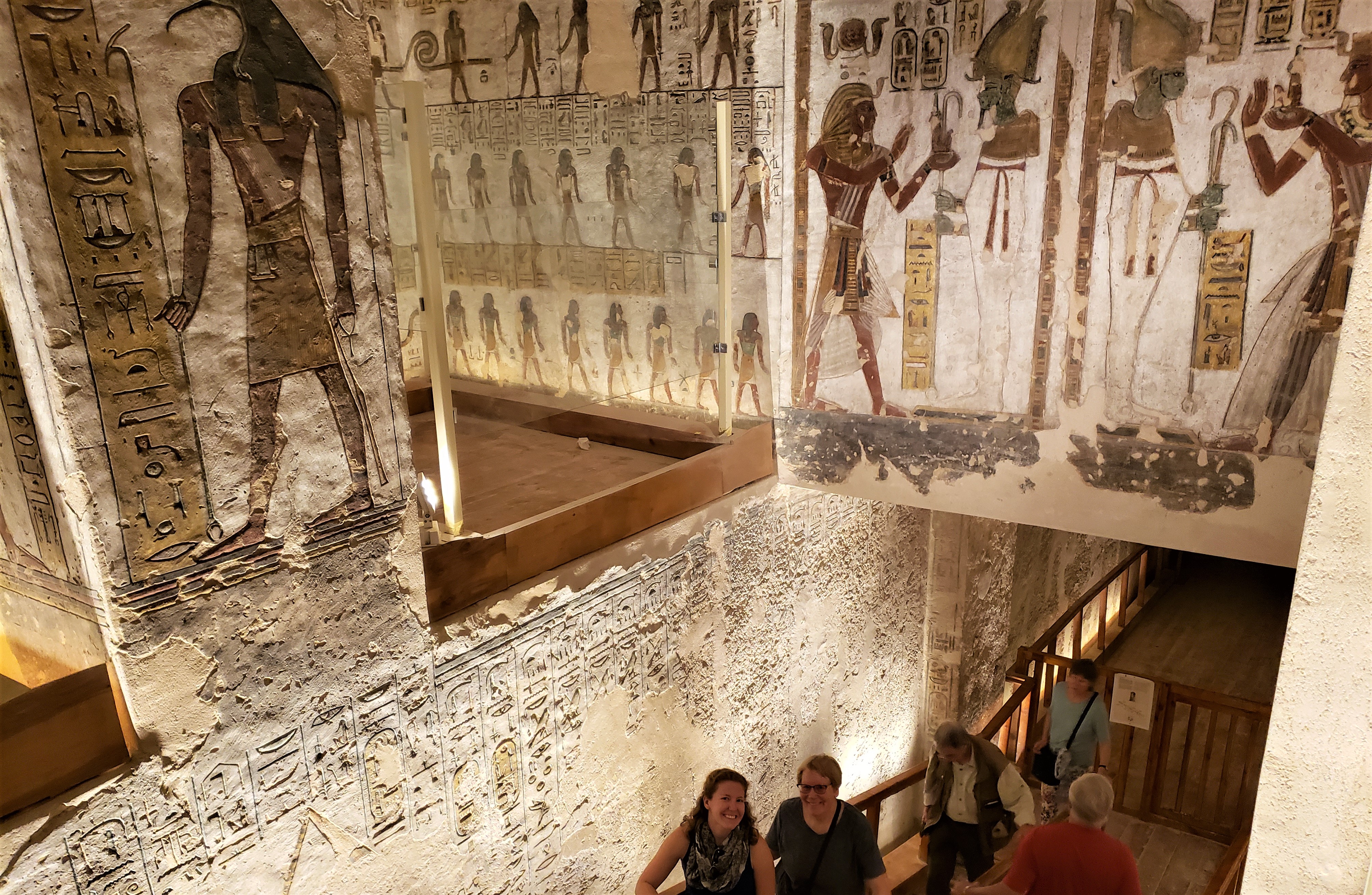
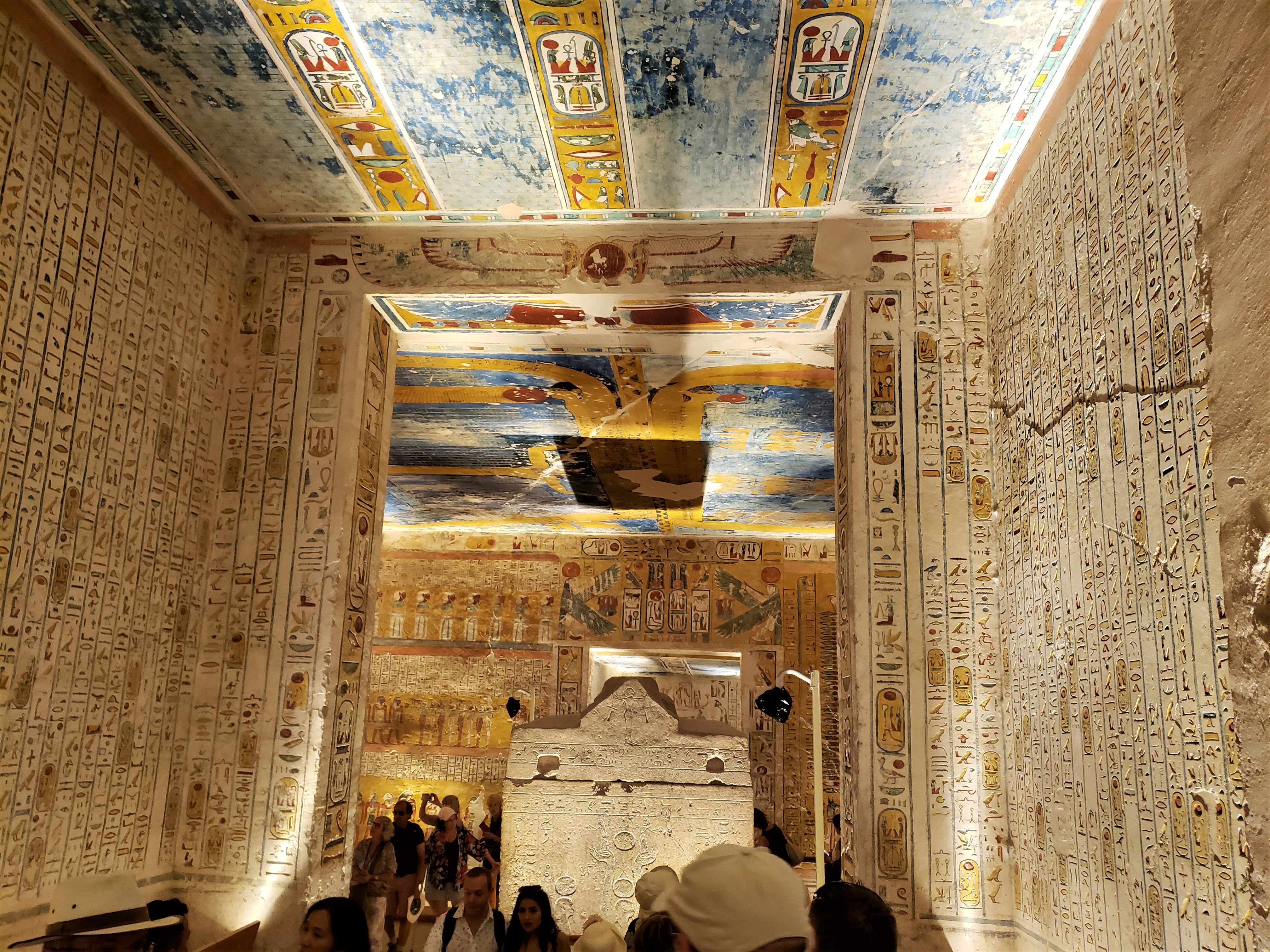
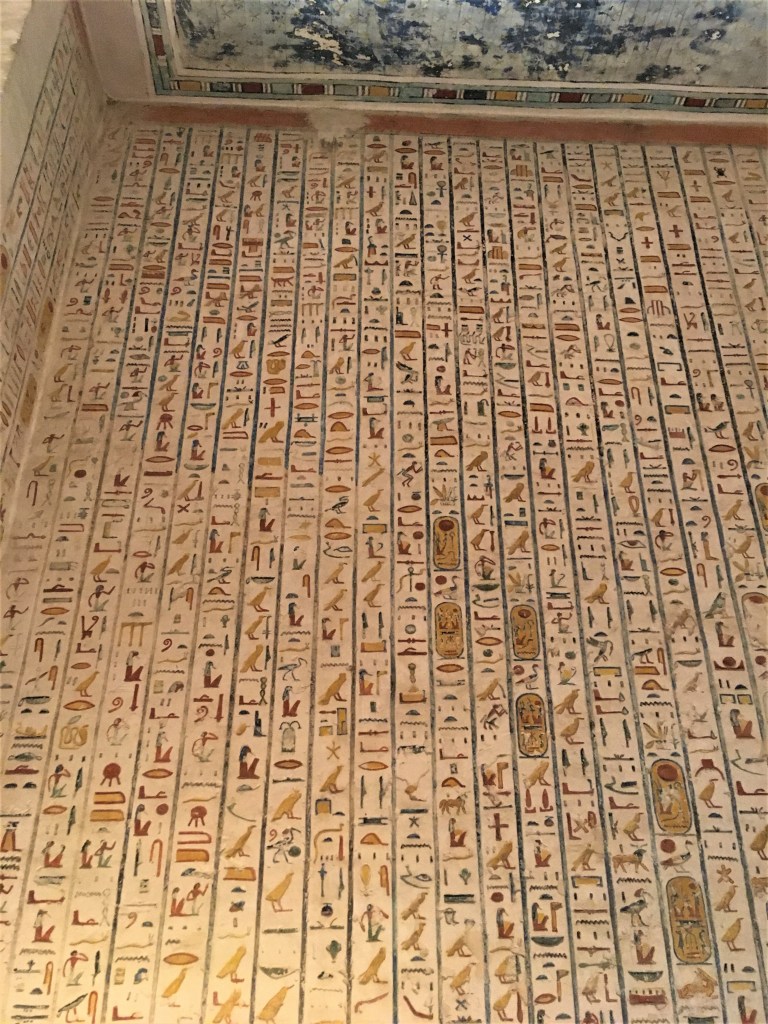
We filed back on the tram and to the bus for our third and final site of the day, the Valley of the Kings. At this point we’d seen a lot of tombs: the artisans, the nobles, and the queens. The Valley of the Kings was quite crowded and, as you’d expect, much larger. We again saw three tombs; Merenptah, Ramses III and Ramses IV. Ancient Egyptians viewed the mountain as a natural pyramid shape and dug their burial tombs in its shadow deep under the ground. They had learned from their forefathers, those that built the pyramids. If you put all your worldly possessions in a giant tomb and for thousands to see, grave robbers are gonna show up eventually. And they won’t need a map. Some of them had several champers of hieroglyphics to walk through before you even reached the chambers. We walked down a lot of “stairs” and saw amazing colors and paintings before finding the final resting places of the kings. All have been removed except for King Tut’s mummy, the rest are in the Egyptian Museum in Cairo. This valley is known to contain 63 tombs ranging over 500 years from 16th to 11th century B.C.
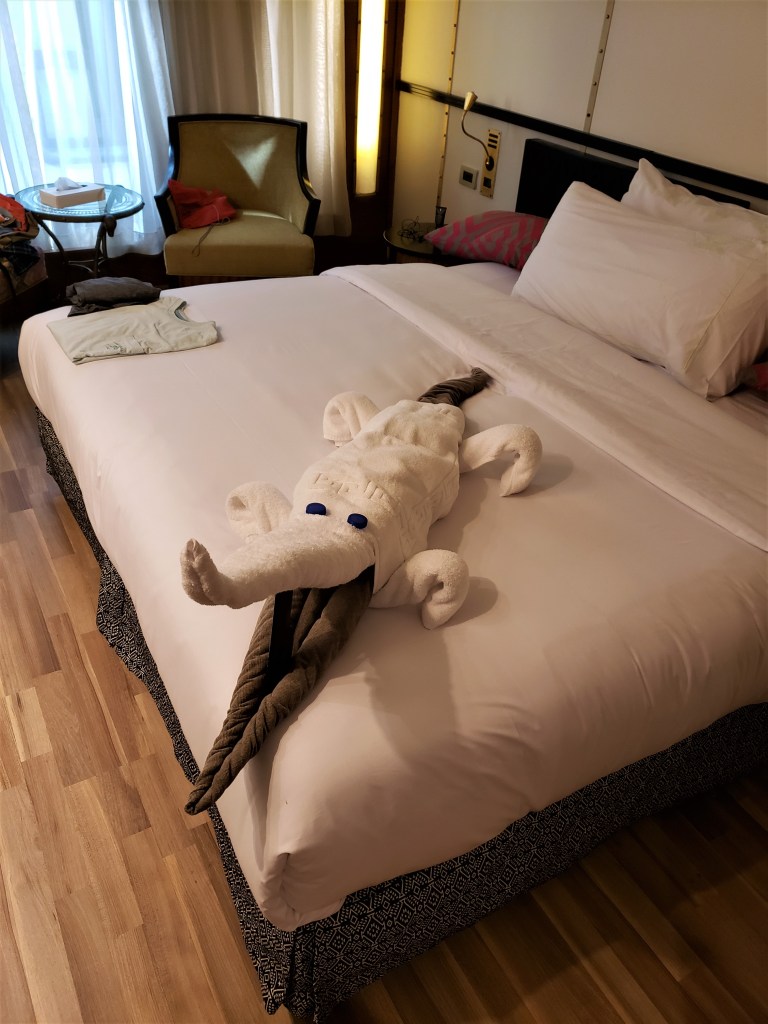
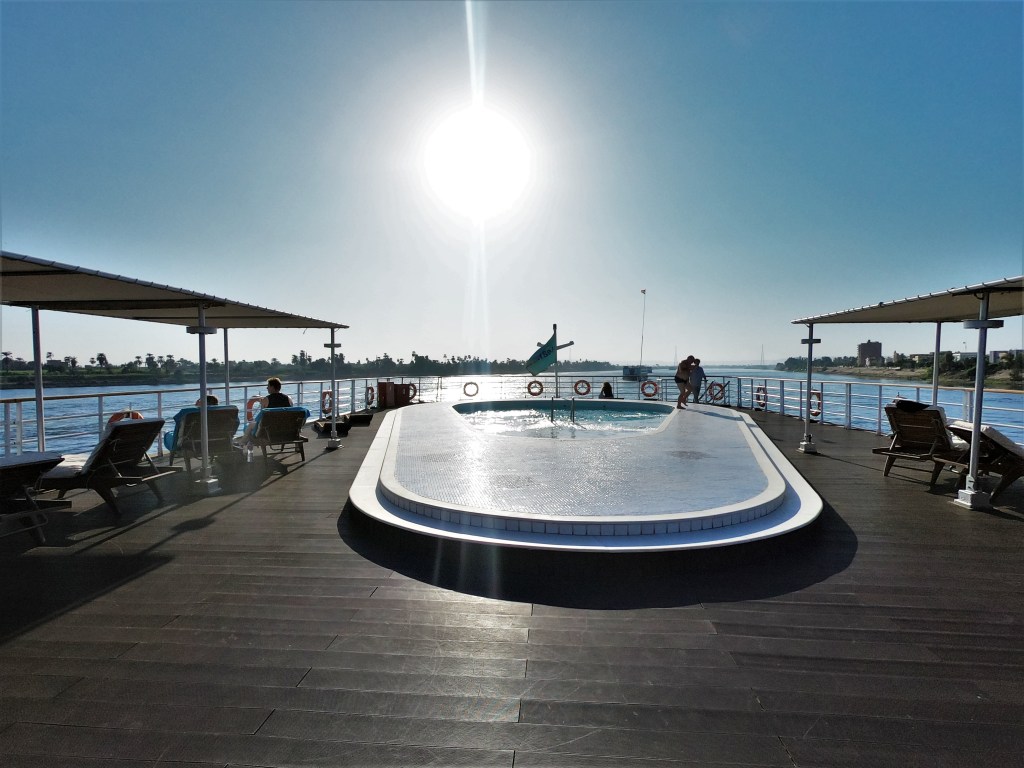
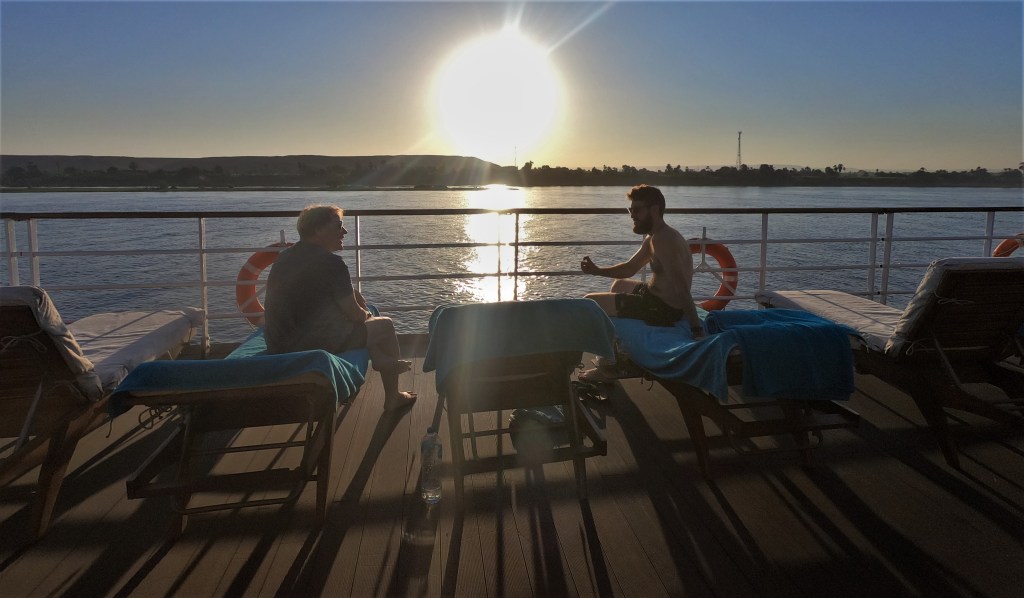
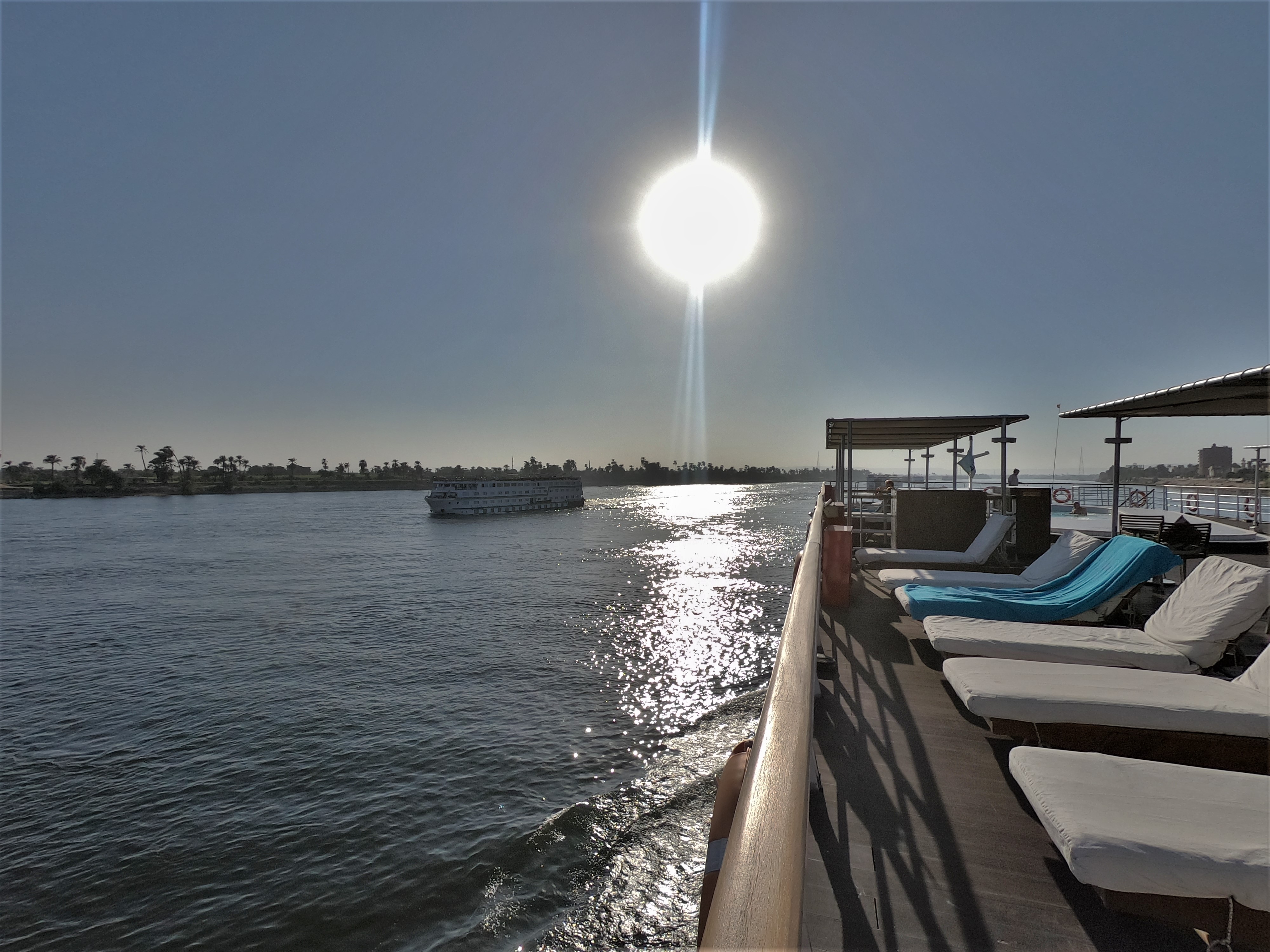
We had to return to the boat before 1 pm because the boat was setting to sail up the Nile towards Aswan. We arrived and enjoyed our buffet lunch before spending the afternoon on the sundeck as we cruised up the Nile. There was a lot of traffic on the water and we were surprised to find that boats honk at each other as much as cars do when passing. Our boat had lots of lounge chairs and day beds so we read and enjoyed the passing banks. We saw a number of little boats fishing with some even attaching themselves to our boat and trying to shout to the deck to peddle the different scarves and dresses they had. We tried to enjoy the small on deck pool, but again the water was pretty frigid. It’s tricky, because a cool breeze or simply lying in the shade is enough to be comfortable, but the air is not so warm that you need to take a dip to refresh yourself. Whenever we go back to our room the staff has a little towel animal waiting, this crocodile’s mouth was propped open with our clicker.
We enjoyed the sunset around 5:30 eating small finger food and guava juice. The temperature drops when the sun sets so we snuck back to our cabins to lay in bed until dinner. Around 7 we headed to the lobby bar for a free drink, sparkling wine with apples in it and to socialize with our guide Zidan, who was stuck to us like glue. Finally, we made our way down to dinner where a surprise awaited Joan. Today was her 65th birthday and the staff made her a cake and sang happy birthday in English then in Arabic, all accompanied by drums. She danced around and was a good sport being the center of attention. The day before Elizabeth had asked the boat staff if they did anything for birthdays/special events, and she was informed that everything was taken care of. Since they had her passport, and knew her birthday, they took some initiative. The boat staff as been incredible and we were happy to have so few guests with us.
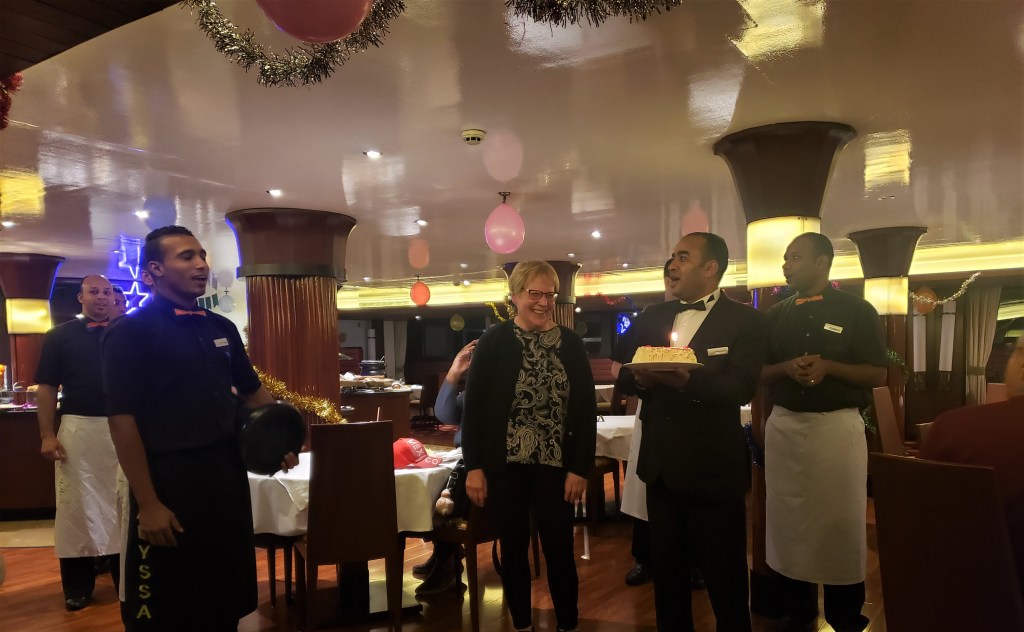
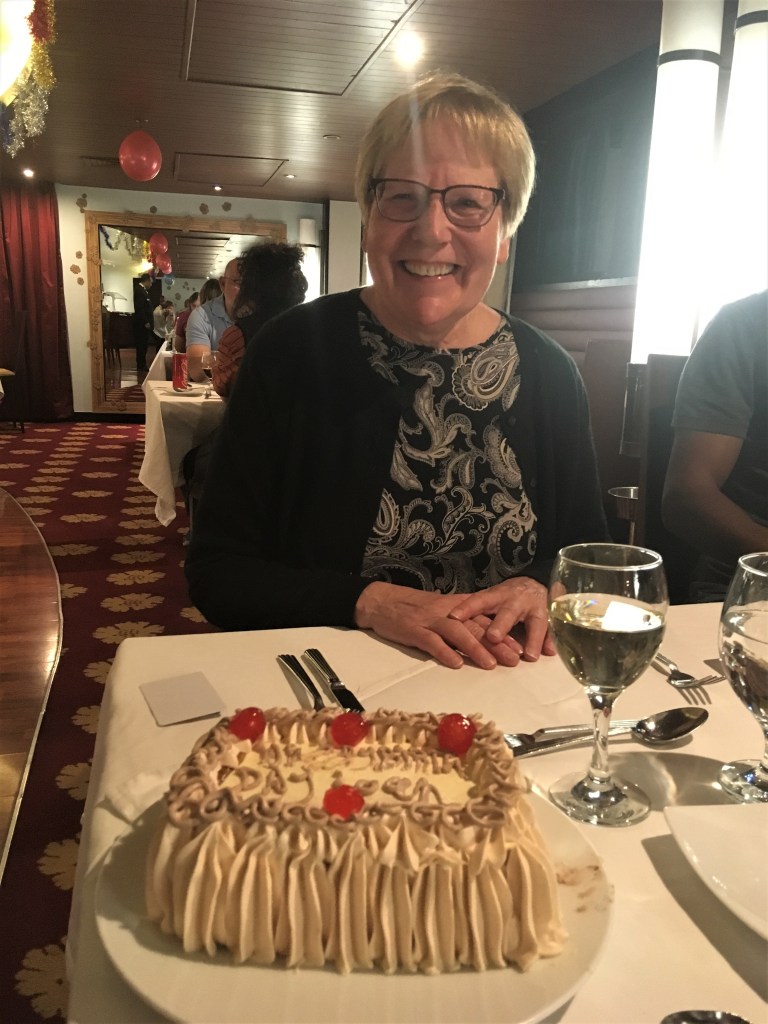
After dinner we went back to the bar to enjoy a few more birthday drinks before calling it a night. When we returned to our rooms, right across the hall from each other, we found the staff had stolen our towels to make Joan a birthday cake of towels on her bed and added balloons everywhere. We think she had a pretty memorable 65th.
Day 6 – Edfu to Aswan – November 23
We woke up to the ship sailing towards Edfu. We’d docked previously upriver and were finishing our transportation this morning. The ships sail pretty much all the time, they just stop for a few hours right outside the temple to let their guest visit then continue cruising. After breakfast we lounged watching the Nile pass. The cruise ships tie up to each other making a long line from shore out into the river. Sometimes you walk through the lobby of 3 to 4 other ships just to make it to the bank.
We loaded into horse and carriages that were waiting to take us to Edfu Temple. We’ve noticed that Egypt has a serious trash issue and the streets are very dirty. The city of Edfu was no different. When we arrived, the temple wasn’t too crowded so we went through the security and found ourselves facing giant carvings of the god Horus. Edfu was constructed in 237-57 B.C. and the hieroglyphics and carvings were some of the best we’d seen. They now appeared with significant relief whereby instead of just being carved into the wall, the wall is carved around the picture.
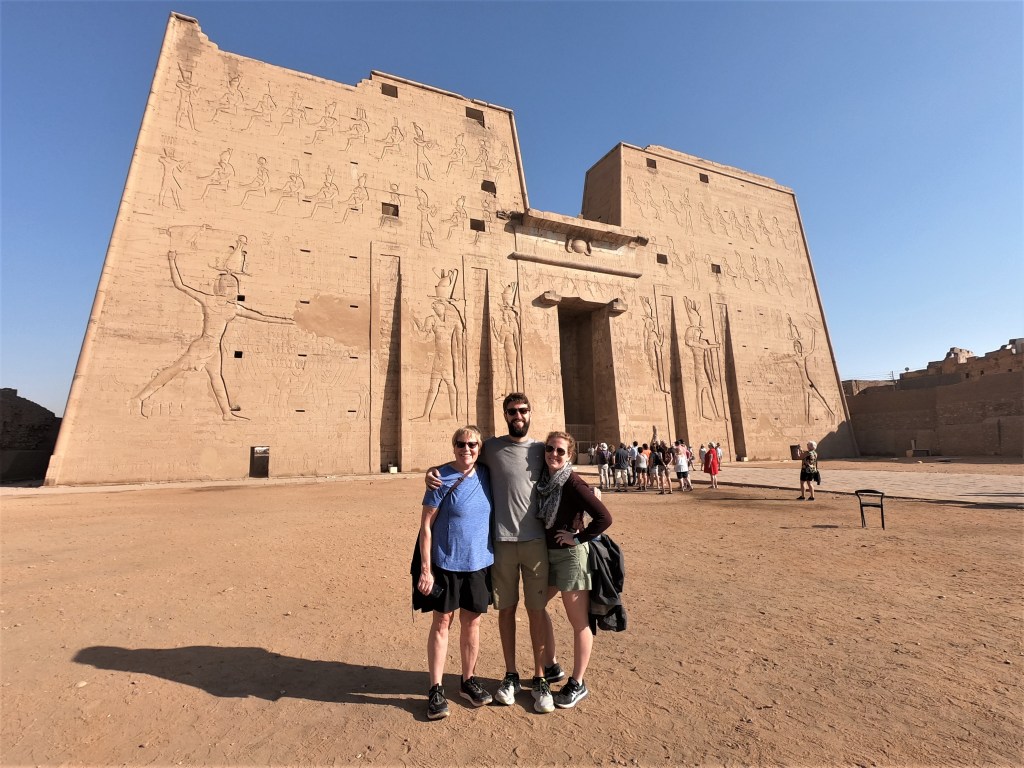
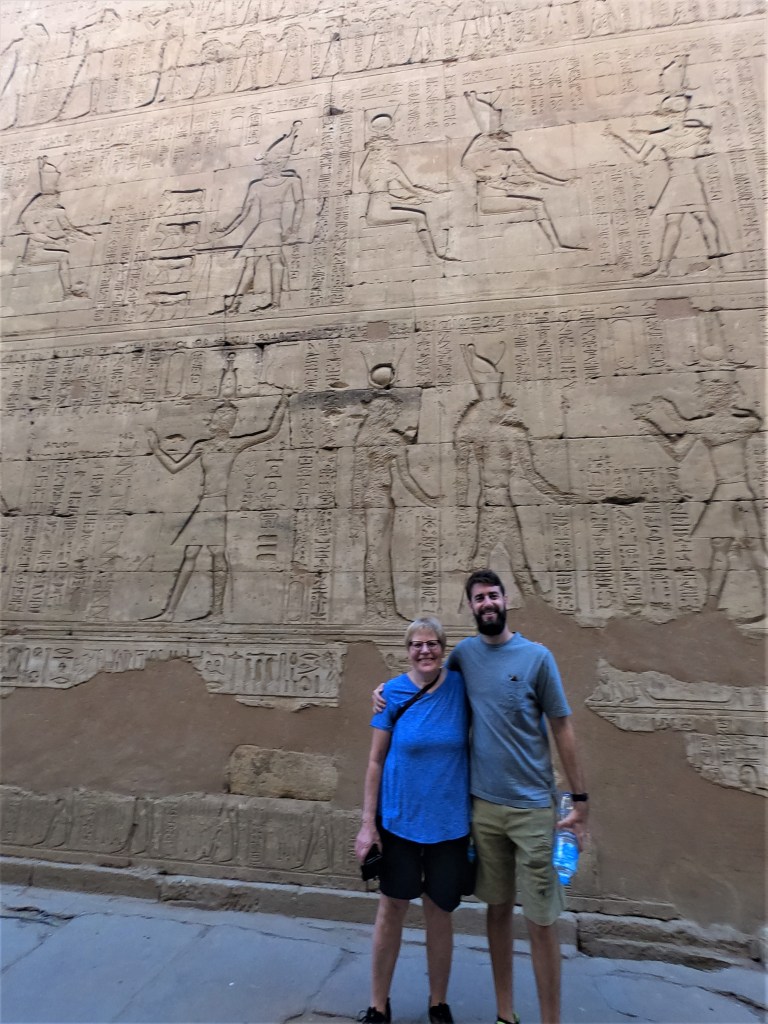
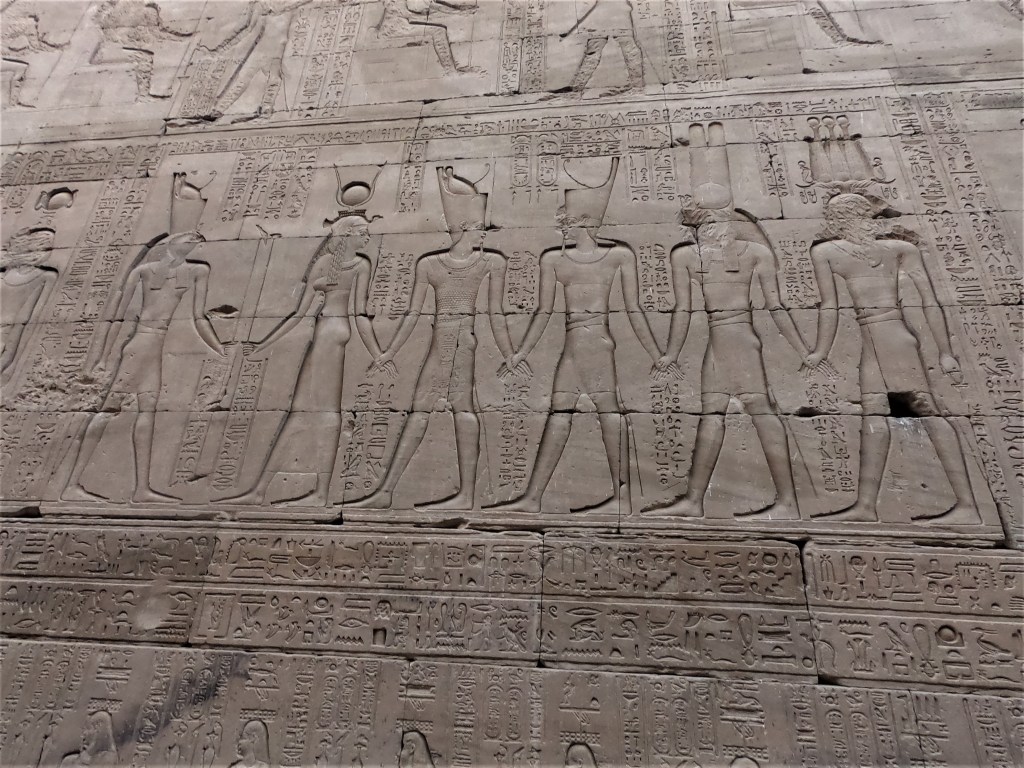
This is one of the best-preserved temples in all of Egypt. We saw a lot of graffiti from early Christians and Greeks. Per usual this temple was built on older temples and grounds, and was so buried when it was found in the late 1700’s it took years to restore.
We rode our horses back to the boat then set sail towards Temple Kom Ombo, our afternoon temple visit. During this time Elizabeth began to feel a little under the weather but we were still able to lounge and enjoy our favorite sun deck. After lunch we disembarked again for the Crocodile Temple.
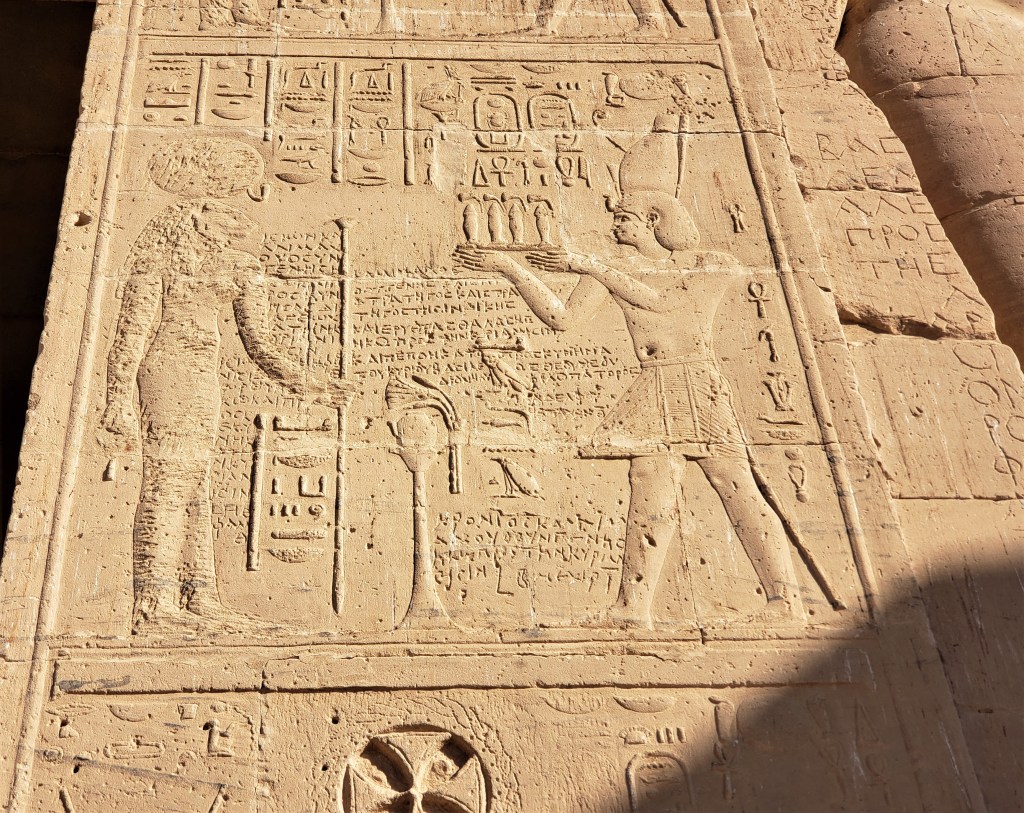
Kom Ombo was constructed from 180-47 B.C. and was very similar in design and detail to Edfu. There are two gods honored at this temple: Horus and Sobek. Horus is the falcon-headed god of power and strength and Sobek is the crocodile-headed god of luck. The temple was actually built during Roman times, like Edfu, and you can tell by looking at the tops of the columns that represent different flowers along the Nile with intricate detail.
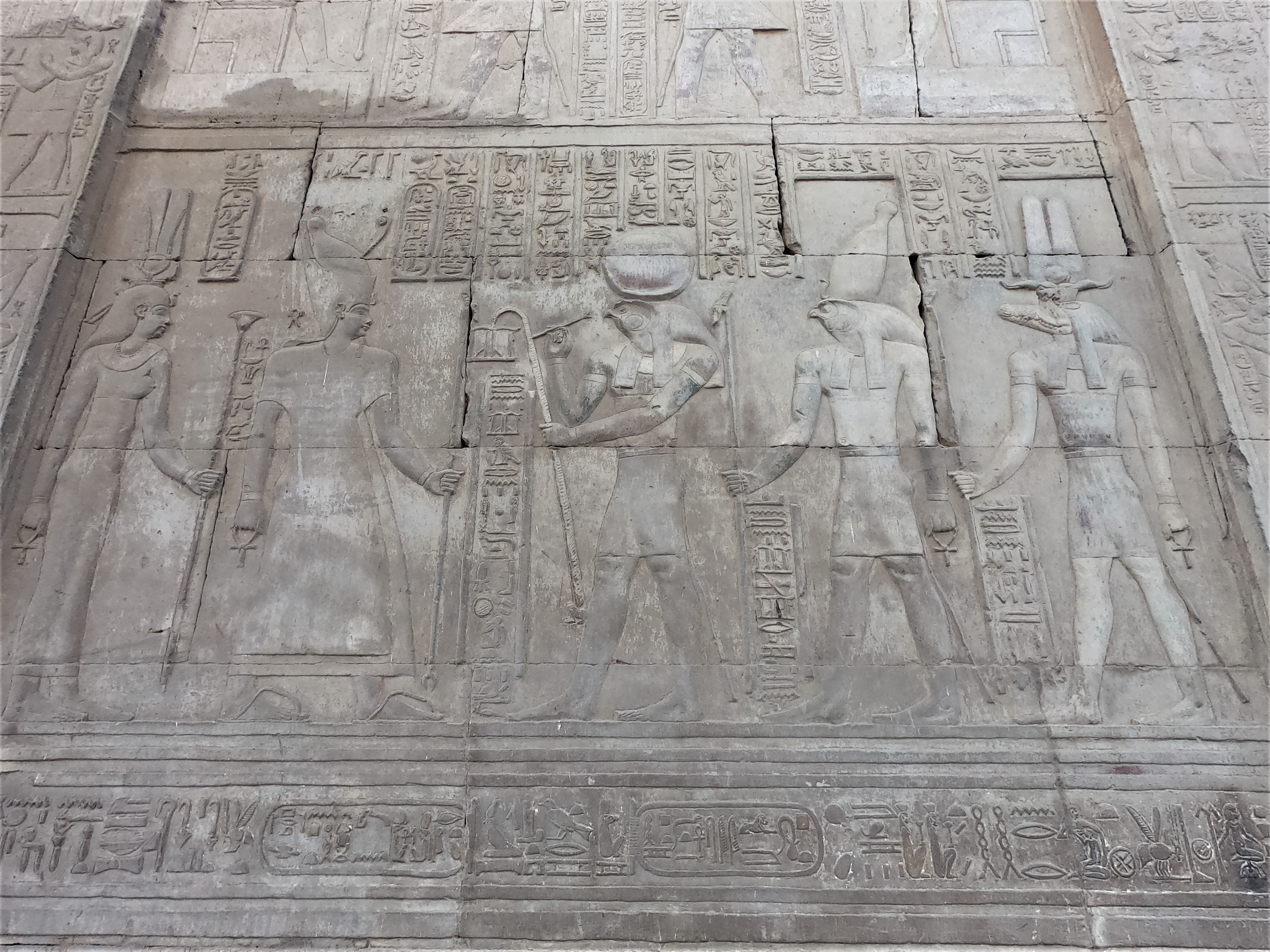
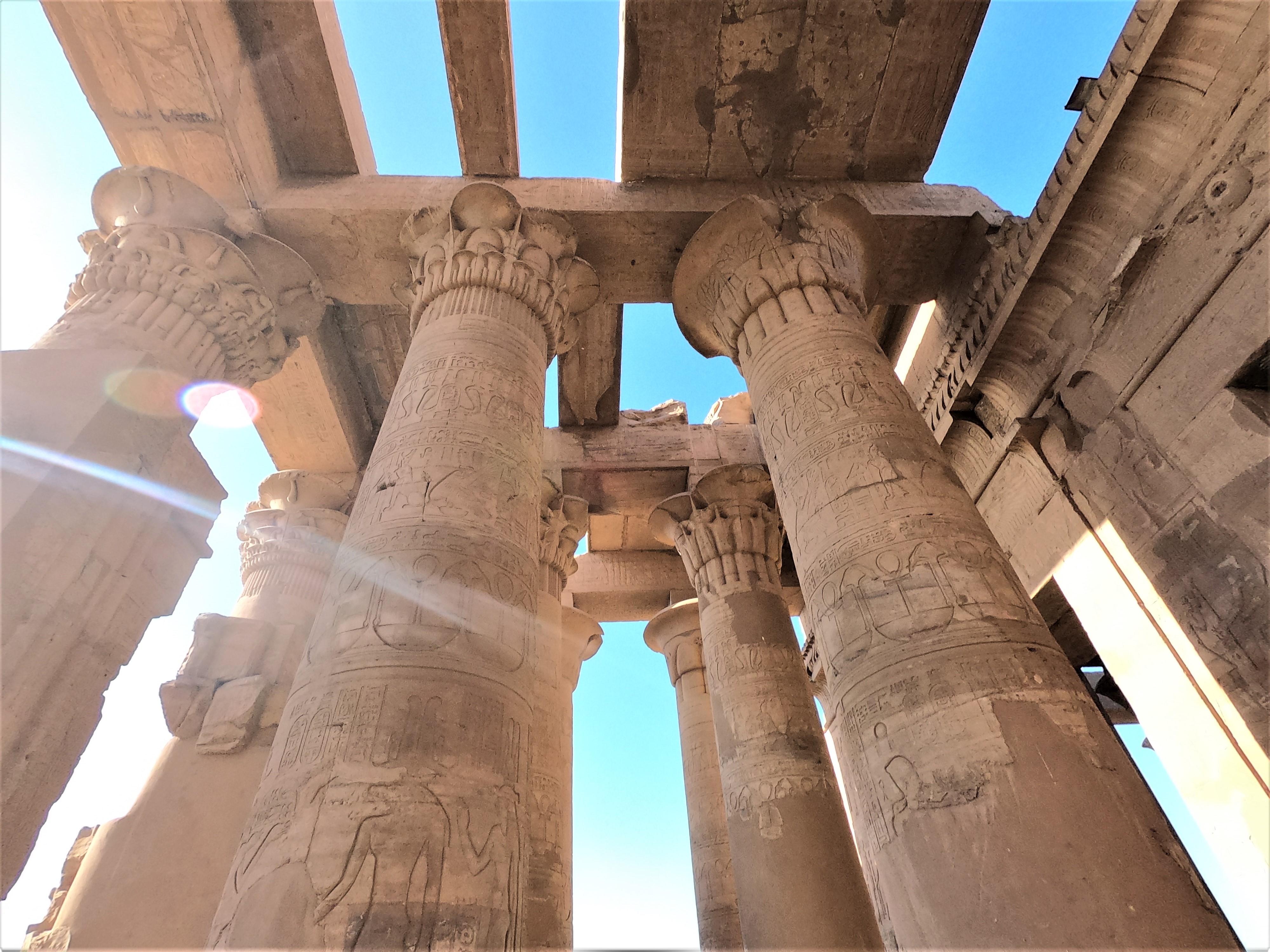
Next door to the temple is a crocodile museum that displays some of the crocodile mummies found at the site. Three hundred mummified crocodiles were found here. We could also see archaeologists working off to the edge of the temple. They were digging and dusting and had large piles of artifacts they were cataloging. After stretching our legs in the hot sun Elizabeth’s condition was worsening as we headed back to the boat. That evening Elizabeth spent praying to the porcelain goddess while the others had a nice dinner and more time relaxing on the sundeck. Again, the boat staff were concerned and very accommodating, providing tea and rice to settle her poor tummy.
Day 7 – Aswan – November 24
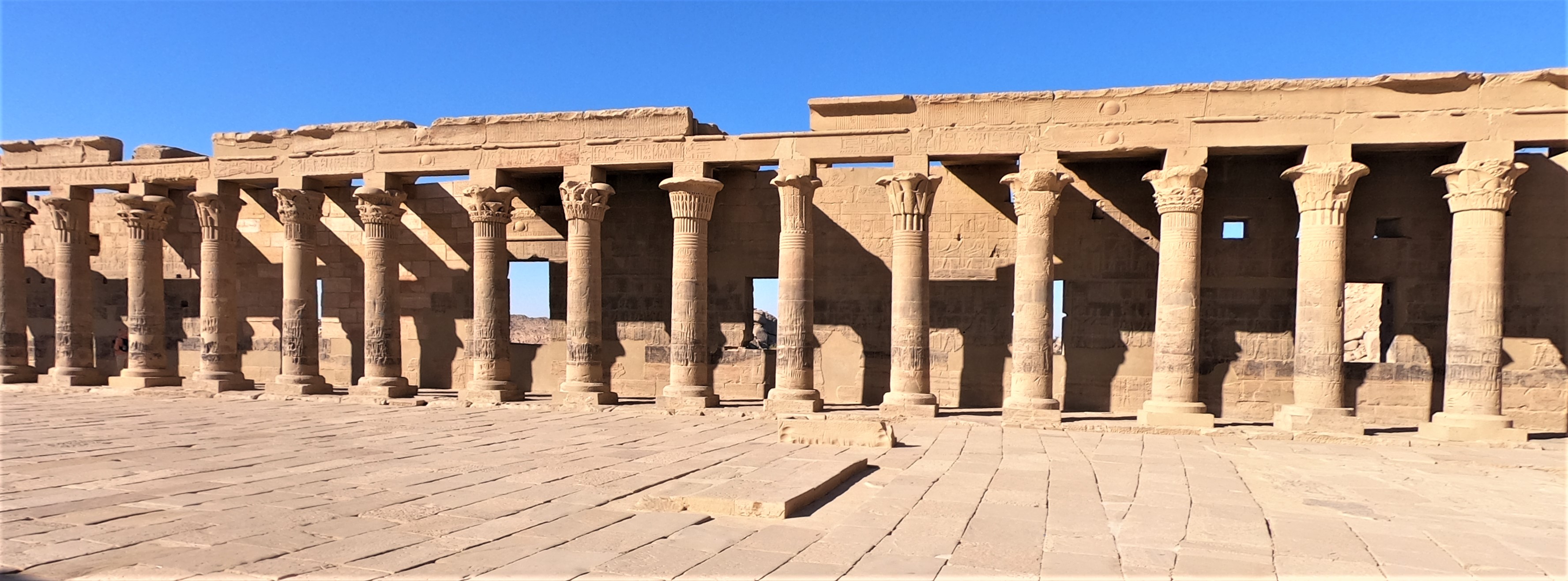
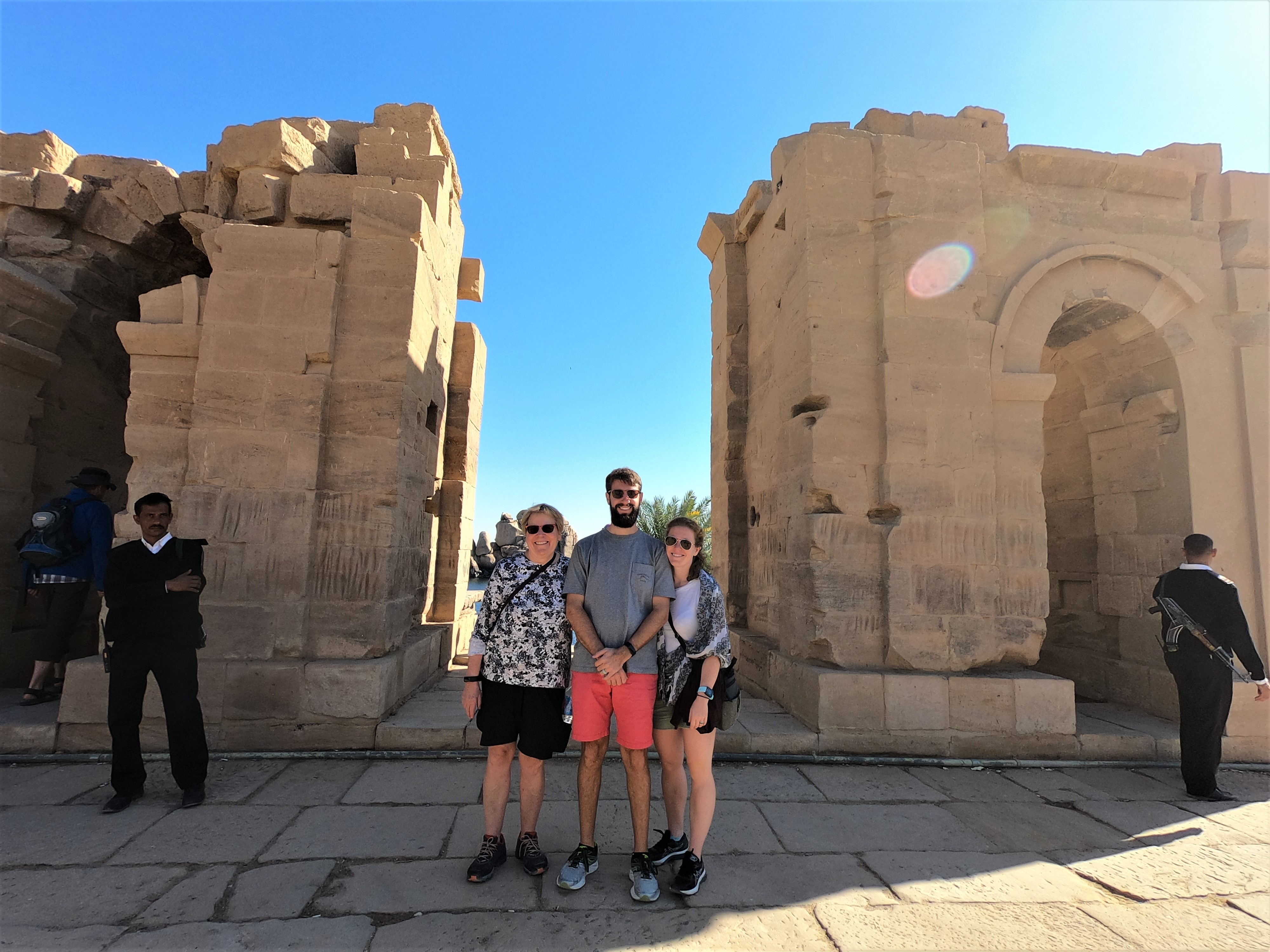
Elizabeth felt much better in the morning, but was far from cured. We departed for our final cruise temple stop, named the Philae Temple, or the Temple of Isis. We rode about 15 minutes in a car towards several water taxis then transported to an island with the temple. When the government built the Aswan Dam, first the lower dam in 1902 then the high dam in 1970s to create Lake Nasser, they incidentally flooded surrounding villages and several ancient sites. Fun fact, Lake Nasser is the largest manmade lake in the world. UNESCO has since stepped in to save 12 temples moving them either internationally or to higher grounds. Some of these temples can be seen in Spain, Germany, the U.S., etc.
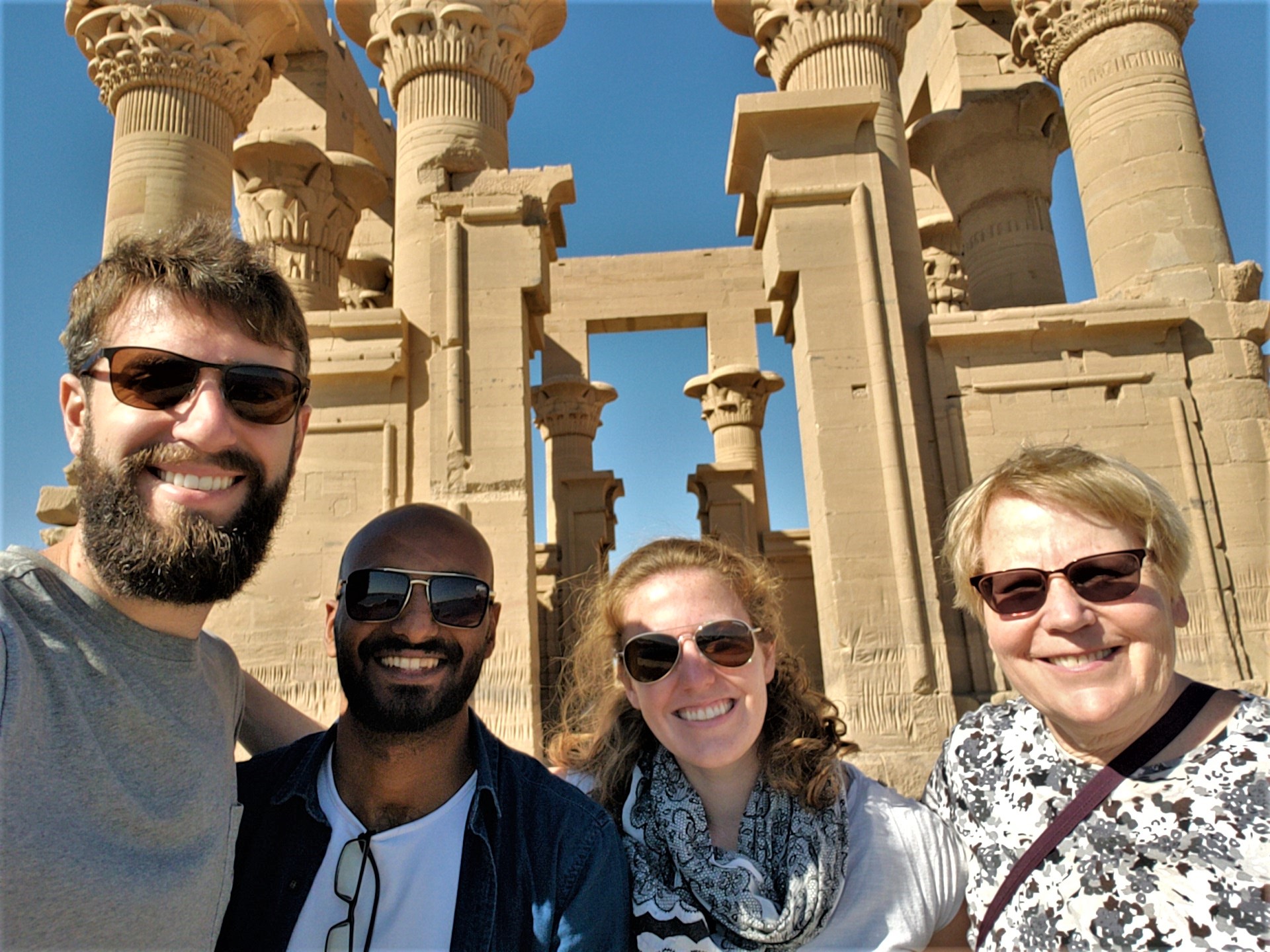
The large temple we saw today was again built on the site of older temples dating back to the 25th dynasty. The temple we see is from the Roman era and is the site of the last known Egyptian hieroglyphics in 394 AD. In one corner of the temple the Christians removed all the ancient hieroglyphics and added an alter with cross decorations. We saw some interesting black and white photos that showed visitors traveling by boat through the temple before it was moved to a higher island.
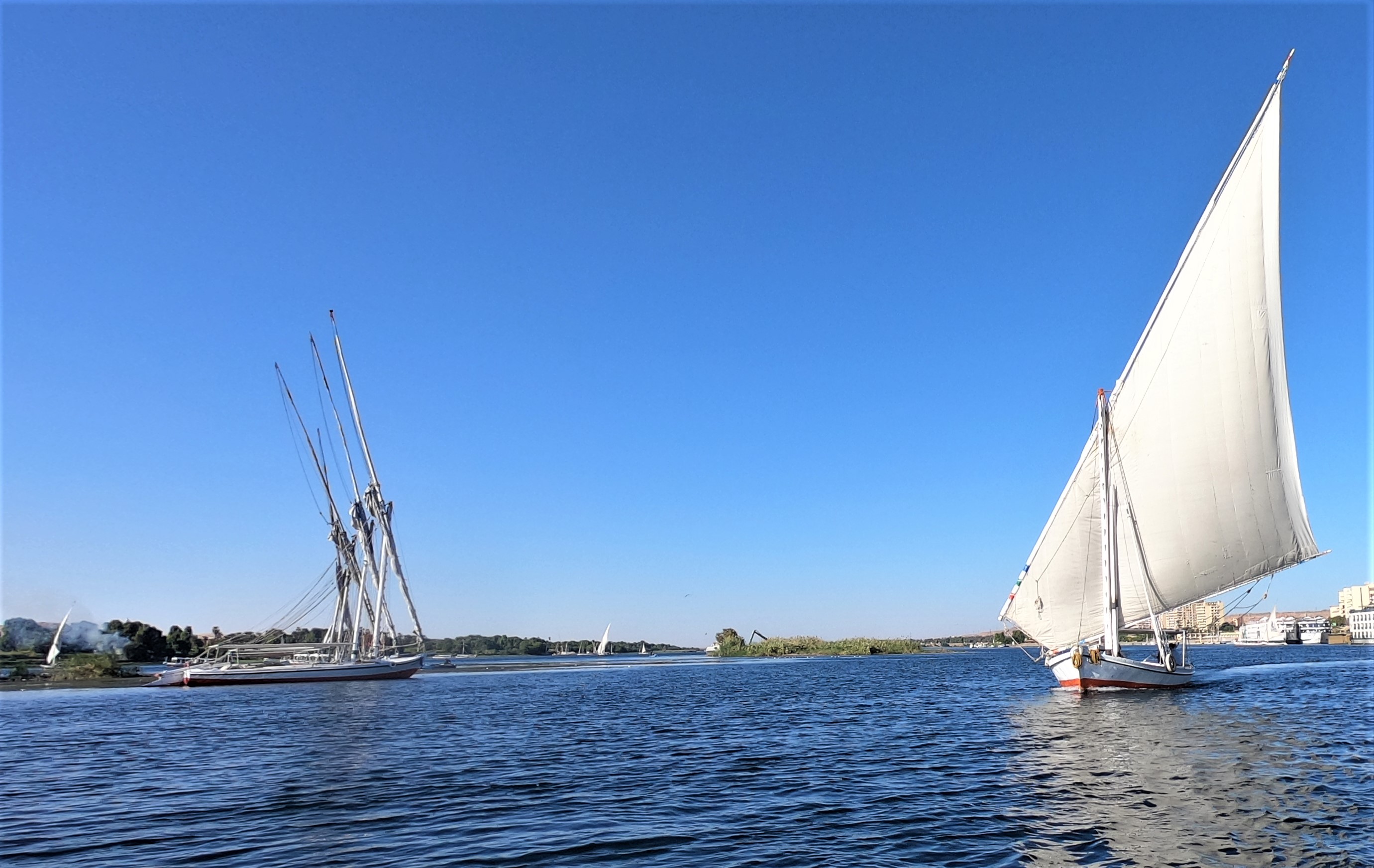
We returned to the boat to lounge and eat lunch until our final activity. We spent about an hour sailing around the Nile on a Felucca boat, or traditional sail boat. We saw more tombs in the distance and even ran into a low sandbar trying to scare some birds. The rest of the evening we read and played games before our final dinner and a belly dancing show. Since the boat was so small, we had a suspicion we’d be singled out in the show. The first act was a man in a colorful skirt and twinkle lights who spun in circles and the second act was the belly dancer who did her best to teach Elizabeth and Ryan some new moves.
Day 8 – Abu Simbel – November 25
We enjoyed our final breakfast on the boat and said good-bye to the staff. Our driver, who was very excited and bubbly, picked us up at 8 am and led us out to our car. His name was Noel and he quickly became our worst nightmare. We were all pretty sick and tired from our various stomach bugs and Noel was too kind and too accommodating. If your arm itched, he’d try to scratch it for you, if you shifted in your seat, he tried to adjust it, if you blinked, he readjusted the curtains, and he never stopped talking. At one point he watched Ryan playing a game on his phone and tried giving him advice. Yikes. At this point we were also beginning to feel slightly inundated with history and he had a lot of knowledge he wanted to share.
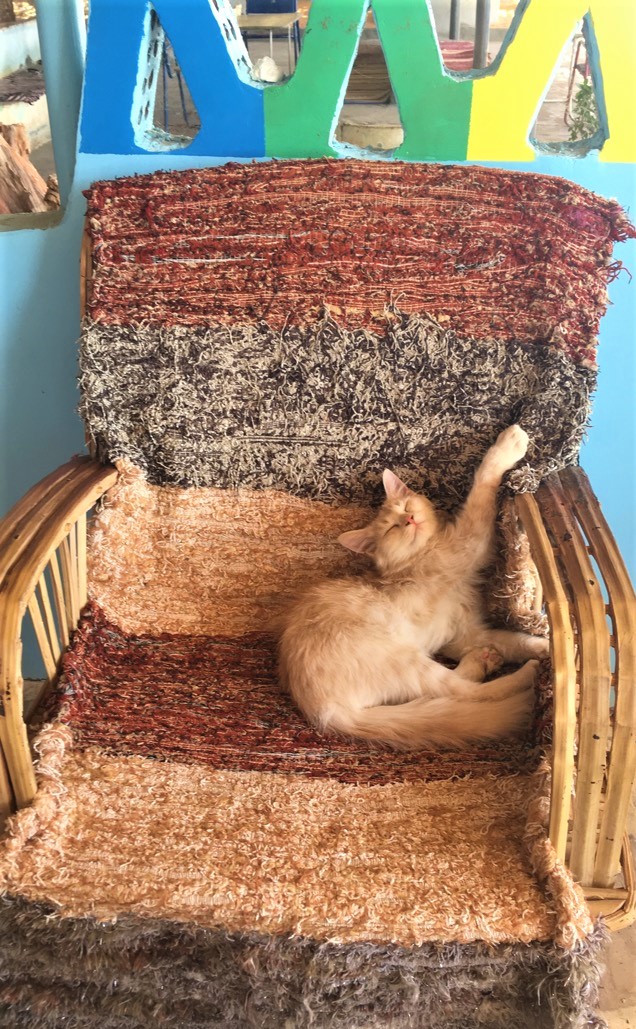
We were in for a 3-hour drive to see the Temple Abu Simbel, which is down on the border with Sudan and on Lake Nasser. The drive was long, especially with Mr. Yammers. Half-way we stopped to at a rest stop to use the restroom and view the mirages in the distance. The mirages were pretty cool, it looked like there was water in the distance, but there wasn’t. About what you’d think a mirage would look like. The rest stop also had the most relaxed cat Elizabeth had ever seen.
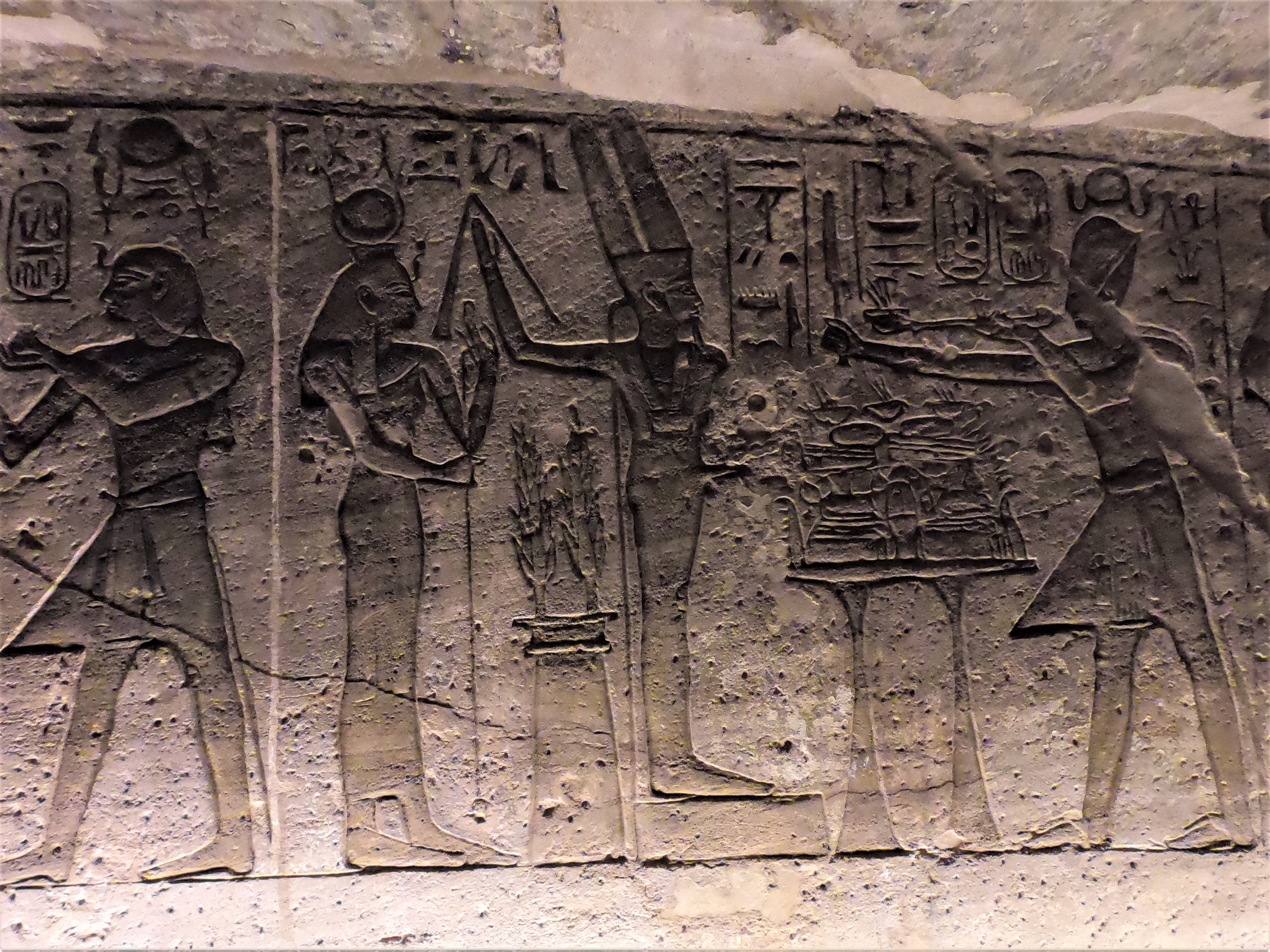
Eventually we made it to our destination and got to see two temples. This temple, like Philae the day before, was flooded in the building of the dam and moved to higher elevation. We saw amazing black-and-white photos of them hand sawing the temple and statues into small pieces and reassembling them. These temples were built in 1265 BC by Ramsesses II. One temple is the final monument for the king and the second for his queen Nefertari.
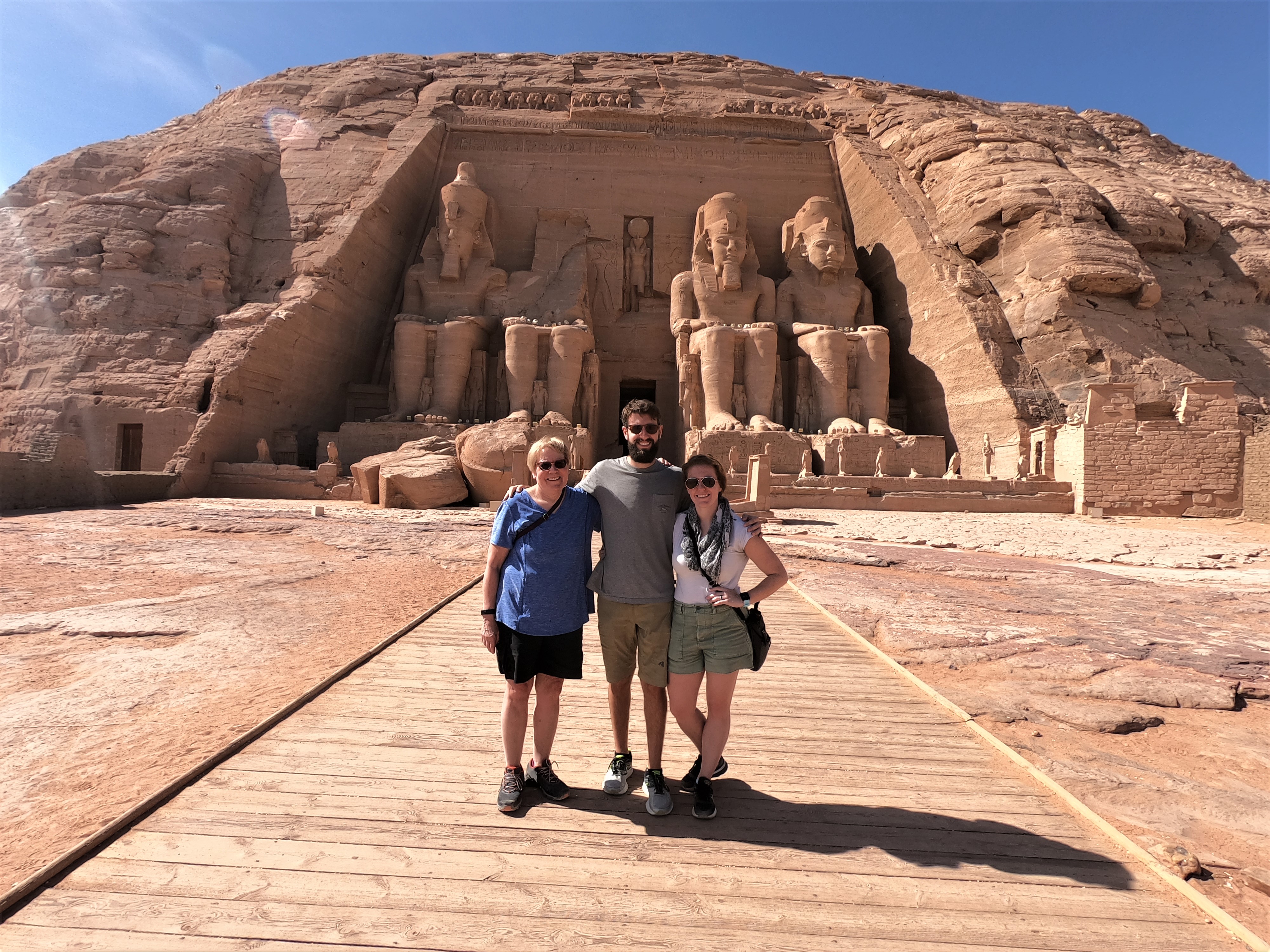
They were such good astronomers and architects that direct sunlight only enters the holy of holy halls in the back of the temple twice a year. The first on Ramsesses’ birthday and the second on the day of his coronation. Since they moved the temple the date shifted back by one day and they now occur on October 22 and February 22 each year.
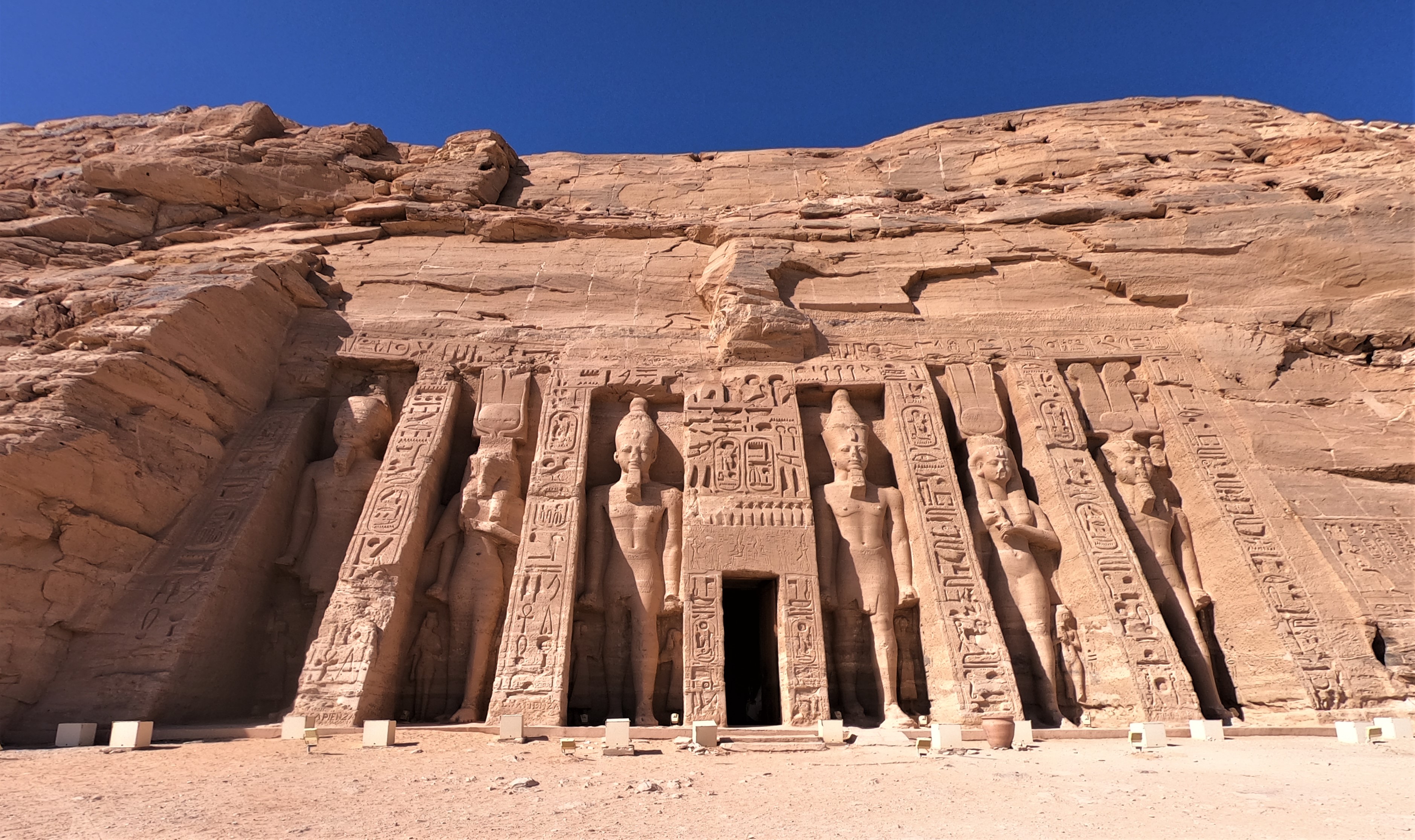
We walked around the two temples and inside. The place was deserted and Noel wasn’t allowed to enter with us, so we took our time wandering the rooms and halls all alone. Noel was keen to take lots of group pictures and lots of pictures of us kissing. Finally, we had to firmly say, no more pictures at the end, or we would have stopped every five-feet to snap one.
Back in the car we had falafel sandwiches waiting for us and a long 3-hour drive back. The temples were very cool to see, but were pretty far out of the way and by this point we’d had a lot of days of appreciating the old buildings. We were staying in the Nubian Village that night in a small hotel right on the Nile. After we were dropped off, we found out there was a little discrepancy on the price and we used all of our cash paying the driver. We had nothing left to tip with, let alone purchase dinner or pay for our cab the next day. We also learned that all the ATMs were in the city, about a 30-minute drive away. We opted to just play cards in the sitting lounge and eat power bars and fruit we’d collected along the way. We’d been eating way too much anyway.
Day 9 – Aswan to Sharm el-Sheikh – November 26
We were up early yet again to catch our taxi to the airport at 6:30. Our car was an old Mercedes, so faded and beat up, we couldn’t tell if it was from the 80s or the 90s and our driver had a need for speed. Ryan had to go through security on his own at first, so he could pull out money to pay the man. He attempted to ask/talk to security about whether he could leave easily after going through, but they really didn’t get it. Their English wasn’t great. After pulling the money and just walking back out through a sign clearly marked, no exit, he got back to the ladies. We then went through several security checkpoints, again being divided, between men and women. The first guard’s face on seeing Ryan was at first surprised and then laughing. He finally figured out what I had been trying to ask when I walked through the second time. Our first flight was from Aswan to Cairo, approximately one hour and 15 minutes. We then spent 2 hours in a small airport lounge waiting our next flight from Cairo to Sharm el-Sheikh. Hands-down the lamest lounge Ryan had ever been in; they didn’t even have alcohol. Sharm is a very popular beach and resort town especially among Egyptians. After even more security we boarded our last flight and flew to the Red Sea.
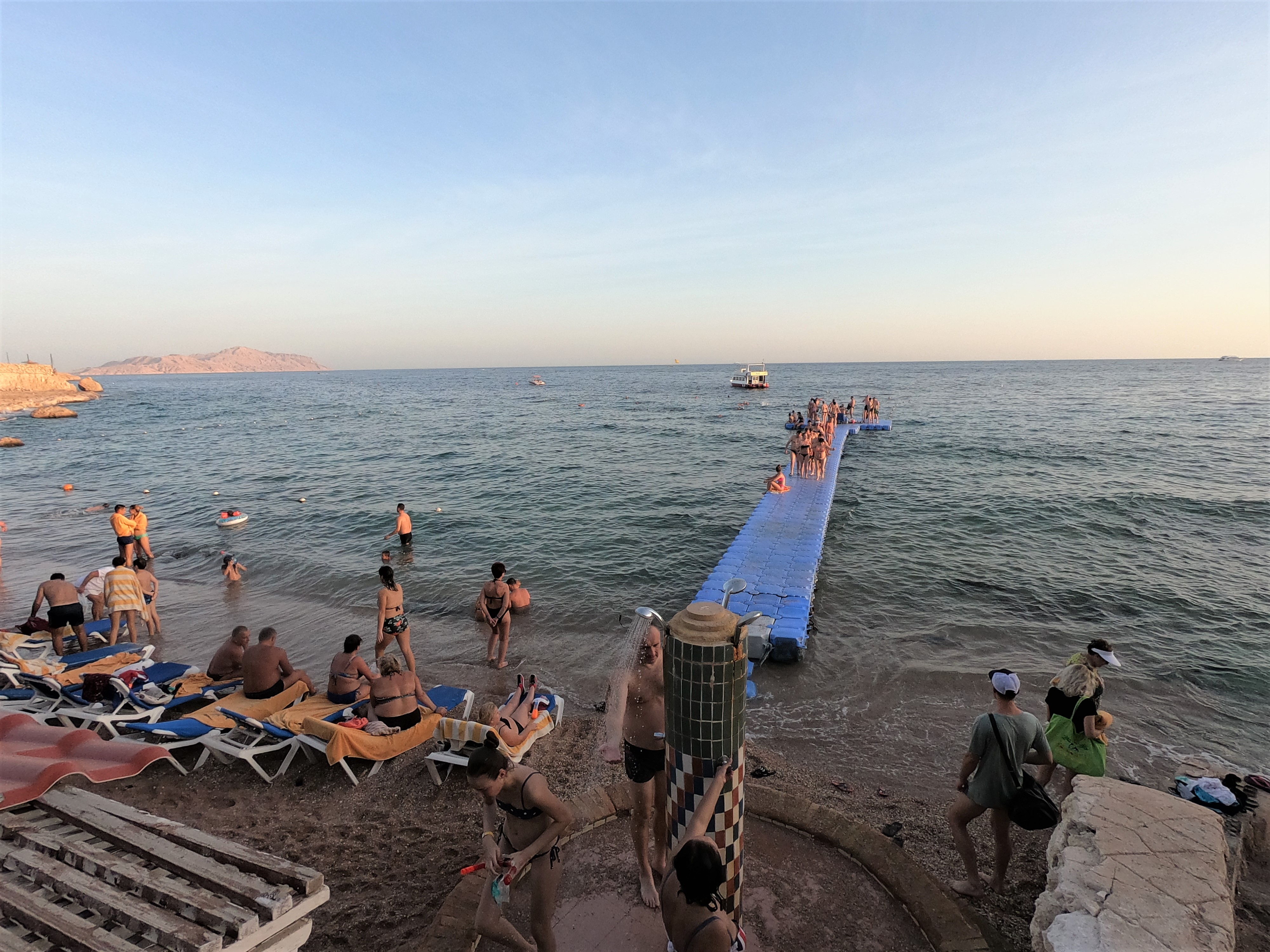
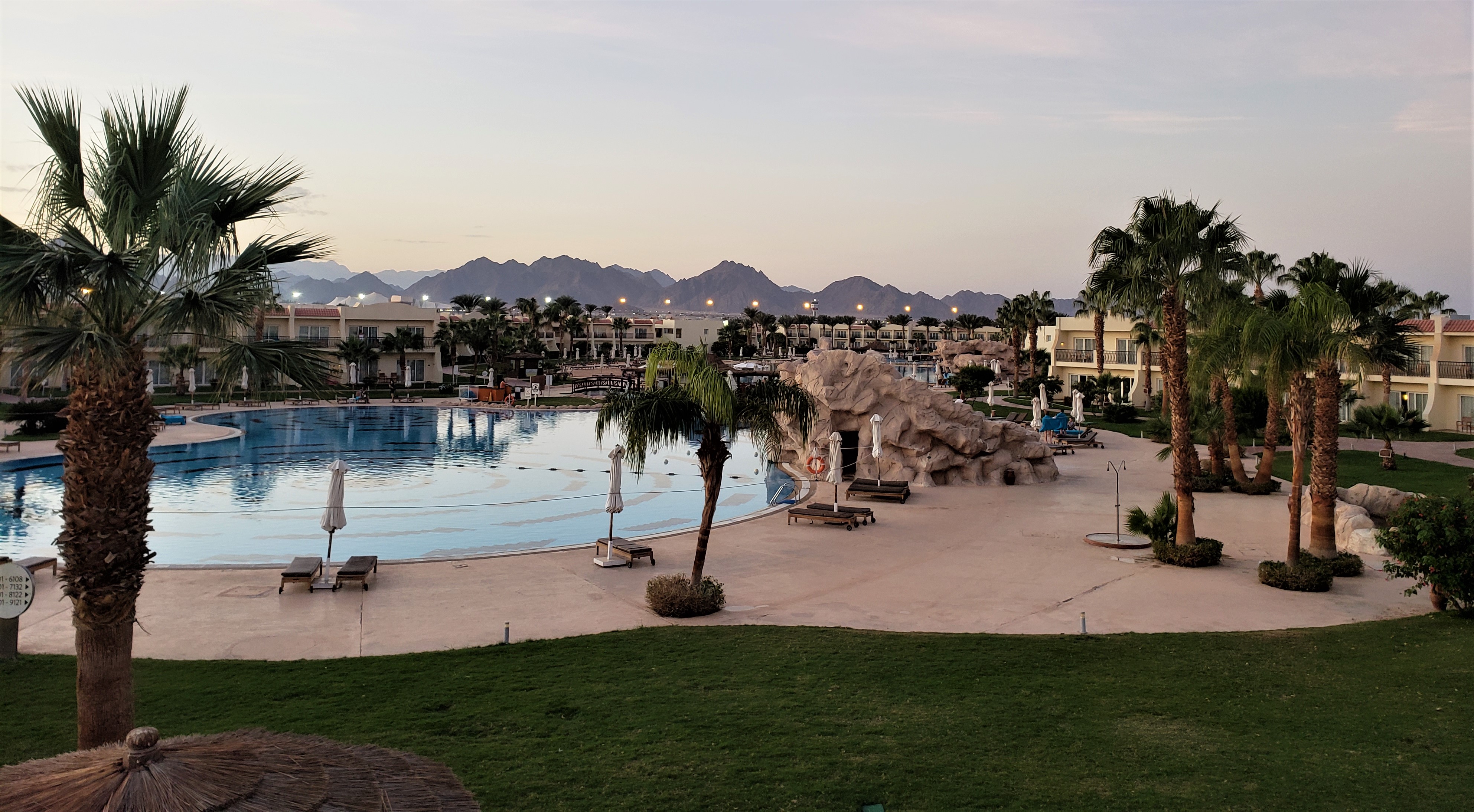
We are staying in the Hilton Sharks Bay Resort, which is gigantic. After settling in we walked along the three pools down to the beach. They have a big floating dock you can snorkel off of that rolls with the waves. We enjoyed a drink at a rooftop bar before lounging pre-dinner enjoying the gorgeous mountain views opposite the sea. Dinner was another buffet, but the ladies missed our small boat and better food. Ryan was happier with the food at the resort, maybe not because it was better, but because the selection was so much wider. Today was a long travel day but, luckily, we have this nice resort to recuperate.
Day 10 – Mount Sinai – November 27
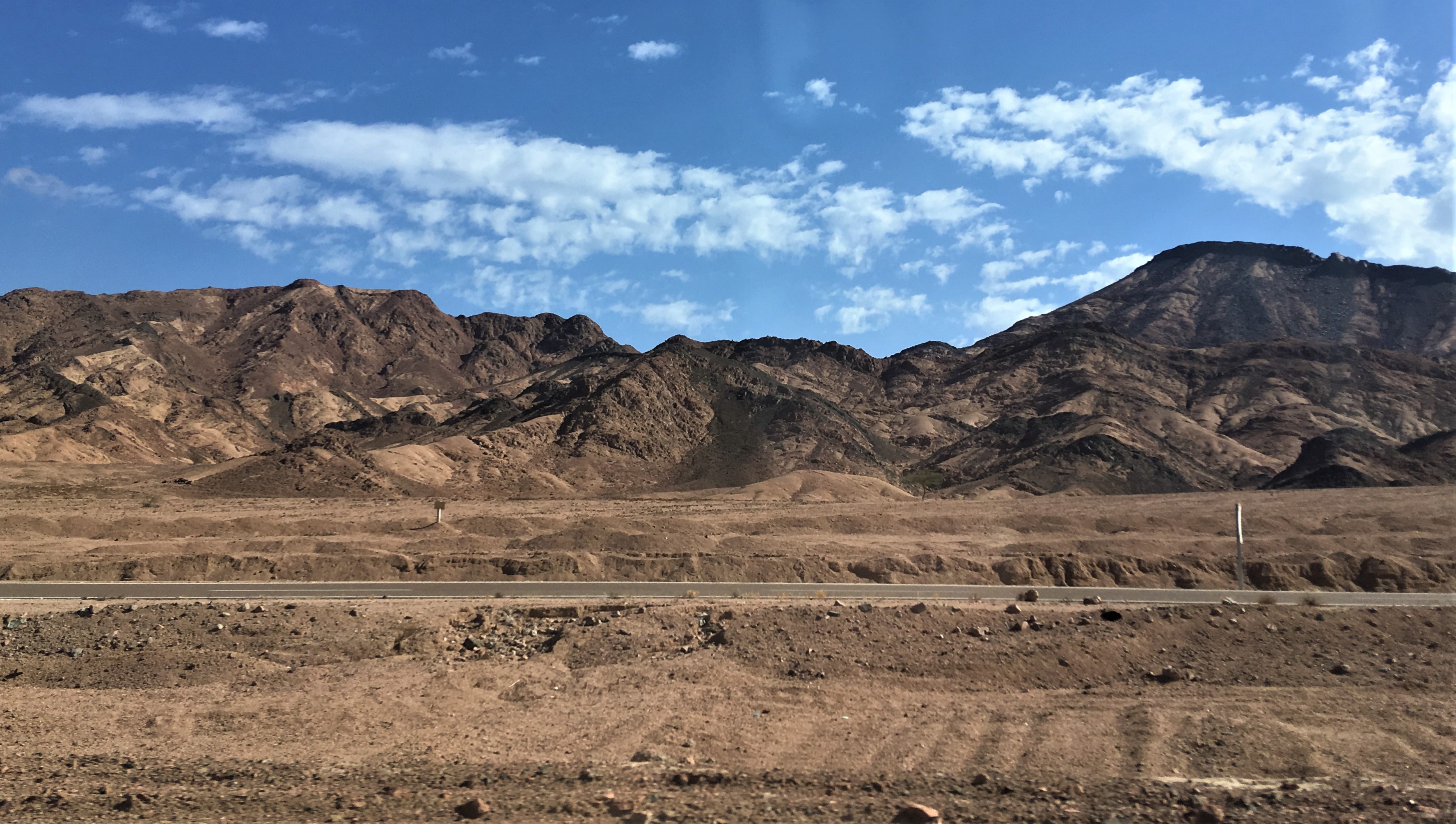
Ryan was still feeling a bit under the weather (really, he just wanted to sit by the pool and drink his free beer) and not in the mood for a long car ride, so Joan and Elizabeth abandoned him early in the morning to head to Mount Sinai. We didn’t really know what to expect or see besides the burning bus but figured we’d come this far and needed to check it out. We grabbed our hotel bag breakfasts and met our driver Mahmoud. It takes roughly 2 hours to get to Saint Catherine’s Monastery and Mount Sinai, so we left at 6:30 am. Our driver blared Arabic pop and R&B the entire drive and barely spoke – what a welcome change. The drive was absolutely beautiful. The mountains had gorgeous cliffs and peaks that made the drive whiz by.
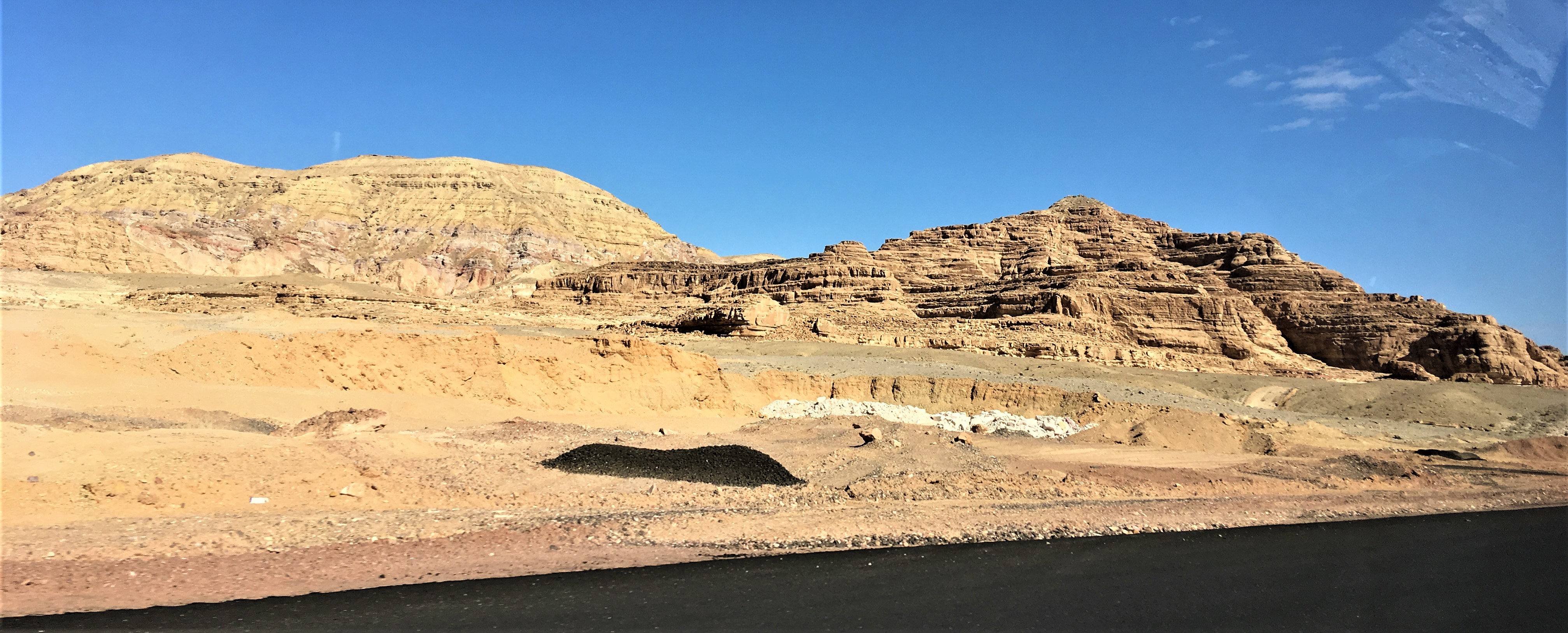
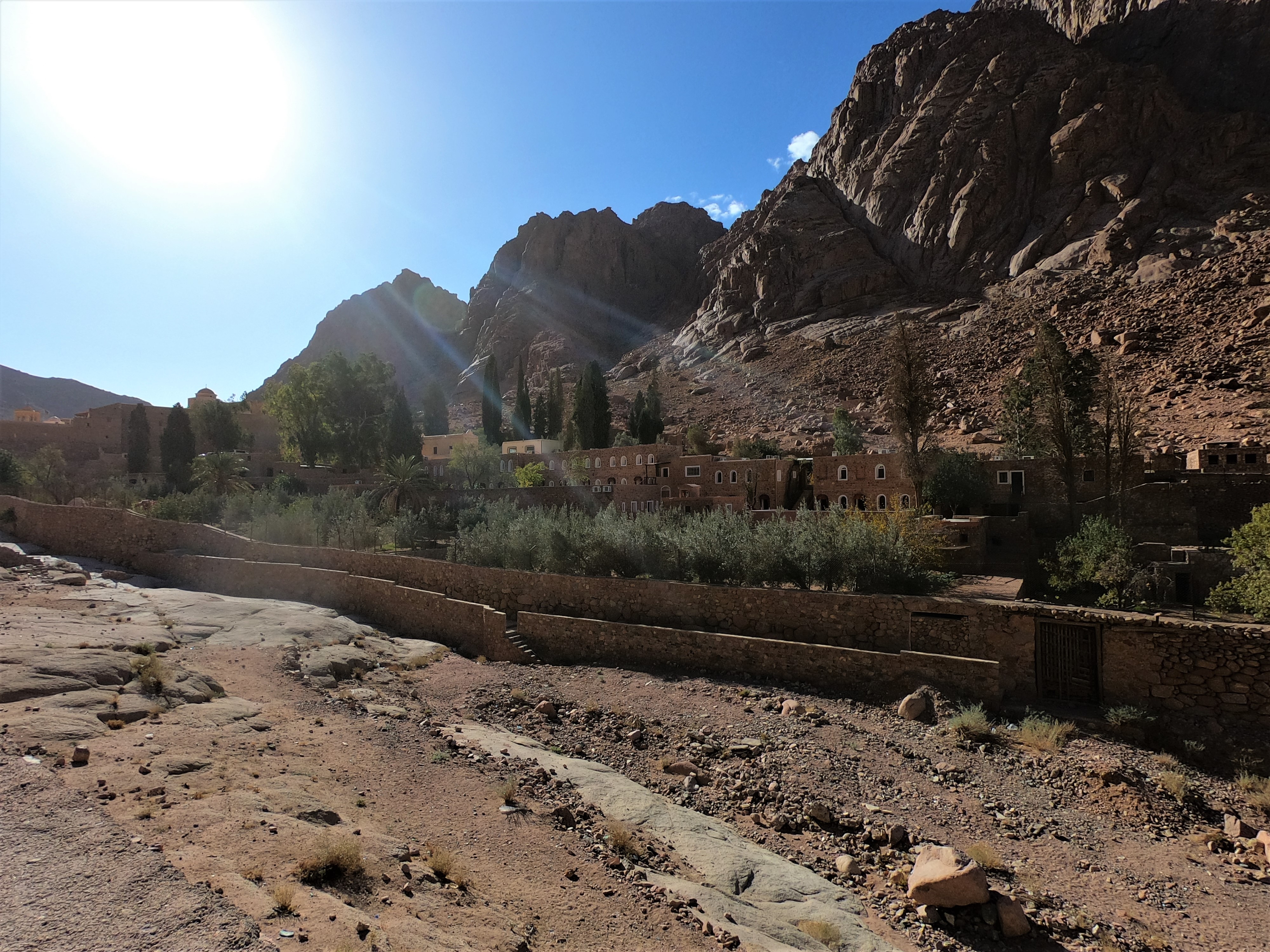
We went through at least 10 checkpoints to get to the monastery. We had to get permissions for us and our vehicles to make it through and had to show our passports at one stop. Once we arrived, we were a little confused to what to do. Our guide didn’t have great English and we weren’t sure if he was coming with us or if we were on our own. The monastery is only open from 9-12 everyday and we arrived right at 9. We walked through the old walls, the monastery was built before 500 AD, and were in with a large group of tourists.
We saw a group snapping a lot of pictures in a corner so we headed over to wait our turn. There were two bushes blocked by a fence. One looked like what we imagined the burning bush would look like and the other looked like a willow bush, however the willow bush had a mosaic of Moses under it. We snapped our underwhelming photo and tried to ask our guide which one was the real one, but he couldn’t understand our question.
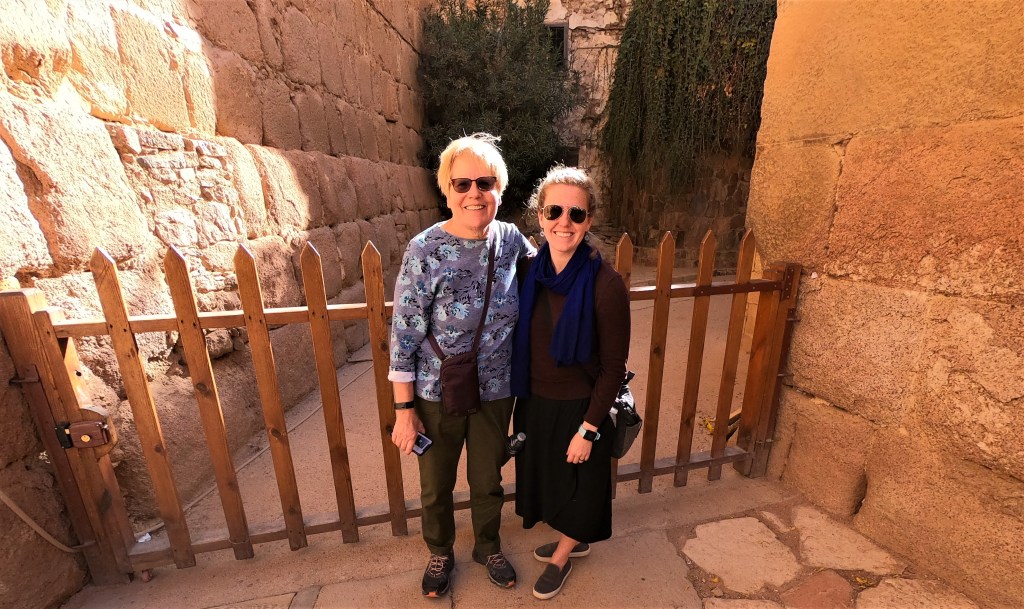
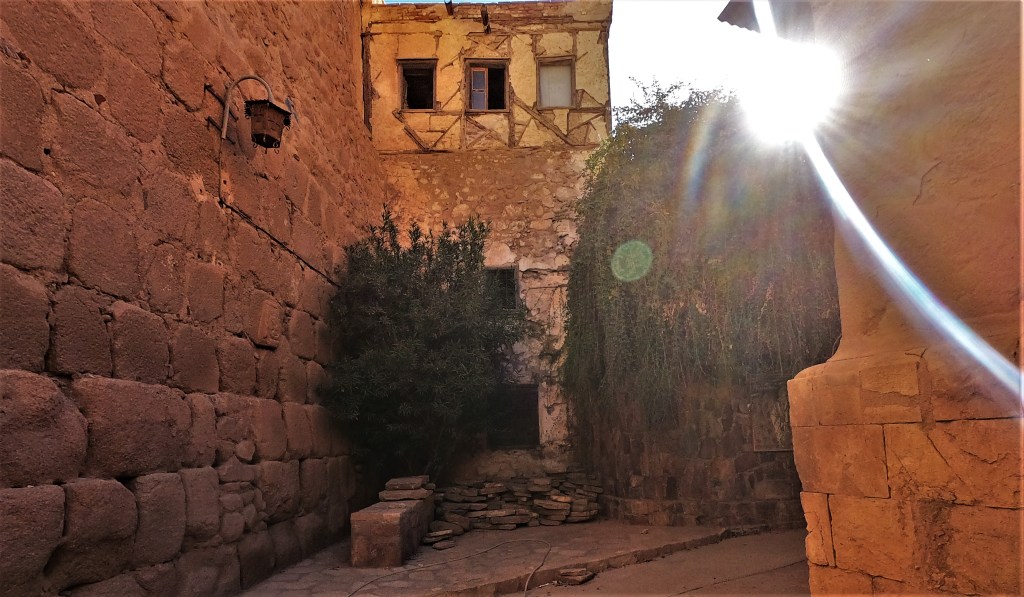
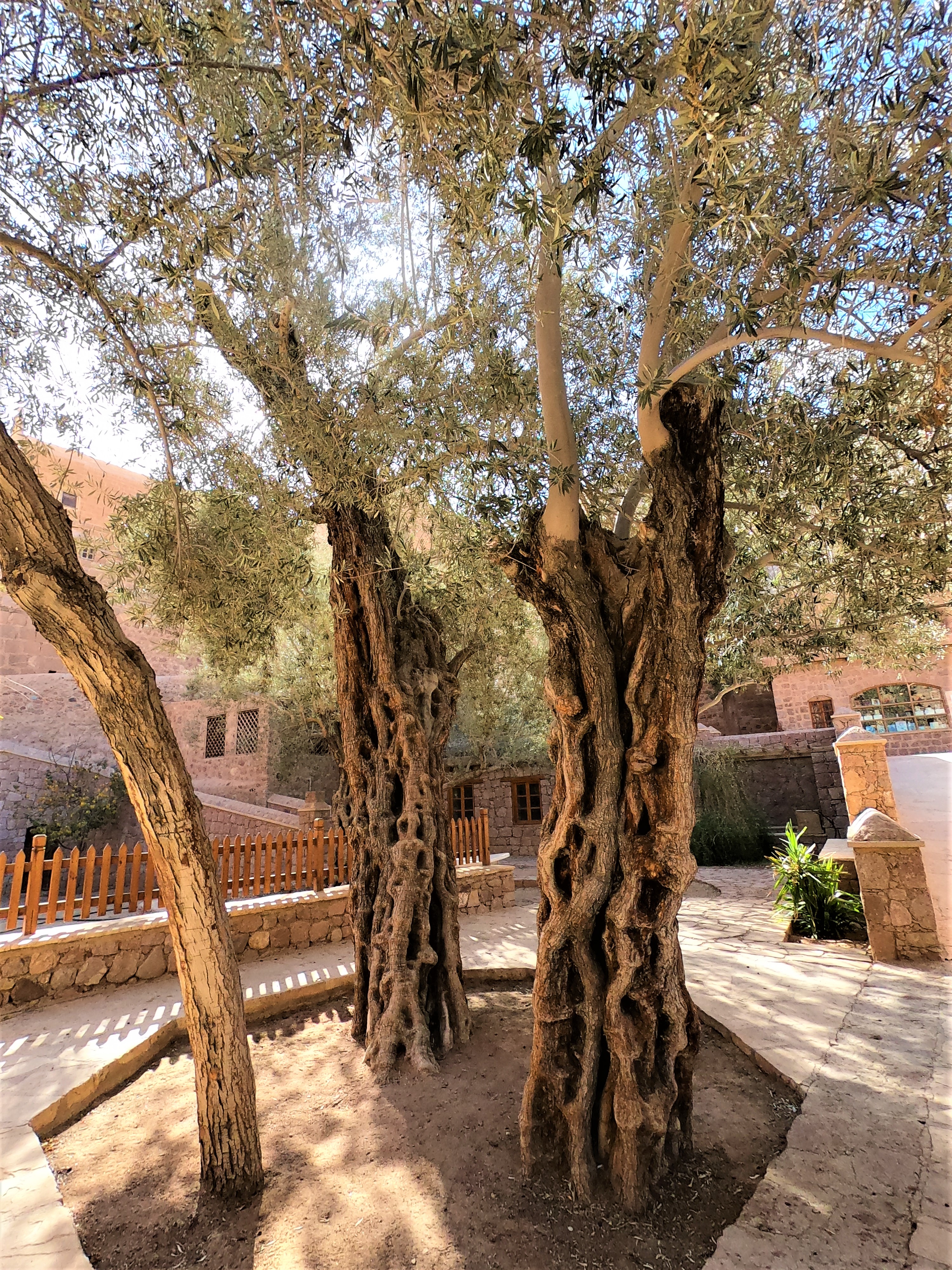
Next, we passed a well. It wasn’t clear what the historical importance was, but everyone was taking a photo. Then we headed into the chapel, where you couldn’t take photos. There were at least 30 chandeliers and incense holders hanging from the ceiling and lots of paintings of Jesus. Elizabeth thinks it’s a Coptic church and all the signs were in Greek. All told, it took about 30 minutes to get in and get out. We’d traveled too far to get back in the car so soon, so we wandered the garden with 200-year-old olive trees and Joan found some magnets in the gift shops.
We made it back home in another 2 hours and at one checkpoint had to put the whole car through a metal detector. In 2005 Sharm el-Sheikh had Egypt’s second most deadly terrorist attack, meant to harm the tourist industry. They take security very seriously with metal detectors and machine guns as far as the eye can see.
We met back up with Ryan for lunch then spent the afternoon lounging by the pool and getting in the icy cold water. Ryan and Joan even went down the slide. After the sunset we got a drink at the rooftop bar then went to the Italian restaurant for dinner. We enjoyed a three-course meal and cheered our last night in Egypt.
Day 11 – Sharm el-Sheikh to Cairo – November 28
We were sad our last morning. We ate breakfast, the best of the buffet meals, then lounged around the pool one last time before another buffet lunch. It was chillier today than other days and had a nice breeze in the air. Our taxi picked us up at 3:30 and we headed to the airport to begin our long day of flying.
We are flying first to Cairo as a group, arriving around 6:30 pm. Then Ryan and Elizabeth leave at 11 pm towards Namibia and Joan leaves at 2 am for Paris, then home. We have loved our time in Egypt and are so grateful to have gotten to see the northern portion of the country in Cairo, then the southern at Abu Simbel, finally ending on the Red Sea to the east. There is so much history here and so much mystery remaining about the ancient Egyptians. We highly recommend.
Things we’ve learned in Egypt:
- They fly as aggressively as they drive, terrifying flights.
- Hotels are obsessed with wake-up calls, even if you don’t ask for them or tell them your plans, they call.
- There is a speed bump every quarter mile, at least.
- Tipping is as confusing as it is stressful.

